Blog » Coaching Models and Techniques » Cattell's 16 Personality Factors
Last updated: March 2026
Cattell's 16 Personality Factors
Understanding human personality has long piqued people's interest. In order to understand how personality evolves and affects behavior, many theories have been created.
To identify and explain the unique distinctions between people's personalities, psychologist Raymond Cattell developed a taxonomy of 16 different personality traits. This taxonomy is one such theory.
The trait approach to personality and the 16 Cattell-identified personality variables are discussed in this article. It also goes into the 16PF Questionnaire's applications and possible interpretations of test findings.
In Brief :Cattell’s 16 Personality Factors
Abstractedness: Imaginative Versus Practical - Imaginative and creative (M), versus logical and practical; high range individuals are often forgetful and preoccupied with multiple thoughts.
Apprehension: Worried Versus Confident - Worried and uncertain (O), versus self-assured and confident; high range individuals experience self-doubt, worry, and a tendency to feel guilty.
Dominance: Forceful Versus Submissive - Forceful and confident (E), versus cooperative and meek; high range individuals tend to be domineering, aggressive, and competitive.
Privateness: Discreet Versus Open - Discreet and diplomatic (N), versus open and sincere; high range individuals are secretive and non-disclosing.
Reasoning: Abstract Versus Concrete - Abstract and mentally capable (B), versus concrete-thinking and less mentally capable; high range individuals have increased general mental capacity and greater intelligence.
Self-Reliance: Self-Sufficient Versus Dependent - Self-sufficient and independent (Q2), versus group-focused and dependent on followers; high range individuals are resourceful and individualistic.
Tension: Inpatient Versus Relaxed - Impatient and time-driven (Q4), versus relaxed and patient; high range individuals are tense, high-energy, and motivated.
Vigilance: Suspicious Versus Trusting - Suspicious and always on the lookout (L), versus trusting and dependable; high range individuals are wary and doubtful.
Warmth: Outgoing Versus Reserved - Outgoing and warm (A), versus reserved and aloof; high range individuals are warm, extroverted, and enjoy engaging with others.
The Fundamentals
The best way to define and describe personality has long been a topic of discussion among psychologists. The trait theory of personality is one of these important concepts.
Trait theory states that a number of general qualities or dispositions make up human personality.
Several of the first characteristic theories made an effort to categorize every single trait that might be conceivably present. For instance, Gordon Allport, a psychologist, found that there are over 4,000 words in the English language that can be used to represent different personality qualities.
Although this method proved effective at locating many qualities, it is cumbersome and challenging to utilize. For instance, a lot of these features are very similar to one another, making it challenging to separate some traits from others. Furthermore, such uncertainty makes it challenging to study many personality traits.
History of the 16 Factors
Cattell, who was born in 1905, lived to see the creation of numerous 20th-century innovations, including electricity, telephones, automobiles, and airplanes. These discoveries inspired him, and he was anxious to apply the same scientific principles to the study of the human mind and personality.
He thought that personality was more than just an elusive, untestable mystery. It was a subject that could be structured and studied. Human qualities and behaviors could be predicted through scientific study based on underlying personality factors.
Charles Spearman, a psychologist noted for his groundbreaking work in statistics, collaborated with Cattell. Later, Cattell would build his own personality taxonomy—the 16PF Questionnaire—using the factor analysis methods Spearman had pioneered.
Allport's list was examined by psychologist Raymond Cattell, who reduced it to 171 traits primarily by removing words that were repetitive or unusual. He then determined which attributes are connected to one another using a statistical method called factor analysis. He was able to reduce his list to 16 important personality traits using this technique.
There is a spectrum of personality qualities, according to Cattell. To put it another way, every person possesses some combination of all 16 of these features, albeit they may be stronger in some than others.
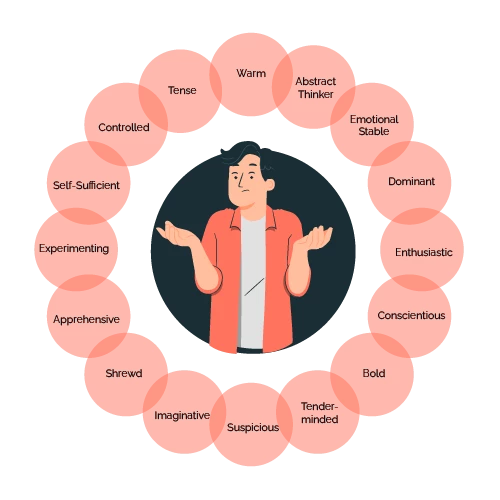
Some of the descriptive phrases used for each of Cattell's 16 personality dimensions are listed in the following personality trait list.
1. Abstractedness: Imaginative versus practical (M)
Descriptors of low range: logical, sensible, traditional, problem-focused, steady, and grounded
Descriptors of high range: abstract, creative, forgetful, impractical, and preoccupied with multiple thoughts
2. Apprehension: Worried versus confident (O)
Descriptors of low range: self-assured, unconcerned, content, secure, guilt-free, confident, and satisfied with oneself
Descriptors of high range: uncertainty, self-doubt, worry, tendency to feel guilty, insecurity, worry, and self-blame
3. Dominance: Forceful versus submissive (E)
Descriptors of low range: cooperative, avoids conflict, is meek, humble, and obedient, easily led, docile and agreeable.
Descriptors of high range: domineering, strong, confident, aggressive, competitive, obstinate, and overbearing
4. Emotional stability: Calm versus high-strung (C)
Descriptors of low range: emotionally reactive, unstable emotionally, susceptible to feelings, and quickly agitated
Descriptors of high range: emotionally secure, flexible, mature, and composed when facing reality
5. Liveliness: Spontaneous versus restrained (F)
Descriptors of low range: serious, careful, taciturn, reflective, and silent
Descriptors of high range: vibrant, lively, spontaneous, ardent, positive, upbeat, expressive, and impetuous
6. Openness to change: Flexible versus attached to the familiar (Q1)
Descriptors of low range: traditional, clinging to the known, conservative, and honoring traditional values
Descriptors of high range: flexible, exploratory, liberal, critical, analytical, and open to new ideas
7. Perfectionism: Controlled versus undisciplined (Q3)
Descriptors of low range: tolerates disarray, is loose-lipped, adaptable, undisciplined, unreliable, insecure, impulsive, irresponsible, and uncontrolled
Descriptors of high range: organized, compulsive, self-disciplined, socially accurate, meticulous, in control, and sentimental perfectionists
8. Privateness: Discreet versus open (N)
Descriptors of low range: direct, sincere, unpretentious, open-minded, guileless, sincere, and interested
Descriptors of high range: secret, non-disclosing, cunning, sophisticated, intelligent, and diplomatic
9. Reasoning: Abstract versus concrete (B)
Descriptors of low range: concrete-thinking, less clever, less mentally capable overall, and unable to deal with complex issues
Descriptors of high range: increased general mental capacity, greater intelligence, brighter, and faster learner
10. Rule-consciousness: Conforming versus non-conforming (G)
Descriptors of low range: expedient, disobedient, disregards the law, and indulgent
Descriptors of high range: rule-bound, rule-conscious, duty-bound, conscientious, complying, moralistic
11. Self-reliance: Self-sufficient versus dependent (Q2)
Descriptors of low range: group-focused, affiliative, a joiner, and dependent on followers
Descriptors of high range: self-sufficient, independent, resourceful, and individualistic
12. Sensitivity: Tender-hearted versus tough-minded (I)
Descriptors of low range: utilitarian, objective, impersonal, hard-headed, independent, no-nonsense, and gruff
Descriptors of high range: artistic, sensitive, soft-hearted, perceptive, and sophisticated
13. Social boldness: Uninhibited versus shy (H)
Descriptors of low range: timid, reluctant, fearful, and intimidated
Descriptors of high range: socially outgoing, risk-taking, tough-skinned, and unrestrained
14. Tension: Inpatient versus relaxed (Q4)
Descriptors of low range: relaxed, tranquil, placid, peaceful, tepid, patient
Descriptors of high range: Time-driven, tense, high-energy, impatient, frustrated, and motivated
15. Vigilance: Suspicious versus trusting (L)
Descriptors of low range: dependable, unwavering, accepting, and simple
Descriptors of high range: always on the lookout, wary, doubtful, and hostile
16. Warmth: Outgoing versus reserved (A)
Descriptors of low range: impersonal, chilly, restrained, disinterested, formal, and aloof
Descriptors of high range: warm, extroverted, perceptive of others, pleasant, laid-back, enjoys engaging with others, and likes people
16PF Questionnaire
Now that we are all on the same page about Cattell’s 16 Personality Factors, I want to give you access to a FREE VERSIONof this personality test which you can share with your clients as well as use it during your sessions. This resource has surely helped me a lot of times!
16PF Questionnaire
Now that we are all on the same page about Cattell’s 16 Personality Factors, I want to give you access to a FREE VERSIONof this personality test which you can share with your clients as well as use it during your sessions. This resource has surely helped me a lot of times!
Purpose of 16 Personality Factor
There are several applications for the 16 Personality Factors (16PF), including:
Career development: The assessment can offer information that aids people in deciding which professions best match their interests and talents. Today, career counseling utilizes the Sixteen Personality Factor Questionnaire (16PF) in a big way.
Industrial and organizational settings: Job candidates may occasionally be assessed using the questionnaire to see if they are a suitable fit for particular positions.
Assessment of personality: Using the questionnaire might help you comprehend many facets of personality.
Research: For examining various facets of personality and behavior, the 16-factor questionnaire is also employed as a research tool.
It is applied in business to choose employees, particularly managers.
By evaluating a person, this test is also useful in clinical diagnosis and therapy planning especially to combat anxiety, big changes in one's life, and behavioral problems.
With this knowledge, you'll be able to communicate better than ever before! It's impossible to be an effective leader without understanding the social styles of the people you're trying to lead.
Frequently Asked Questions (FAQs)
What is Cattell's personality scale called?
Cattell developed the 16PF in 1949 after factor-analytic research led him to believe that a set of 16 qualities would adequately capture personality features. As a result, it's possible that the 16PF is the only significant inventory that was created utilizing a factor-analytic methodology.
What are the 5 global factors of 16PF?
Extraversion, Anxiety, Tough-Mindedness, Independence, and Self-Control scores, as well as an Impression Management (lie) score, can all be derived using the primary factor scores in combination.
ABOUT SAI BLACKBYRN
I’m Sai Blackbyrn, better known as “The Coach’s Mentor.” I help Coaches like you establish their business online. My system is simple: close more clients at higher fees. You can take advantage of technology, and use it as a catalyst to grow your coaching business in a matter of weeks; not months, not years. It’s easier than you think.