

Team Coaching: The Definitive Guide
Last updated: March 2026
Team Coaching
The Definitive Guide
Team coaching is not a new concept in the business world. In fact, it can be traced back to ancient Roman times when gladiators were given advice and guidance by their coaches before entering the arena. According to a Human Capital Institute research, companies with a strong coaching culture generate 51 percent higher revenue than their industry peer group.

This, in itself, proves how important team coaching is today.
So if you want to:
- Understand the fundamentals of Team Coaching and how it works
- Find out the purpose of Team Coaching
- Understand the perks of Team Coaching and how it can benefit your clients
- See how Team Coaching compares to other leadership styles
You’ll find this article useful!
Let’s get started.
Contents




Team Coaching and Other Leadership Styles: A Comparison
Chapter 1:
Fundamentals of Team Coaching
In this chapter, I will be delving into the basics of team coaching, including what it entails, its purpose, and how it works.
I’ll also be taking you through a special tool called the team coaching development model, and how it can help you – as a coach – understand the kind of support your team needs.
Let’s get started!

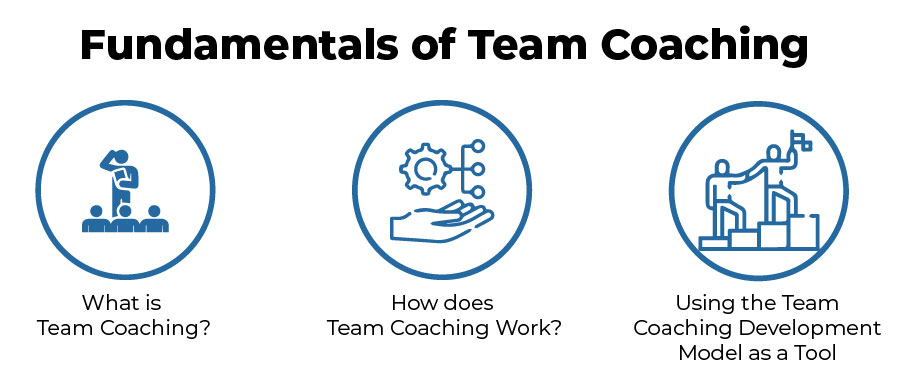
What is Team Coaching?
Team coaching is the process of helping individuals and teams to achieve their goals.
Team Coaching can be applied in many different settings, including schools (teachers working with students), businesses (managers leading employees), or sporting organizations.
It's about giving people feedback on how they're doing, to know what needs improvement.
The goal for team coaches is to help athletes identify potential areas for improvement. The idea is also to provide them with some tools that will allow them to solve these problems on their own, without having a coach present every time.
How does Team Coaching work?
The purpose of team coaching is to help teams get better.
To do this, the coach will need to understand how their team operates at a particular point in time.
This means understanding where they are in team development, and knowing what needs to be done to improve performance. In the very next subsection, I explore a useful tool that can help you identify which stage of team development your team is currently at.
Team coaching works by empowering the manager, not replacing them.
Team coaching on an ad-hoc basis can be very effective, especially when teams pass through a difficult transition.
But if the team coach is seen as a short-term solution, it could do more harm than good by creating dependency and disrupting team dynamics. For this reason, many businesses only see team coaches as part of a long-term solution.
Having a team coach from outside the organization ensures that the coach is neutral and removed from the team's way of doing things. Rather than focusing on who made which decision, the coach focuses on how successful and efficient the team is.
Using the Team Coaching Development Model as a Tool
A team coaching development model is a tool coaches use to help them understand the stage of development that their teams are at, and what kind of support they should be offering at each stage.
The typical team development cycle consists of four stages:
- Forming - The team is formed and comes together for the first time.
- Storming - The team begins to find their voices, often accompanied by conflict.
- Norming - Team members begin to learn how to work with each other, getting used to everyone's different personalities.
- Performing - Without outside distractions, most teams can achieve their goals.
For team coaches, it's important to ensure that teams move from one stage to the next as quickly as possible.
This is because prolonged conflict, or a slow transition, can make it difficult for team members to achieve their goals.
Some teams may remain stuck in the storming stage or never advance beyond normalizing into performing. Or a team might perform well for a time, only to fall back into a storming phase if a conflict arises.
Every time the team recruits someone new or loses an existing member, it must begin again at the forming stage.
Now that you have an idea of the fundamentals of team coaching, I’ll be taking you through the purpose of team coaches next.
Chapter 2:
Purpose of Team Coaching
I have already established what team coaching is, and how it works.
Next up, I’m going to take you through the purposes and characteristics of a good team coach in this chapter, along with the aspects that they help with. I’ll also be delving into how a competent team coach can help their clients overcome challenges.
Let’s get right into it !
What do Team Coaches help with?
A team's coach aids in keeping a team on track to achieve its objectives.
This might include any of the following points:
- Helping a team become more effective by giving them feedback on how they can improve.
- Helping a new team member fit in, and understand how the existing members operate.
- Help in managing conflicts, and directing the conversation in a productive direction.
- Helping a team identify and achieve its goals.
- Ensuring that team members are delivering on their promises.
- Keeping a team focused on their goals requires both supporting and challenging team members.
- Building an environment that encourages learning and growth, especially during difficult times.
- Developing team members so that they can perform the roles assigned to them without guidance or support from the coach.
Coaching a team may seem like simply giving advice, but it is more than that.
An effective coach must be able to provide feedback so that it stimulates learning and development, not conflict and confusion.
A team coach must also mediate between different personality types, and help the team move toward a consensus.
Team coaching is not necessarily an easy job, as what works with one group of people might not work with another.
The most effective coaches have experience working in a variety of settings, and know how to adapt their approach based on the needs of their team.
Characteristics of an Effective Team Coach
Since team coaching is an emerging field, there are no universal standards for coaches. But there are some characteristics that all effective team coaches share.
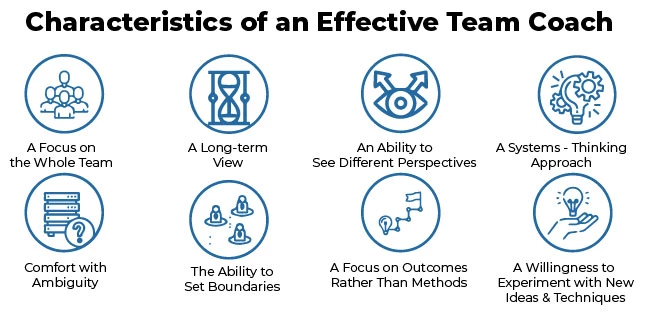
Here’s a look at some of them.
A Focus on the Whole Team
A good team coach can manage an individual session with any team member, while staying focused on the big picture.
For instance, coaches will ensure that what they say during one-on-one sessions doesn't contradict messages sent in group settings. This requires being aware of what each person is saying and how they are saying it.
A Long-term View
Team coaching is not a quick fix.
It requires long-term investments of time and energy to see results, so coaches who are only looking for short-term gains will likely not be successful.
An Ability to See Different Perspectives
Coaches must have a solid understanding of many different personalities, backgrounds, and work styles to address them all when necessary.
This means being able to see a problem from a variety of viewpoints rather than just one's own.
A Systems-Thinking Perspective
Using a systems-thinking approach to coaching means that the coach recognizes that every action by an individual affects the system as a whole.
This means that team members might be inadvertently helping or hurting other members, simply because they have not been aware of how their actions influence others.
Comfort With Ambiguity
Predictability can be great, but it doesn't work in a team coaching environment. The coach must be able to adapt quickly and roll with unexpected changes.
This requires coaches who are not afraid of change or challenges, and have a positive attitude toward trying new things.
The Ability to Set Boundaries
The job of a team coach requires close relationships with the team members. This means that coaches must establish boundaries and ensure that all parties respect these boundaries.
There is no one type of person who makes for an effective team coach. But it is important to note that good coaches come from various backgrounds, including psychology and business.
Team coaching is a role that combines the best of managing and mentoring, so team coaches need to know how to do both.
It's also not something that can be done successfully in isolation; it requires an understanding of group dynamics and interpersonal relationships.
A Focus on Outcomes, Rather Than Methods
Good team coaches are effective because they know how to identify problem areas and develop solutions that work for everyone involved.
This requires coaches who are more concerned about results than processes, as it's easy for processes to become overly-complicated during group sessions.
A Willingness to Experiment With New Ideas and Techniques
Team coaching is still a fairly new field, so coaches constantly look for new ways to be effective. It's important that they are open to new ideas and willing to experiment with different techniques.
Now that I’ve taken you through the characteristics of an effective coach, next up – I’ll be exploring the perks of team coaching.
Chapter 3:
Perks of Team Coaching
In this chapter, I will be taking you through a detailed analysis of the key benefits of team coaching.
Post that, I’ll be getting into six comprehensive guidelines on providing team coaching to an organization or company, and how to go about it.
Let’s cut to the chase.

What are the key benefits of Team Coaching?
Following are some of the key benefits that team coaching offers:
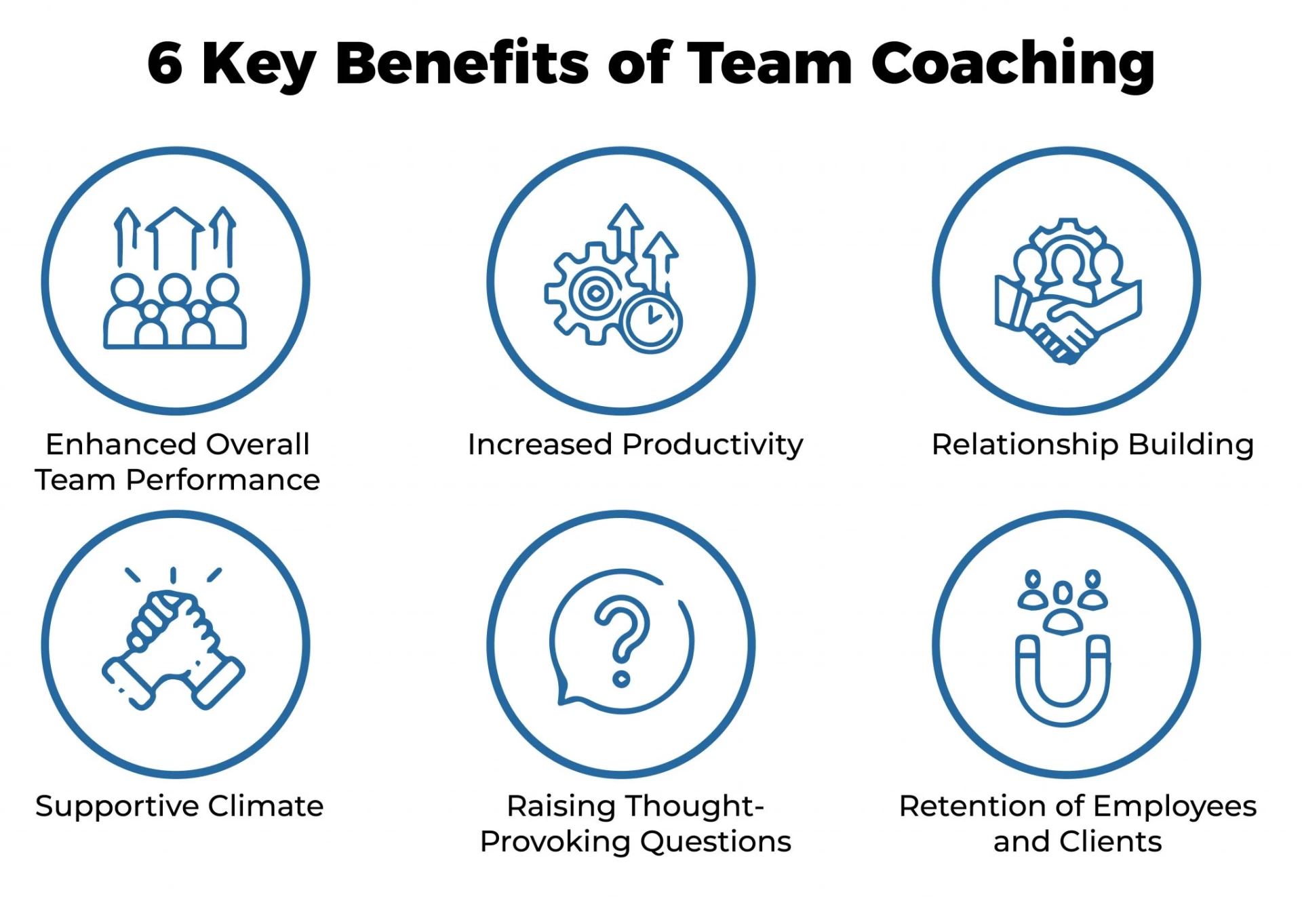
Enhanced Overall Team Performance
Team coaching enhances the talents and characteristics of team members.
As a result, they are better-equipped to accomplish objectives and fulfill obligations.
Increased Productivity
Team coaching enhances collaboration and cooperation, leading to better results.
Plus, team members become more productive as they learn to manage their own time and communicate more effectively with others.
Relationship Building
Team coaches help team members understand each other and build healthy relationships based on trust and openness.
This ability to work together, as a cohesive unit, creates an accepting environment where everyone feels valued.
Supportive Climate
Team coaching creates a positive atmosphere where team members feel comfortable sharing their opinions and asking for help.
This creates an environment of support, trust, and respect.
Raising Thought-Provoking Questions
Team coaches structure their questions so that they get to the heart of the matter while offering different perspectives on the situation at hand.
This ability to think critically and ask the right questions makes for an effective coach.
Retention of Employees and Clients
Team coaching can help prevent turnover and increase client retention.
This is because team members feel like they belong to something great, and feel valued by their peers and coworkers for who they are as people, not just employees or clients.
There is no one benefit that stands above all others; rather, team coaching offers a wide range of benefits tailored to the environment in which it is implemented.
Next up – I’m going to be discussing useful tips on how to provide team coaching to your organization.
6 Tips on Providing Team Coaching To Your Organization
Now that I’ve taken you through the key benefits of team coaching, I’ll be sharing some handy tips for you to implement at your workplace.
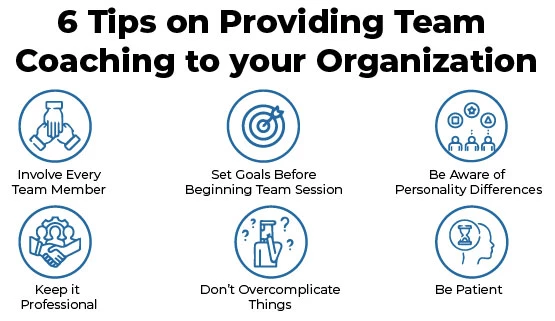
Involve Every Team Member
Team coaching shouldn't be a one-way street! Involve every team member, not just the group leader.
The most effective team coaches include all of the individuals who are part of the group session, and give them inputs and feedback.
Set Goals Before Beginning Sessions
In order to keep team coaching focused, it's important to establish clear goals, as well as the desired outcome, before starting.
This will make team sessions more efficient and ensure that everyone is on the same page.
Be Aware of Personality Differences
Team coaching requires an awareness of personality differences, as some people may respond better than others in certain situations.
Plus, a specific set of personalities might be more effective together, while other combinations of personality might clash.
Keep It Professional
While team coaching is an opportunity for people to share their feelings and thoughts, coaches should be sensitive to the emotions of others and keep conversations focused on the task at hand.
Don't Overcomplicate Things
Team sessions should be productive, so avoid overly-complicated group activities or exercises.
The most effective project team coaching sessions are straightforward.
Be Patient, Team Coaching May Not Work Instantly
While there is no one-size-fits-all approach to team coaching, it can be an effective way to boost morale and productivity.
By providing your group with the chance to talk openly about feelings and concerns and understand their roles within the group, they will be able to form healthy relationships with each other and achieve more as a whole.
Chapter 4:
Team Coaching and Other Leadership Styles: A Comparison
In this chapter, I will be comparing team coaching to other leadership styles found in the business world.
While there is no replacement for team coaching, a knowledge of the different approaches can be useful, depending on the situation.

Team Coaching Vs. Team Building
Team building is another leadership style that companies use to bring high-performing teams together.
This method focuses on group activities and exercises as a means to bolster motivation, morale, and productivity.
While team coaching may include some of the same elements as team building, there are a few key differences between the two.
- Team building emphasizes individual relationships within groups, whereas team coaching focuses on the relationships between the group members.
- While both leadership styles provide an opportunity to get to know one another and work better together, team coaching focuses on productive conversations about feelings and concerns as well as understanding roles within a group.
- Team coaching is when a professional coach works with a group to achieve an objective, and it may be conducted in person or virtually, via phone or internet meetings.
- Team building is generally a one-time event, whereas team coaching lasts for a longer period until the objective is accomplished.
Because they are working together to accomplish a certain goal, team coaching may also enhance the relationship among members by fostering a stronger connection between them.
Team Coaching Vs. Group Coaching
Group coaching is a similar leadership style to team coaching.
In group coaching, the coach works with individuals from different teams to help them communicate better and work more efficiently as a group.
While group coaching does provide an opportunity for members to share their feelings and concerns, there are differences between this model of leadership and team coaching.
- Group coaching focuses on individual relationships within a group, while team coaching enhances the relationship between group members.
- Group coaching is conducted with individuals or small groups, whereas team coaching involves all group members.
- Group coaching generally lasts for only one session, whereas team coaching can be ongoing until the objective is achieved.
Now that I’ve taken you through the comparisons between team coaching and team building, and team coaching and group coaching, respectively, let me answer a few questions that you might have in your mind.
Frequently Asked Questions
what is Team Coaching FAQs?
This chapter will discuss some frequently asked questions about team coaching. By better understanding the basics of team coaching, you can be more prepared to coach your team.
Who can benefit from Team Coaching?
Team coaches may conduct sessions with employees at all levels, from executives and managers, to non-management staff members.
Whether you are part of a large organization or small business, team coaching can effectively improve communication and boost productivity and morale throughout the entire team.
Is Team Coaching only for formal groups?
Informal teams may include family members or friends who work together informally to accomplish a common goal, or simply socialize.
Team coaching provides a means of improving communication and relationships within informal workgroups.
What is the difference between Coaching and Mentoring?
While both coaching and mentoring are leadership styles that benefit others, there are some key differences between them.
Mentoring is more of an informal leadership style where the mentor guides someone who is less experienced than themselves. Mentoring can be a one-time event, or ongoing and mentors can come from within the organization or outside of it.
Team coaching involves:
1.Leading a formal team toward a common goal, whether that comes from increasing morale.
2.Improving communication.
3.Achieving better results.
4.Some other goals.
A professional coach leads the team, and may work with team members individually, and together as a group.
How much does Team Coaching cost?
It is based on the duration the coach is hired for, the number of coaching sessions, and the hourly cost of the coach.
Team coaches charge rates comparable to those of other consultants, with a little more variation based on the project and the coach's experience.
We'll go into more depth later in this section.
How long is the Team Coaching process?
This process varies in length based on the goal's intricacy.
Some organizations achieve their objectives in a few months. Some teams may require coaching for many months, or even years, to achieve their objective.
Once a team decides on a coach that works well with them and collaboratively helps them reach their goals, they might return for another team coaching session to continue working on the next project.
Conclusion
Team coaching is a valuable leadership style that can help your team work better together.
Whether you are part of an organization or small business, it should be considered as an option to improve communication and morale throughout the entire group.
The team coaching process can vary depending on the goal's intricacy. Some team coaching teams may require many months or even years to achieve their objective, while others might accomplish it within a few months.
What have your experiences been with Team Coaching?
What are the challenges you faced, and how did you overcome them?
Is there any aspect of Team Coaching that you’d like to find out more about?
Let me know in the comments!
