
Non-violent Communication: The Definitive Guide
Last updated: March 2026
Non-violent Communication: The Definitive Guide
What is something we humans need to fundamentally thrive as social creatures? If you guessed communication, you are 100% right. Humans are social creatures and if we are able to communicate fairly well, we are able to build lasting relationships and have fun in the process.
Communication has various forms but can be widely classified into two main types- violent and non-violent.
Violence in communication need not be malicious; it is frequently instinctive and ingrained. This article will examine nonviolent communication (NVC), a method that teaches us to communicate openly and honestly while attending to our needs and those of others.
In this blog we will understand:
- The fundamentals of NVC
- History behind NVC
- Components of NVC
- How Coaches can use NVC in their sessions
And much more!
So let’s get started.
Contents





Chapter 1:
Nonviolent communication 101
This chapter will focus on the basics of nonviolent communication and help you understand all that you need to know about nonviolent communication.
Let’s go!
What is non-violent communication (NVC) and why is it important?
An approach to communication based on nonviolent ideals is known as nonviolent communication (NVC). It is a strategy to build empathy and enhance the lives of those who use it as well as those around them, not a method to put a stop to arguments. The principles of person-centered treatment were the ancestors of nonviolent communication, which was created by clinical psychologist Marshall Rosenberg in the 1960s and 1970s.
The primary objective of NVC as a communication technique is to foster empathy in the discourse. The notion is that once there is empathy amongst the persons involved in the dialogue, it will be much simpler to discuss a solution that meets the essential needs of all parties. Interpersonal harmony and information acquisition for future cooperative efforts are the objectives.
Important ideas include avoiding coercive language, acquiring information through observation without judgment, expressing wants and feelings honestly and concretely, and creating persuasive and sympathetic requests. Both as a therapeutic psychotherapy approach and a self-help method, nonviolent communication is becoming popular, especially when it comes to achieving harmony in personal and professional relationships.
History of NVC
The NVC model's foundations were laid in the late 1960s, when Rosenberg was promoting racial integration in Southern American institutions of higher learning. The original version of the model, which included observations, feelings, needs, and action-oriented goals, was written by Rosenberg in 1972 and was included in a training handbook.
The foundation of nonviolent communication is traditional psychology theory. Carl Rogers' ideas and person-centered therapy have been crucial to the development of NVC. Rogers placed a strong emphasis on experiential learning which focused on using experiences to build communication rooted in empathy and active listening.
The main ideas that influenced Rosenberg from Carl Rogers’ research were that: (1) individual mental health depends on the social structure of a community; (2) therapists alone cannot meet the psychological needs of a community; and (3) the community will gain more knowledge about human behavior if psychology is freely given to it. Thus, he started working on the NVC model and first started using it in schools to teach children NVC. He started incorporating puppets to make it easier for children to understand how to use NVC. A ferocious jackal was the flagbearer of violent communication and a wise, “foresighted” giraffe that of NVC. This model worked wonders in classrooms.
The model since then evolved a lot and now, has expanded to include both official (e.g. police-citizen, boss-employee) and informal power connections ( e.g. man-woman, rich-poor, adult-youth, parent-child). The ultimate goal is to create social bonds based on reparative, "partnership" paradigms and mutual respect as opposed to punitive, fear-based, "domination" paradigms.
Examples of NVC
It is easy to follow NVC but it will be easier to really get to the crux of it with some well-thought of examples from Rosenberg’s book.
- NVC in a classroom
In her classroom, a special education teacher employs NVC. Her students have also been taught the techniques by her. For the instructor, a student in her class who has behavioral issues has grown more and more annoying. When other kids approach this child's desk too closely, he acts violent (spitting, swearing, stabbing with a pencil).
He stops when the teacher asks him to utilize NVC, alters his bearing, and adds, "Would you mind getting away from my desk? When you're standing so near to me, I get upset. The other kid returns the favor. The instructor recognizes the unmet requirements that are the source of her annoyance with the child using NVC herself.
Her sense of freedom and creativity in the classroom have been restricted because of the amount of time spent on behavior management. Knowing this, she develops more effective and considerate responses for the pupil (Rosenberg & Chopra, 2015, p. 7).
- NVC in healthcare
To better understand her patients' requirements, a doctor uses NVC with them. Her patients suffer from difficult, chronic illnesses including AIDS and hemophilia. These ailments frequently lead to anger and resentment toward healthcare professionals.
The doctor can help the patient enjoy ordinary life by using NVC to demonstrate a sincere interest in them.Her patients see this interest and are appreciative. As a result, the doctor is inspired and motivated and has an improved capacity to view her patients holistically as people who are defined by characteristics other than their diagnoses (Rosenberg & Chopra, 2015, p. 10).
- The role of NVC in global relations
When a listener interrupted Rosenberg's speech and called him a "murderer," Rosenberg himself used NVC to continue (Rosenberg, an American, was seen as a representative of his country, which supplies weapons to Israel).
In order to listen to the man instead of speaking up for himself, Rosenberg employed NVC.
By listening, he discovered that the man desired the same things as everyone else: a tidy and secure home, top-notch instruction for his kids, political freedom, and independence.
The man's wrath was reduced as a result of the listening. As opposed to an "American," he started to perceive Rosenberg as a fellow human being. As a result of their conversation, Rosenberg received a dinner invitation to the man's house (Rosenberg & Chopra, 2015, p. 15).
What are the benefits of NVC?
It is quite obvious that such a profound and well-thought model has benefits which are far reaching and useful in every aspect of social and corporate life. But here are some of the most important benefits of NVC:
- NVC enables us to establish connections with one another and with ourselves that promote the development of our innate compassion.
- By focusing our awareness on four areas of NVC—what we are observing, experiencing, needing, and requesting to improve our lives—it helps us to rethink the way we communicate with and listen to others.
- Deep listening, respect, empathy, and a shared desire to contribute with purpose from the heart are all fostered by NVC.
- NVC is used by some people to develop more meaningful personal connections, others to deepen professional or political connections, and yet others to respond compassionately to themselves.
- NVC is utilized all over the world to resolve conflicts and disagreements at all levels.
Now that we have the knowledge of all the basics of NVC, let us understand NVC a bit more in depth, including the four basic components of NVC and the three primary modes of implementing NVC.
Chapter 2:
Components and steps to implement NVC
NVC is neatly broken down into its relevant components to help us understand the model better. There are basically four components of NVC which can further be implemented using three highly effective modes.
In this chapter, we will first look at the four basic components followed by the modes of implementation.

Four basic components of NVC
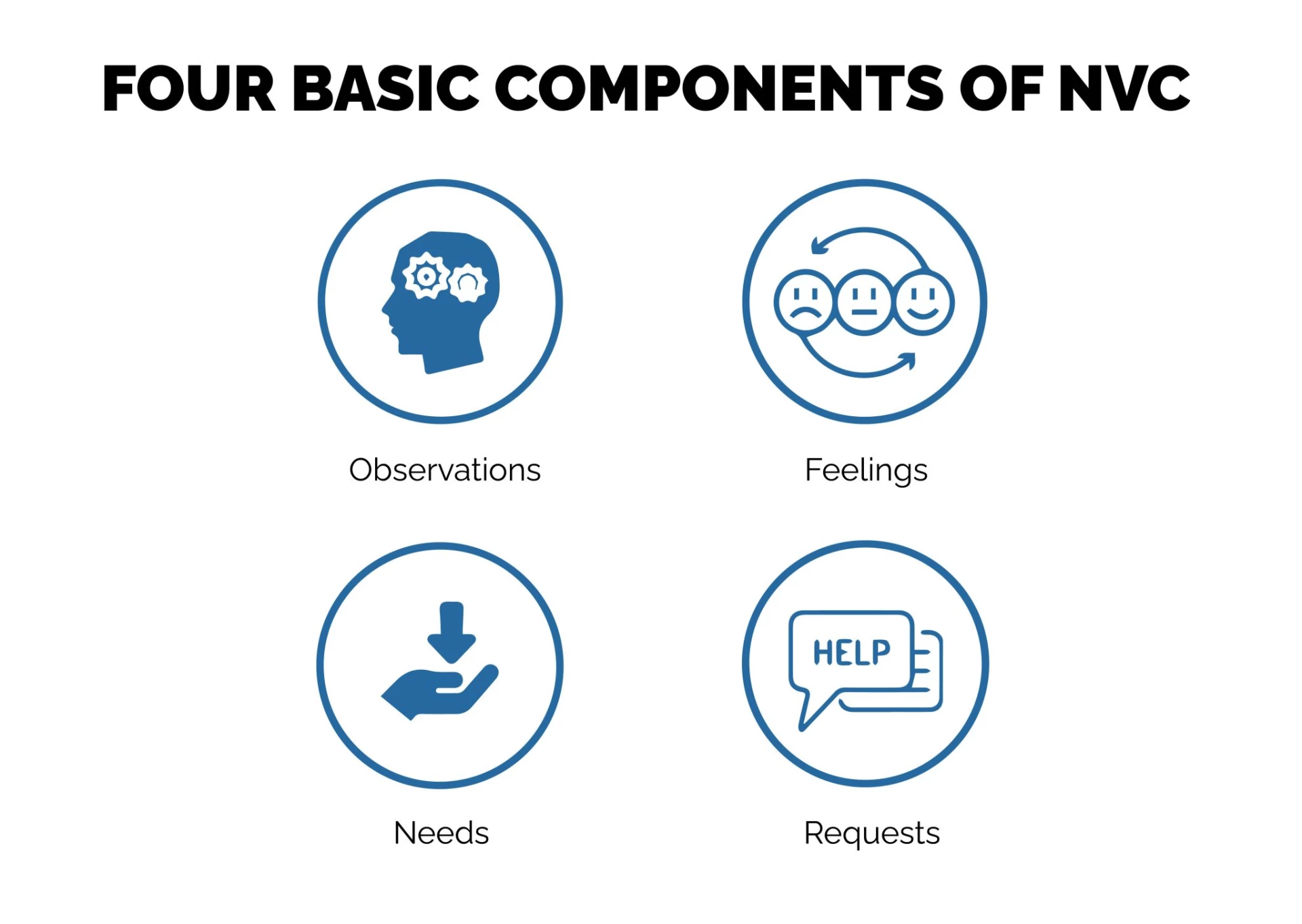
The four basic components of NVC are observations, feelings, needs, and requests. I am going to walk you through all four of them in detail.
- Observations
NVC places a strong emphasis on objective observation. This entails summarizing the straightforward facts we have found. For instance, you could say, "In our meeting today, I observed that you were on your phone," as opposed to, "You frequently don't listen when I'm speaking."
Learning to practice NVC requires developing the ability to keep your observations separate from any personal value judgments you may have about them. By reserving these judgments, one can increase the likelihood of an understanding-promoting conversation by avoiding the emergence of defensive mechanisms. NVC begins with the exchange of these observations with others.
- Feelings
NVC calls for accepting accountability for your emotions. This necessitates a shift in how we view how the words and deeds of others affect our emotions. According to NVC, what other people say and do should only serve as a stimulant and never as the root of emotions.
Instead, it is our decision to do so, as well as our wants and expectations at the time, that determine how we respond to these stimuli (Rosenberg & Chopra, 2015).
NVC highlights four alternatives when confronted with a bad message from another person. Let's utilize the complaint, "You're so selfish," to demonstrate these choices:
- Think about it: "I'm incredibly selfish."
- Defend yourself by saying, "You're selfish; I'm not."
- Think on your own needs and feelings:
Say something along the lines of: "When you call me selfish, I get wounded
because I require some acknowledgement of the effort I make to take your
preferences into account." The speaker makes it simpler for their partner to react
compassionately by tying their emotions to their requirements.
- Think on the wants and feelings of the other person:
Ask a question along the lines of, "Are you wounded because you need greater respect for your preferences?" (Rosenberg and Chopra, 2015) The other person can now convey their underlying needs in the dialogue as a result of this reaction.
The user using NVC must get slowly habituated to alternatives c) or d) in order to avoid the first two likely instinctive responses.
This gives the person the freedom to choose differently while engaging with others and to assume responsibility. They are more likely to comprehend their conversation partner and satisfy their own wants by making these various decisions. Reaching a state of "emotional emancipation" is the aim of learning to express one's own demands, according to Rosenberg (Rosenberg & Chopra, 2015).
3. Needs
This step is where NVC establishes a link between an individual's feelings and unmet demands. All people have these universal and basic needs (Rosenberg & Chopra, 2015). Indicators of unmet needs, such as love and acceptance, are visible in the outward manifestation of emotions, such as rage and frustration.
The third NVC phase teaches the person to search within themselves for these requirements. This is made easier by NVC training through practice and by growing the lexicon of feeling terms, which increases the nuance with which people can identify and express their needs. Speakers use this knowledge to create persuasive appeals to listeners.
4. Requests
Making specific, realistic requests for items that will improve the requester's quality of life is the last step of NVC. They are designed in a way that makes it possible for the person to respond to the request with compassion. Demands are never made of others. Demands are always harsh, intimidating, and forceful in the eyes of NVC, and they frequently result in fruitless communication interactions.
Positive requests are made in NVC. In other words, ask for what you want instead of what you don't want. Saying "I'd like you to spend more time with me at home" as opposed to "I don't want you to spend so much time at work" is an example of how to do this.
The best method to distinguish between a request and a demand is to incorporate your own wants and sentiments in the request. This necessitates being aware of both what you are asking for and why (Rosenberg & Chopra, 2015). Your chances of getting what you want increase with the clarity of your request.
Due to the nature of NVC as a reciprocal exchange, it can be divided into two parts: (1) Honest Expression through the Four Components, and (2) Empathetic Reception through the Four Components (Rosenberg & Chopra, 2015). The second component is dependent on listening skills, which NVC considers to be at least, if not more, as important as speaking skills.
It's crucial to keep in mind that NVC is an approach tailored to each specific scenario rather than being a predetermined formula. Rather than the words spoken, the substance of the process lies in the consciousness of the four parts (Rosenberg & Chopra, 2015).
Rosenberg asserts that NVC can be carried out in silence, with no words being exchanged between partners, because NVC is more than just a language or a set of skills. It also involves taking an empathic attitude, being aware of deeper needs, and having a caring intent (Rosenberg & Chopra, 2015).
Now that we fully know and understand the four components of NVC, let’s move on ahead to understand the three primary modes of implementing NVC in the next half of this chapter.
Three primary modes of implementing NVC
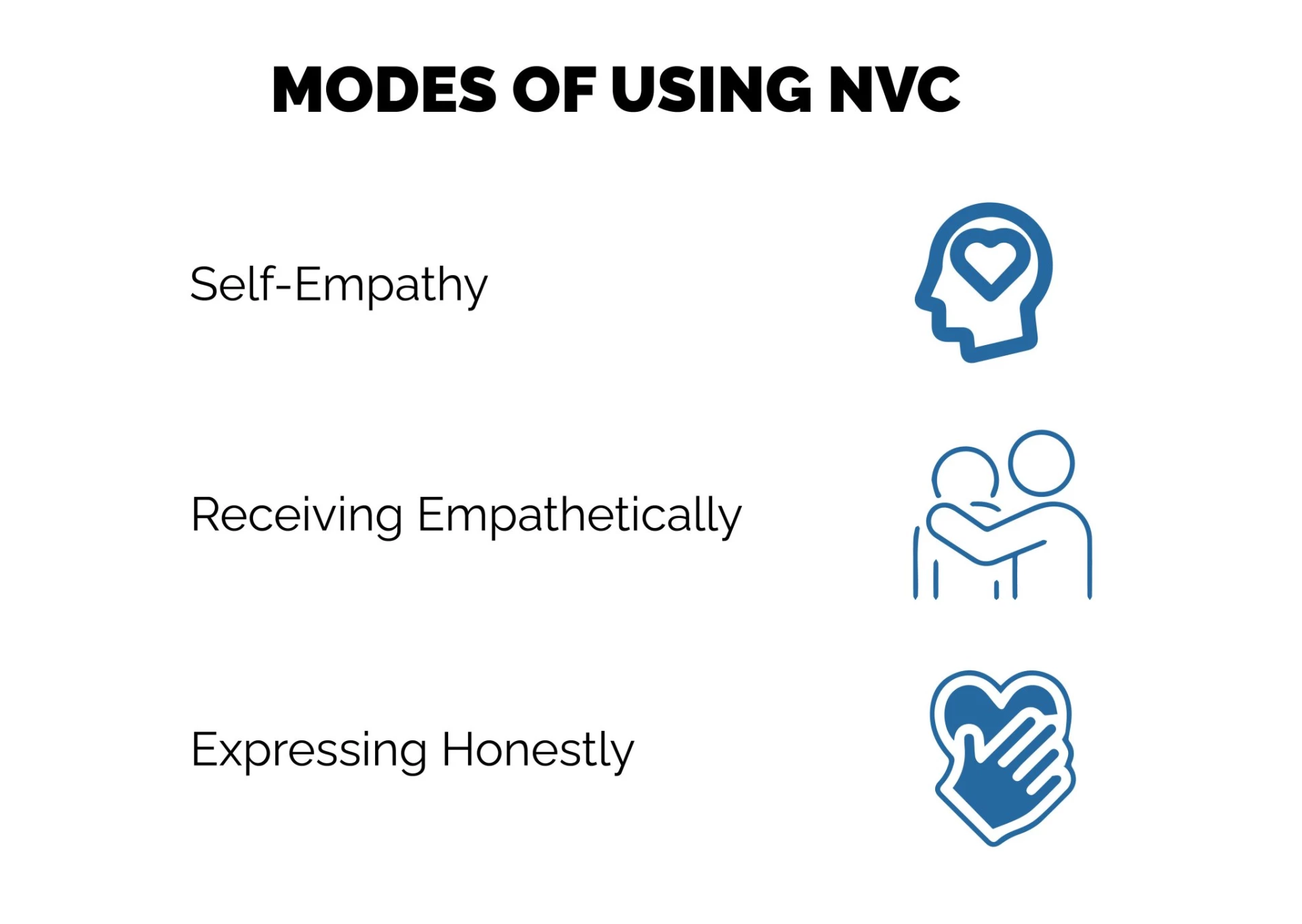
The NVC model also talks about implementing the four basic components in three different modes, adjustable to each individual. We will be looking at those modes to help you understand the most common ways to use NVC. However, just because NVC highlights these three modes doesn’t mean there can’t be any other modes of implementing NVC. So, let us consider these three options first:
- Self-empathy
Self empathy entails having a sympathetic relationship with what is happening within us. Without assigning blame, this may entail observing our feelings, our thoughts, and, most importantly, connecting to the needs that are having an impact on us.
- Receiving empathetically
According to NVC, receiving empathy entails "connection with what's alive in the other person and what would make their life joyful” It's not a cerebral understanding in which we only comprehend what another person says. Empathic connection is an understanding of the heart through which we perceive the other person's beauty, divine energy, and life within them.
It doesn't imply that we must share the other person's emotions. When we experience sadness over another person's distress, that is sympathy. It only indicates that we are with the other person and not that we share their feelings. You are not there with someone if you are trying to intellectually understand them. Emptying our minds and listening with all of our beings are required for empathy.
NVC advises concentrating on listening for the underlying observations, feelings, desires, and requests regardless of how the other person communicates themselves. It is proposed that reflecting a paraphrase of another person's words that highlights the NVC elements that are implicit in their communication, such as the feelings and wants you assume they are expressing, can be helpful.
- Expressing honestly
Expressing an observation, feeling, need, or request is a big part of NVC. If the conversation's context is clear, an observation may be skipped. It is thought that when you name a need in addition to a feeling, people are less likely to assume you are holding them accountable for your emotion. Similar to this, it is stated that stating a request in addition to a need reduces the likelihood that others will interpret your request as a general demand that they take action to meet your needs. The parts are supposed to cooperate harmoniously.
All of these three modes seem quite logical considering the roots and basics of NVC. Once one learns to communicate in a nonviolent way, these modes start becoming a part of your daily conversation habits and behaviors.
But many of you must be wondering how we use NVC in coaching and what are some types of coaching methods where NVC is used quite often. In the next chapter, I will be focusing on NVC in coaching and what you need to do as a coach to use NVC in your sessions.
Chapter 3:
NVC in coaching
Now comes the most sought-after question; “Sai, how can I use NVC as a coach?”. Well fret not my friend, I am going to outline exactly how you can use NVC in your sessions, if you need an NVC license to use it, and which type of coaching methods have used NVC in the past in this chapter. So, gear up!

How can coaches use NVC?
The NVC model is one of my favorite models in coaching because of its elegance and simplicity. Furthermore, it doesn’t need any complex studying or huge books to understand the context. It is fairly simple- basically try to be a good person and show empathy towards others and you will already set yourself on the path of NVC.
As far as implementing it in coaching, if you understand the four main components of NVC and how one leads to another, you can start using it in your coaching sessions. Plus, the NVC website has a lot of free resources and research papers to help you get creative about its use in coaching.
Just for the main components and combine it with the main modes of execution and you can start using it as a tool in your sessions.
Do coaches need to be trained in NVC?
When Rosenberg thought of developing a model based on NVC, he was fully sure that he wanted to make it as available as possible to everyone. He wanted everyone to also have ease of access to this model. So, fortunately for us, there aren’t any specific certifications or training you need to undergo to use NVC in your sessions.
However, I do highly recommend following Rosenberg’s method and applying NVC in your daily life as well. If you as a coach start practicing NVC, you will be better able to help your clients with the execution of NVC in your sessions. Practice what you preach and it will not only make your life better but also help you lead sessions with far more confidence and understanding.
Which type of coaching has used NVC in the past with examples
Relationship coaching
Relationships may be a significant source of happiness and fulfillment as well as tension and sorrow.
In contrast to inefficient communication, which can lead to conflict and rifts between partners, effective communication helps couples improve and develop their love relationship.
The Emotion Focused Couples Communication Program (EFCCP), which aims to support couples in communicating nonviolently and compassionately rather than demandingly and disconnectedly, is built on the principles of NVC.
The four NVC phases are repackaged in EFCCP with an emphasis on thankfulness and appreciation, two feelings that promote closeness (Vazhappilly & Reyes, 2017).
The program is completed by couples, and interventions happen in both group and couple-only settings. Couples can also engage in extracurricular activities like writing and making an effort to recognize and appreciate their partner for particular acts of kindness.
Couples that participated in a three-week intervention using the EFCCP showed noticeable behavioral changes, such as increased levels of effective communication and marital satisfaction (Vazhappilly & Reyes, 2017). According to this study, caring and efficient communication increases feelings of wellbeing and marriage happiness.
Consider incorporating NVC into your practice for couples who have communication issues if you are a marriage and family therapist or a therapist who specializes in relationships. Read the aforementioned article for further details on EFCCP.
If you are a relationship coach, you can try to use this kind of an extended NVC approach to help your clients in sessions
Business coaching
The most major sources of stress at work can be found in difficult relationships with clients and coworkers. Numerous employees engage in interpersonal disputes with their coworkers, which causes significant stress and challenging weekend recovery (Wacker & Dziobek, 2018).
The underlying premise of NVC is that stress can be reduced by switching to a compassionate and nonviolent communication approach. It is hoped that NVC would help to avoid workplace stress brought on by coworkers and burnout.
Healthcare professionals were used in a study to test the claim that NVC can reduce social stress and empathic distress at work (Wacker & Dziobek, 2018). The three-day program that was offered was a traditional NVC session that placed an emphasis on challenging emotions like irritation and anger.
Participants were urged to use actual scenarios in their role-playing exercises.
The researchers discovered evidence that the NVC training effectively promoted emotional and interpersonal skills and avoided empathic discomfort and interpersonal conflict after following the participants for three months post-intervention (Wacker & Dziobek, 2018).
Participants displayed improved NVC abilities in casual discourse and increased expression of negative emotions during heated exchanges (Wacker & Dziobek, 2018).
The study is encouraging and shows how NVC can be helpful in fostering a workplace where employees can take care of themselves and resolve problems amicably and productively. If you're interested in implementing NVC at your place of business, think about becoming trained yourself and taking the interventions and your newly acquired knowledge to work.
If you are a business coach, you can try using this research on both corporate and small-business clients and see how communications in the workplace get better with consistent use.
Spirituality coaching
NVC and meditation work nicely together. Slowing down and becoming aware of your own wants and sensations are necessary for the NVC process. Meditation practice can help with this process because the abilities learned in meditation are applicable to the NVC process.
Content on NVC meditation has been created by NVC trainers and educators. Additionally, there is a guided meditation for NVC practice down below.
If you are a spiritual coach, there are high chances that you have already been using or have used NVC in your sessions. It is highly effective and is a great tool for life transformations.
Apart from understanding how and when to use to NVC in coaching, it can also be helpful to have ready to use worksheets and games to help foster NVC in sessions. I am going to share some amazing worksheets and games that I personally use in my sessions in the next chapter.
Chapter 4:
Worksheets and games for NVC sessions
It can sometimes be daunting to understand and design games and worksheets for NVC sessions.
Which is why I am going to give you some amazing worksheets and games that you can use in your sessions which have worked wonders for me personally.

5 specific worksheets to effectively use NVC
Try these five worksheets for nonviolent communication training.
1. Worksheet on Accurate Listening
In NVC, listening makes up half of the procedure. Utilize the Listening Accurately Worksheet to sharpen your listening abilities so you may better understand the sentiment and desire that lies beneath your partners' words.
2. Checklist for Conflict Resolution
This useful Conflict Resolution Checklist will assist you in keeping track of which components of the conflict have been handled when applying NVC in a conflict resolution scenario. Use this to tie up any loose ends and stop resentments from developing.
3. Worksheet on Anger Exit and Re-Entry Routines
The emotion most likely to prevent compassion is anger. Use this worksheet on Anger Exit and Re-Entry Routines to discover a method for controlling your anger if it prevents you from using NVC.
4. Mistakes to Avoid and Success Tips
In this worksheet, some of the typical conversational pitfalls are broken down. With a client getting ready to have a challenging conversation with a significant other, consider going over this document.
5. Worksheet on using "I" statements
A key element of NVC is the use of "I" statements, which enable the speaker to own their comments and accept accountability for their needs and feelings. Use this worksheet to assist your client in developing this crucial ability.
Games to use NVC in sessions
Try out these helpful exercises to deepen your client’s comprehension of communication in a nonviolent way.
1. What did I intend to do?
Conflicts may result from our intentions behind a certain action. For instance, when we perform someone else's tasks, we can do it with the aim of lessening that person's workload or with the objective of making that person feel guilty.
We could unintentionally generate conflict if we don't take the time to reflect on our objectives. Use this activity to improve your ability to comprehend your intentions:
- Ask your clients to note down a statement or action they made.
- On paper, describe the action and the motivation behind it.
- Investigate further: ask them if their true intention was hidden beneath any other layers of intention.
- Ask your clients if they would alter their intentions if they could go back in time? Would they go back and do things differently? Encourage them to explore their thoughts and feelings in writing after completing this practice.
2. Play acting
NVC training benefits from role-playing. Either of these role-plays can be facilitated by you in a pair or individually.
- Empathy/Non-Empathy
Spend the first five minutes of the role-play talking to each other while one role-player portrays the opposite of empathetic communication. Change roles. then practice NVC for the following ten to fifteen minutes. Then, have a debrief. What did each phase feel like? How did it feel to be on either of the two sides? Which did they prefer more?
(If you conduct one-on-one sessions, you can pair up with your client for this exercise)
- Develop self-compassion
This activity is very beneficial in front of a crowd or audience. Have a courageous role-player represent each side of an NVC discussion. In this way, they get to practice not only with both sides of NVC, but also with identifying their needs and growing familiarity with what it sounds like to have their needs met.
3. NVC card games
The components of NVC have been developed into several different card games, which are great for children, couples, and groups working on these skills.
I hope these activities and worksheets help you and your clients in your sessions just like it helped me. Remember, you can always find more creative ways to use NVC games in your sessions.
Chapter 5:
Alternative models to NVC
NVC as a model does not have major criticisms. It is because of this that many other researchers and scientists have used this model as a basis for other models which explore the various themes discussed in NVC.
If you, as a coach, want to learn more ways to use the NVC-based coaching approach, here are some models I recommend you look into, side-by-side to the NVC model.

Alternative models to NVC
- Marion Little looks at NVC-related theoretical frameworks. Although neither model explicitly mentions the other, the influential interest-based model for negotiating and mediation created by Fisher, Ury, and Patton at the Harvard Negotiation Project and the Program on Negotiation in the 1980s appears to have some conceptual similarities with NVC. Based on conceptual parallels, though not any clear evidence of a connection, Little cites The Gordon Model for Effective Relationships (1970) as a potential forerunner to both NVC and interest-based negotiation. Rosenberg and Gordon had both worked with Carl Rogers, therefore the similarities between the models may be the result of shared influences.
- According to Suzanne Jones, there is a significant distinction between Rosenberg's advocated empathic listening and Gordon's active listening in that the latter involves an ongoing process of listening with both heart and mind and being fully present to the other's experience with the intention of understanding and empathizing with the needs of the other.
- With the notion that "Violence occurs when certain individuals or groups do not see any other way to meet their need, or when they need understanding, respect, and consideration for their needs," Gert Danielsen and Havva Kök both point out an overlap between the tenets of NVC and those of Human Needs Theory (HNT), an academic model for understanding the causes of conflict and designing conflict resolution processes.
- Chapman Flack sees a connection between what Rosenberg promotes and critical thinking, particularly when it comes to Bertrand Russell's idea of combining kindness and rational thought.
- Martha Lasley notes parallels between the NVC's observations, feelings, wants, and requests components and the Focused Conversation Method (FCM) stages of objectivity, reflection, interpretation, and decision-making.
Conclusion
Congrats on getting through yet another coaching model with me! The NVC model is one of my most favorite models and I use it all the time in my sessions as well as in my personal life. But, what did you think of the model and its uses?
Would you be keen to use it in your sessions as a coach?
Comment below and let’s get a conversation started!
