
Ladder of Inference: The Definitive Guide
Last updated: March 2026
Ladder of Inference
The Definitive Guide
Have you ever found yourself in a situation where you have been misunderstood and left wondering why someone else has interpreted something you said or did, and put a meaning on it that you never intended? Or have you ever been accused of jumping to conclusions?
Then chances are you have been climbing the ‘Ladder of Inference’ too fast.
The Ladder of Inference is a theory that implies every person has a different perspective and understanding of the same given situation.
Understanding your own and others’ "Ladder of Inference" can help us make better decisions and also help evaluate the quality of a decision.
In this article, I will explain the Ladder of Inference in more detail, and show how you can use it.
So if you want to:
- Avoid jumping to conclusions
- Catch yourself before you act out of bias
- Save yourself from unwise choices.
- Avoid falling prey to confirmation bias.
- Take appropriate fact-based action.
You’re going to find this guide super useful!
I have put together well-researched tips in this guide so that you can avoid jumping to conclusions.
Let’s get started.
Contents
Business Model Related to Ladder Of Inference

Chapter 1:
The Fundamentals of Ladder of Inference
How individual acts depends on how they perceive the situation they are in. People can come to very different conclusions about a situation, depending on what aspects of the situation they notice and how they interpret it.
In this chapter, I will introduce the fundamentals of ‘Ladder of Inference’, a model you subconsciously use to jump to conclusions.
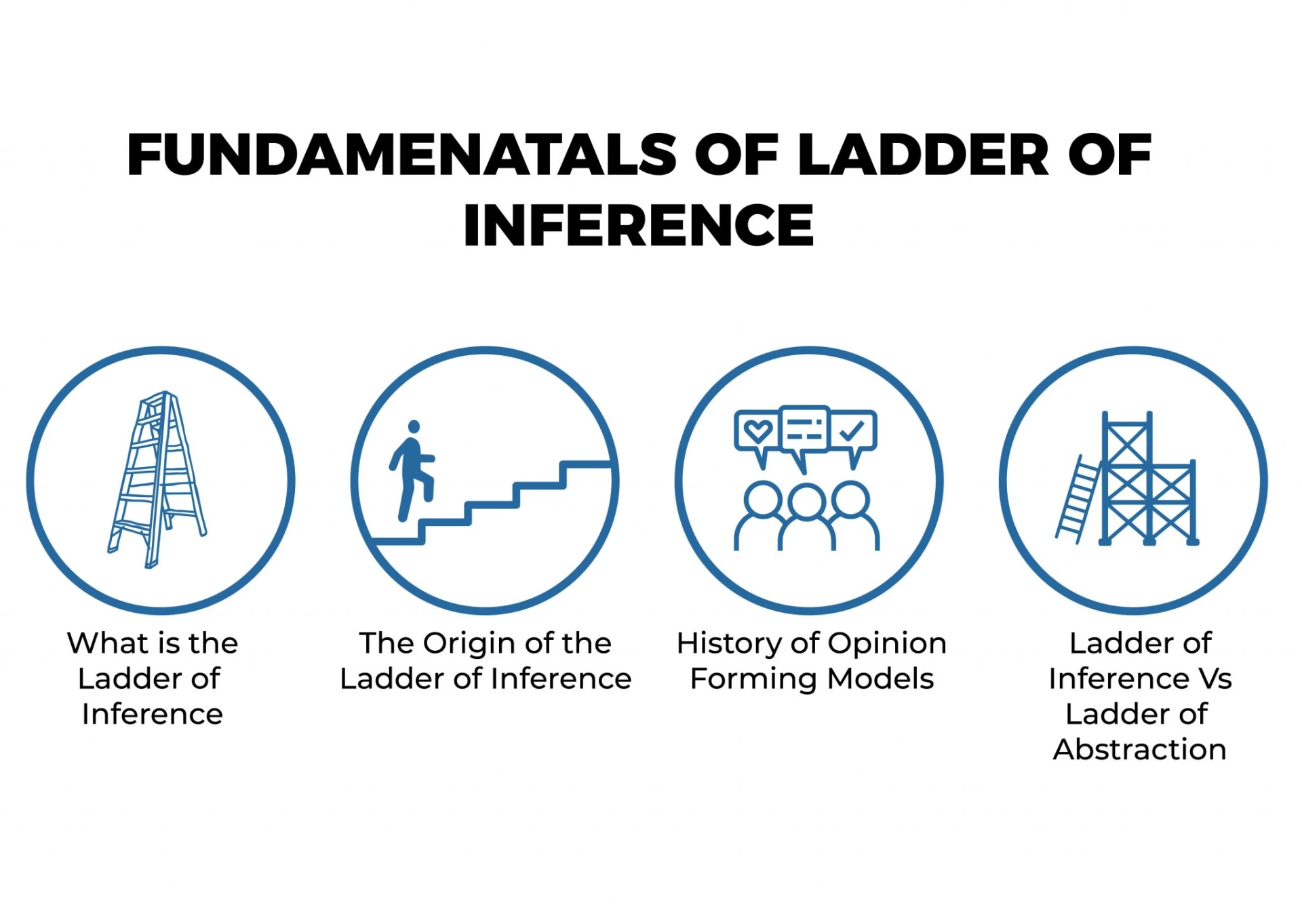
What is the Ladder of Inference?
The Ladder of Inference is a mental model describing how we move from a piece of data through a series of mental processes to reach conclusions and take actions. It highlights how we select data, make assumptions, and draw conclusions that reinforce our existing beliefs.
The Ladder Of Inference provides a 7-step process, just like the steps of a ladder, that we use to make sense of situations to act. It describes the thinking process that we go through, usually without realizing it, to get from a fact to an assumption and action.
What is the origin of the Ladder of Inference?
The Ladder of Inference was developed by the American organizational psychologist Chris Argyris, a former professor at Harvard Business School, in 1970. Argyris developed the “Ladder of Inference” to describe how people form and sustain mental models. According to Argyris, people make assumptions in their daily lives. Those assumptions are necessary.
However, these assumptions could be wrong, especially when these assumptions are about the intentions or beliefs of others. In 1992, the Ladder of Inference became popular after being described in the bestseller The Fifth Discipline: The Art and Practice of the Learning Organization, by American scientist Peter M. Senge.
History of Opinion-forming Models
To understand the ‘Ladder of Inference,’ in its entirety we must understand the prominent theories which were precursors to the model and also get an understanding of similar theories which are often confused with the Ladder of Inference.
Fixation of Belief- Charles Sanders Pierce
One of the earliest research on opinion formation was done by American philosopher and mathematician Charles Sanders Peirce.
In his 1887 article, titled “The Fixation of Belief,” Peirce introduced the process by which he observed how individuals hold beliefs and opinions. Pierce identified and defined four basic methods people use to fixate on their beliefs.
1. Method of Tenacity: Individuals resist other principles, opinions, viewpoints, dogmas, or attitudes that challenge their belief and waste no time in trying to make up their mind.
2. Method of Authority: Individual looks up to a figure such as an individual or institution he or she deems as an authority to determine which beliefs they are going to accept.
3. Method of Taste: Individual chooses principles, opinions, viewpoints, dogmas, and attitudes that sound good to him or them or that could bring forth personal benefits. 4.
4. Method of Science: Individuals accept an assumption as true for the simplest reason that it sounds logical or reasonable, although it remains untested or unproven.
Abstraction Ladder- Hayakawa
The Ladder of Abstraction was created by linguist S. I. Hayakawa. It is a mode to understand how people think and communicate. In ‘Language in Thought and Action’, published in 1939, he explained how the ladder of abstraction works.
His theory argues that humans can reason at four language levels ranging from concrete words to abstract words. The concrete words are the base of the ladder and the abstract words are at the top of the ladder.
The higher up one goes on the ladder, the more abstract the idea, language, or thought becomes and the lower one goes on the ladder the more concrete the idea, language, or thought becomes.
For instance, if you stay on the top of the ladder, you will end up just talking of concepts that aren’t backed by any fact. On the other hand, if a person is on the bottom of the ladder, he/she will end up only talking about facts and not explaining them.
Both scenarios are ineffective while communicating. That is why understanding the Ladder of Abstraction and finding your balance on the ladder becomes critical.
Four Rungs of Hayakawa’s Ladder of Abstraction
Level 1- Specific, (Concrete words)
The first level of the ladder is concrete words. These sit at the bottom of the ladder. These are less complex and very concrete words defining people, things or places.
Examples: the Channel 5 perfume, BLT sandwich, a Tesla car, the Traveller’s Palm plant, etc.
Level 2- Definite groups
The second rung of the ladder consists of words that are less concrete and little more abstract.
Examples: house plants, perfumes, sandwiches, electric cars, etc.
Level 3- Broad groups
The third rung is more abstract than the previous rung and helps people talk about things in a broad group instead of being specific. For instance, instead of Channel no 5 or perfume, here it can be clubbed under a broad group of toiletries.
Examples: plants, toiletries, young people, women, etc.
Level 4- Abstractions
The four and the top rung of the ladder describes ideas and things which are more abstract.
Examples: beauty, nutrition, success, etc.
What is the difference between the Ladder of Inference and the Abstraction Ladder?
Though they have similar names, the two models are very different. The Ladder of Inference mostly helps us understand how we make assumptions, while the Ladder of Abstraction describes levels of thinking and language.
The applications of Ladder of Inference and Ladder of Abstraction are different. While the Ladder of Inference may be used to improve your reasoning and understanding of a situation leading you to make better decisions, the ladder of Abstraction can be used to improve your communication skills, by finding a fine balance between concrete and abstract thoughts and ideas.
Chapter 2:
Understanding the Ladder of Inference
Decision-making is undoubtedly an essential part of life. Our decisions are driven by varying perspectives (emotional, rational, business, social, etc.). The theory of Ladder of Inference translates how people draw conclusions and make decisions by using data and available information.
In this chapter, I will explain why understanding the Ladder of Inference is important and break down the seven stages of the decision-making process that you can use from filtering data through different stages to finally concluding.
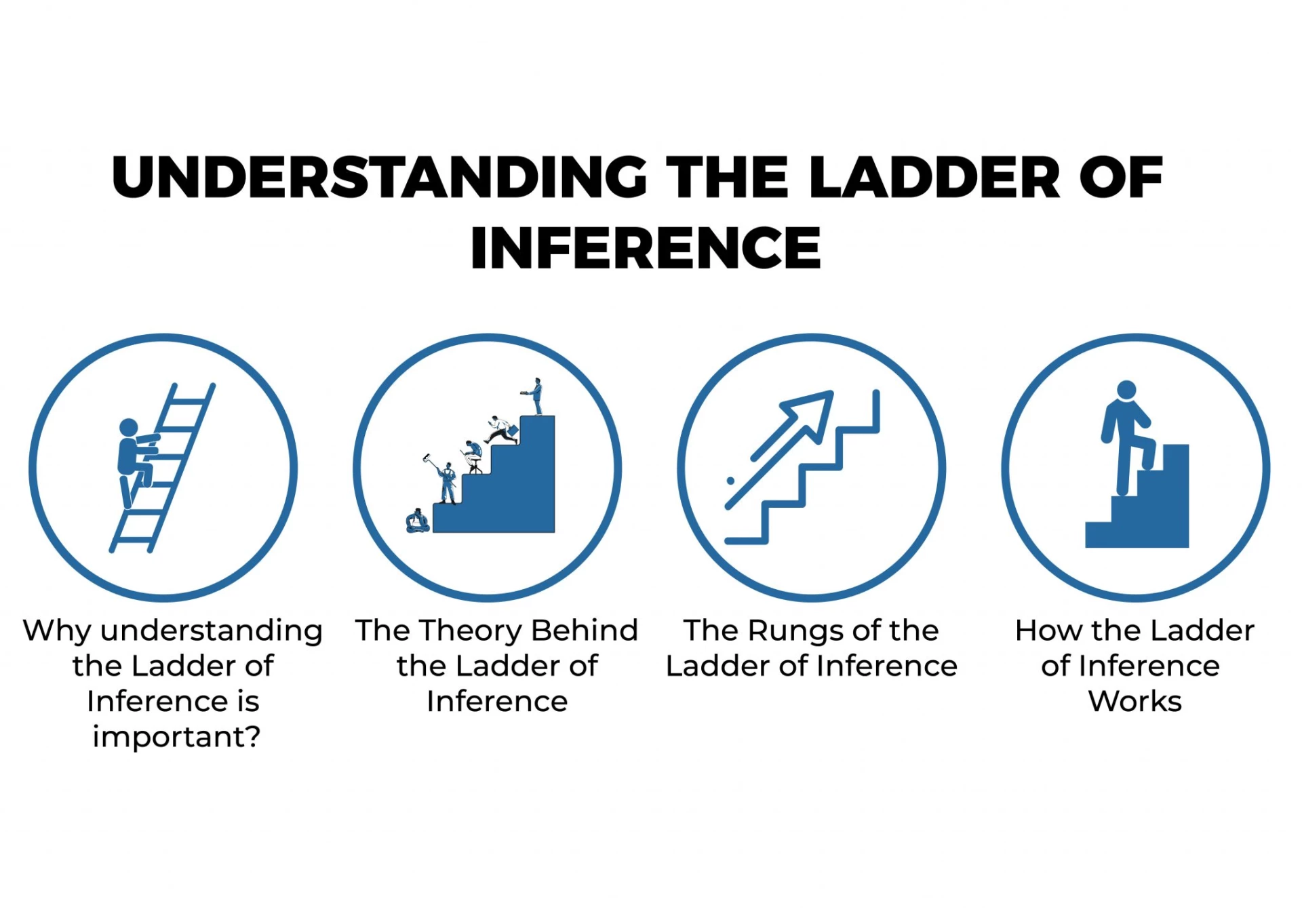
Why understanding the Ladder of Inference is useful?
The process of decision-making happens very fast in our minds and often subconsciously to arrive at conclusions. For instance, when presented with a set of facts your past experiences or beliefs may lead you to ignore certain facts altogether, and skip steps in the reasoning process to jump to a conclusion.
The conclusion made in this loop supports our beliefs, and these beliefs, in return, will affect how we perceive information and select data in the future. Your previous beliefs, right or wrong, influences the process of the future creating a vicious circle of bad judgment and decisions.
The Ladder of Inference, helps you get back to the facts and use your beliefs and experiences to positive effect while evaluating facts and reality. It helps you broaden your field of judgment by using reasoning while looking at available facts, thus avoiding mistakes.
Understanding the Ladder of Inference can help you draw better conclusions- in both your personal and professional life. It can be used in your personal life to resolve a conflict.
For example, forgiving a friend for taking a last-minute rain check or you can use it in your professional life to test assertions, such as "whether to launch a new product for a certain geography."
The Theory Behind the Ladder of Inference
Inference can be referred to as drawing conclusions by using the premises and evidence. Our inferences are influenced by experience, current situation, emotional state, values, and beliefs.
For example, if your subordinate is late for a meeting, we usually jump to the conclusion that the person is unprofessional, but when your seniors walk in late for a meeting you assume there could be a genuine reason for getting late.
The ladder of inference theory focuses on our thinking process and helps us understand how we make decisions. The underlying idea is that we can improve our communications/ decision making by reflecting on your thinking and reasoning so that you can discover and correct errors in our reasoning.
The Ladder of Inference also calls for making one’s reasoning process more explicit so others can understand and talks about looking into others’ thinking and reasoning process.
Reasoning forms a major part of our decision-making. The effectiveness, consequences, and outcome of your actions depend on the quality of your reasoning. The challenge with improving our reasoning is that it is often invisible and happens very fast. The Ladder of Inference also calls for making one’s reasoning process more explicit so others can understand. This helps in avoiding misunderstandings.
The Ladder of Inference comprises seven steps within our thinking process, which I will cover in the next section.
Rungs of the Ladder of Inference
The ladder has seven rungs that represent our mental processes. The first rung of the ladder is ground facts and data that can be observed and absorbed by our five senses.
The second rung corresponds to the selected data from the available set of data. This is the data that you pick from everything you observed. The third rung is about interpreting the selection data that advances into assumption making and adding meaning to the selected observations.
The higher level of the ladder is about concluding the data into meaningful information. It is the summary of everything we had observed, selected, assumed, and interpreted.
The conclusions forge your beliefs that translate into your actions regarding the specific perspective and context.
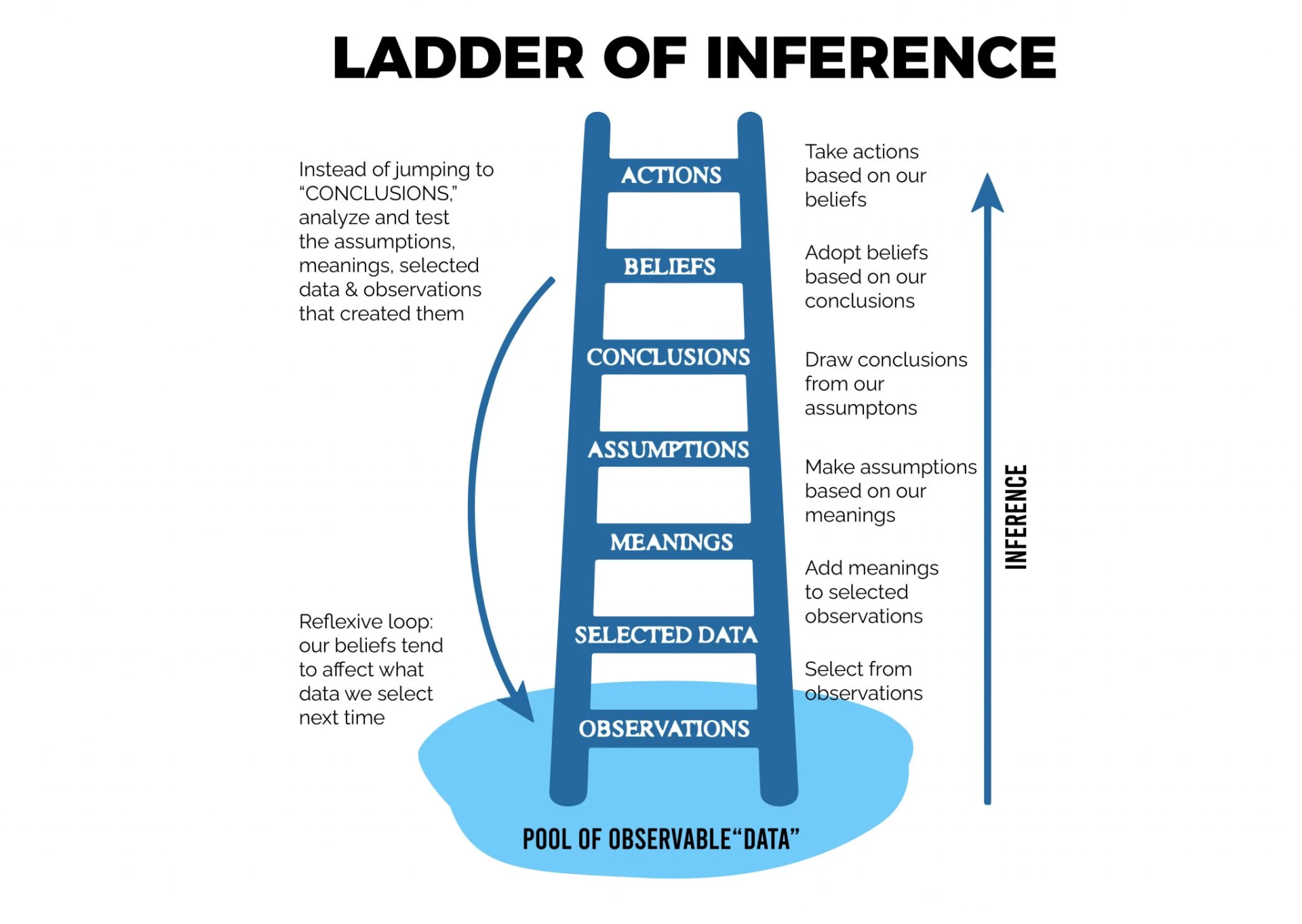
Here is how it looks:
● Step 1 - Experiences / Observations / Reality
The first step of the ladder is based on our experiences and observation of data and facts around us.
● Step 2 - Filtering / Selected Reality
Your mind has been spontaneously observing situations and data around you. The second step corresponds to how your mind starts filtering out data that it thinks is useful. The selection of data is often based on the conscious choice that tends to ignore the facts that are contradictory to your previous beliefs and experiences.
● Step 3 - Meaning / Interpretation
The third rung of the ladder is when you start perceiving things and giving meaning to your selected reality (data, experience, situations, observations, etc)
● Step 4 - Assumptions
At this stage on the ladder, you can use your prior experiences, beliefs, and assumptions to build the new assumptions according to your interpreted reality. The assumptions might ignore a lot of facts that are relevant to current experience but irrelevant to prior beliefs.
● Step 5 - Conclusions
The fifth stage is when you jump to a conclusion by using your interpretations and assumptions.
● Step 6 - Beliefs
Conclusions lead to affirmation or adjustment of your beliefs regarding an ongoing scenario. Your old beliefs are reinforced by new assumptions and conclusions.
● Step 7 - Actions
The real-time action is taken based on the beliefs. The new circumstances is defined by your actions and the vicious circle starts again.
How does the Ladder of Inference work?
The process of jumping to a conclusion takes place through the Ladder of Inference very fast. Given the limits of the human mind, when you are presented with multiple data, you can’t pay attention to everything. Most likely you select data that is most important to you and ignore the rest. Then you interpret the selected data and form your own assumptions based on your past experiences or your own casual theories. You decide how to act or respond to the situation based on those assumptions.
Let’s try to look at the process through an example.
John is a marketing manager in a company loaded with projects, tight schedules, deadlines, and things to do. The team had been under stress for these reasons, but one of his subordinates was one hour late to the office. John is frustrated to see this.
He doesn’t analyze the situation or look for the data but quickly jumps to a conclusion. He approaches the latecomer and gives him a warning about the consequences if the behavior is repeated. Given the tight schedules and deadlines to meet, it makes sense for most of us.
However, it wasn’t the best decision to immediately take action. What could have been done? John could have given himself time to analyze the ground facts. The subordinate had been late due to an emergency, traffic, or any other legit reason.
Even worse, the subordinate had informed us about the delay by calling the reception. The receptionist was busy with other stuff and forgot to inform John about the emergency.
If all of this information was available to John, would his action be the same as it was before? John is not the only person who tends to jump to conclusions.
Here is when the Ladder of Inference comes up to add perspective to the situation. If the Ladder of Inference is added, the appropriate action can be taken. Let’s take a closer look at how we form mental models and the science behind the mental models in Chapter 3.
Chapter 3:
The Science Behind Ladder of Inference
Ladder of Inference is a paradigm for learning, expertise, and cognitive bias. At any one moment, there are many, many more objective facts in the world than we can focus on.
In this chapter, I will talk about mental models and the science behind the Ladder of Inference.
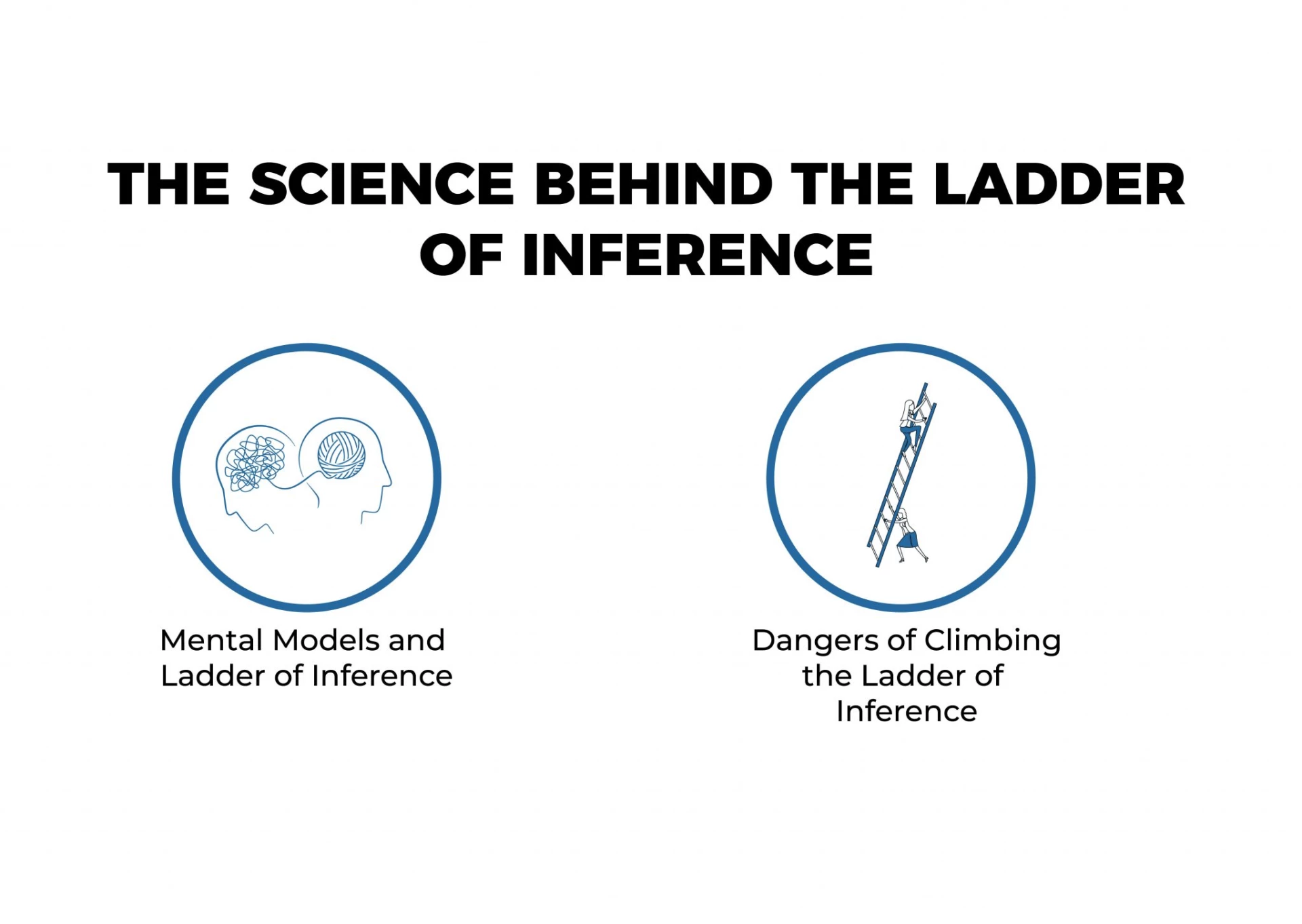
Mental Models and Ladder Of Inference
Mental models are frameworks that decide how we perceive and understand the world around us. Images, assumptions, values, beliefs, and experiences are all part of a person's "mental landscape."
These models influence our perceptions of the world and our actions as a result. It dictates how you perceive and interpret a piece of information. People who see the same thing, but have distinct mental models, may have dramatically different perspectives on what they saw. Mental models, in a sense, are like eyeglasses, transforming your perception of the world.
Bias
Bias occurs when our interpretations are skewed due to the selection of irrelevant evidence based on preconceived notions, assumptions, meanings, and assumptions that are not always conscious. A group of individuals views things differently because they have diverse learning histories that have led them to believe various things and make different assumptions about the world around them based on their own experiences. There are a variety of mental models that we use without even realizing it.
Unconscious Bias
Assumptions, opinions, and attitudes that you've learned but aren't necessarily aware of are often linked to the Ladder of Inference, which is often based on unconscious biases. Unconscious prejudice is also known as implicit bias, and it develops over time as you encounter various preconceptions in your daily life.
A decision-making process such as the ladder of inference isn't possible with unconscious bias. As a result, it affects your thinking at all levels of decision-making.
The Ladder of Inference demonstrates the steps you take before making a choice and taking action. Various cognitive biases, including unconscious prejudice, play a role in this process.
It also shows how even if your ideas and prejudices are unfounded, the way you make decisions may serve to reinforce them.
The Dangers of Climbing the Inference Ladder
There are multiple dangers of climbing the ladder of inference too fast, taking leaps on the ladder based on your assumptions.
Let me highlight two of the most common dangers here.
Ladder of Inference and Bad Judgment
As I mentioned in the previous chapter, your assumptions, values, past experiences, and beliefs dictate what data you select, and what you observe. This is called “Confirmation Bias.”
You make decisions based on your assumptions and observations. Your decisions in turn reinforces your assumptions, values, and beliefs. This creates a reflexive loop increasingly making you to select data that ends up reinforcing those very same beliefs. So your ways of understanding create a self-reinforcing system, stopping you from alternative ways of understanding and trapping you into a reflexive loop, which can create bad judgment.
As discussed in the previous chapters, you can’t possibly analyze all available data before you begin to move up the ladder and initiate the decision-making process.
The “reflexive loop” makes your decisions seem fact-based. But in reality, they are ultimately a function of the beliefs you had before even without considering the objective facts of the current situation.
Taking Short-cuts to Decision Making
Ideally, the Ladder of Inference should help you improve the quality of your decision with every cycle, however, it is not always the case if you take shortcuts.
It is easy for any person to let their beliefs and biases color their mental models. As discussed earlier, it is common when people get trapped in the reflexive loop they tend to take shortcuts to expedite their decision making by (a) limiting themselves to data that supports their existing beliefs, and (b) ignoring alternate data (mostly contradictory data) that challenges their assumptions. This leads to a “tunnel-vision” preventing people from seeing opportunities and hindering their ability to think creatively.
Next, in Chapter 4, I will cover the various ways in which you can use the Ladder of Inference.
Chapter 4:
How to Use the Ladder of Inference
Making sound decisions is important in any aspect of life. Whether you are deciding what to wear for the day or trying to figure out a complex problem at work, using the Ladder of Inference can help you get there.
The Ladder of Inference is a model that helps you step back and analyze your thoughts and assumptions so that you can make better decisions.
In this chapter, I will discuss how to use the Ladder of Inference.

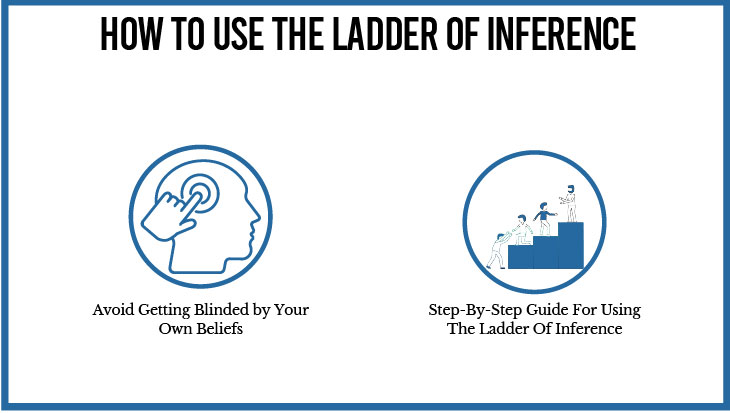
Avoid Getting Blinded by your Own Beliefs
Everyone has a set of beliefs, and it’s important to be aware of them. Your beliefs can sometimes blind you to evidence that contradicts them. It’s important to be open-minded and consider all of the evidence before coming to a conclusion.
1) Be Aware of your Limitations and Find your Blind Spots :
No one is perfect. Everyone has limitations. Every person also has blind spots. You might not be aware of our own limitations. It’s important to be aware of your own limitations and find your blind spots. This will help you to make better decisions.
2) Question your Assumptions :
I’m sure you have made your fair share of assumptions. However, it’s important to question your assumptions and make sure that they are valid. Otherwise, you may come to a conclusion that is not based on evidence.
3) Make your Thinking Explicit :
It’s important to make your thinking explicit. This means that you should make sure that your reasoning is clear and understandable. Otherwise, you may come to a conclusion that is not based on evidence.
Step-by-step guide
On a Ladder of Inference, you try to work our way down to ensure that you are acting on facts rather than self-limiting beliefs. You climb down to the bottom to check whether you have evaluated all the observable facts and data.
Here is a step-by-step guide on how you can do that:
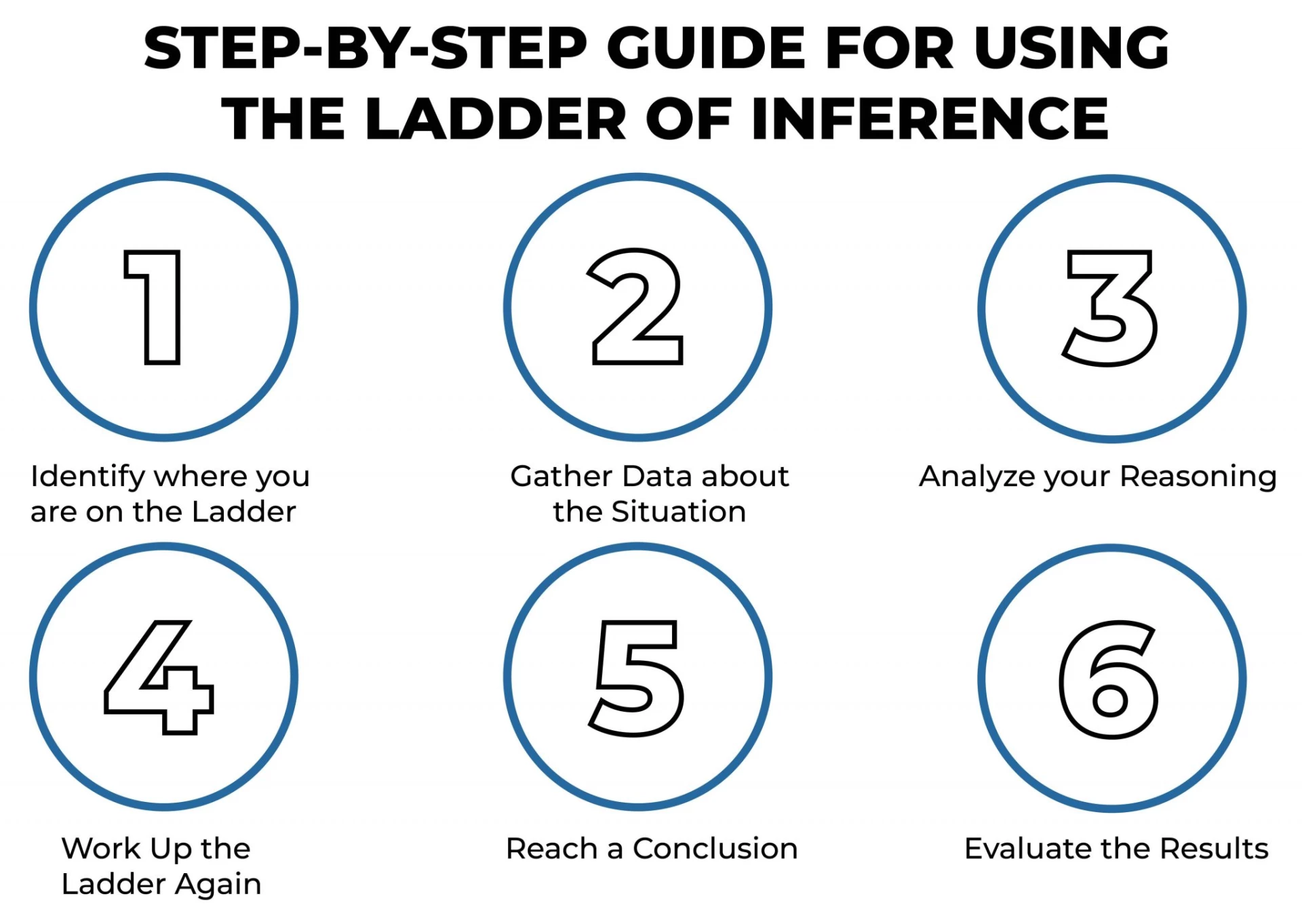
1) Identify where you are on the Ladder
The first step is to identify where on the ladder you are. This will help you to understand the different steps that are involved in making a decision.
2) Gather Data about the Situation
The second step is to gather data about the situation. This includes gathering information about the problem or challenge that needs to be addressed.
Ask yourself: Am I looking at all the available data? Did I ignore any data or didn't pay attention? Are there other data that challenges my current assumptions?
3) Analyze your Reasoning
The third step is to analyze your reasoning. This includes making sure that your reasoning is clear and understandable.
Ask yourself: Am I looking at the data objectively? Could the data be interpreted in some other way? Are my assumptions valid?
4) Work Up the Ladder Again
The fourth step is to work up the ladder again. This includes evaluating the evidence that has been gathered and developing a hypothesis about the situation.
5) Reach a Conclusion
The fifth step is to reach a conclusion about the situation. This includes deciding on a course of action to take in order to address the problem or challenge.
6) Evaluate the Results
The sixth step is to evaluate the results of the action that has been taken. This includes assessing whether or not the solution was effective in addressing the problem or challenge that was identified.
By following these steps, you will be able to reach a conclusion that is based on evidence and not bias.
Chapter 5:
Applications and Uses
From the above discussions, you are already aware now of why the Ladder of Inference can be so helpful and how it can break the reflexive loop and equip you to stop treating your own beliefs as the hard truth.
In this chapter, I will share the multiple uses and applications of the Ladder of Inference which can help you in your personal and professional life.

Uses
From the previous discussions, by now you know that the Ladder of Inference helps to take decisions based on facts rather than your own assumptions. Apart from helping you make rational decisions professionally, the ladder can also come in handy to improve your interpersonal relationships.
Here are a few uses of the Ladder of Inference that you may find beneficial.
- Interpersonal Relationships
A Ladder of Inference can be used for improving your interpersonal relationships. It can help you not to jump to conclusions without receiving the full amount of data. Like a friend may be late to a party that you hosted and she is not apologetic for it.
This makes you believe that maybe she is not interested in your party and is coming out of the will and next time you just don’t invite her to the party.
Instead, if you would’ve been clear with them, they may have told you a valid reason and because of more data, you may have reached a different well-informed result.
- Mindful Living
The ladder of inference can help you become more mindful. Most of you would have certain implications and made certain assumptions about people which are not true. It only harms your relationship with the person.
You can establish mindful thinking through this practice. Through the Ladder of Inference, you can train your minds to be much more attentive and see for more details and collect more data. You train your minds to be more focused and attentive.
Moreover, once you understand others’ Ladder of Inference, you become more understanding and empathetic.
- Group Thinking
Often, a subgroup has a different opinion than the rest of us, and sometimes it is because of some underlying issues and past experiences. Talking towards the ladder and making better and informed choices help us in making much better collective decisions.
For example, Professor Brown asked his students to write an essay taking help from literature. The group of 30 students started arguing about whether the professor meant only the scientific journals or only the course materials when he said to take help from literature.
After a lot of arguing and then getting to the bottom of each group, they realized they all had different opinions because of different reasons.
One of them wanted to have less workload and so only wanted to cite and read the course materials. The other group had previous experience with research projects so were comfortable extracting data from journals.
The last group admitted that they just wanted the best grade and so wanted to remain within the boundaries as set by the professor. They then made an informed decision and managed the workload accordingly.
Applications
Ladder of Inference not only helps in informed decision making, but it has other applications as well. In the previous section, you saw some of the uses of the Ladder of Inference.
In this section, I will tell you areas where the learnings from the Ladder of Inference can be applied.
As a leader, your decisions have a great impact on your employees. With half information, you can end up making bad decisions which will affect the whole team and also your reputation as a leader.
Also, it can lead to bad judgment and bias which can worsen the whole dynamic of the team. It is better for the leader to learn and communicate effectively, observe in a meaningful way and make every decision, whether in the head or in reality after being fully informed.
- Conflict Resolution
Conflict often arises because of incomplete information. MIT Professor P. Senge recommends following the ladder of inference for solving the conflicts as it gives a platform on how our personal, or team’s opinions matter in making a decision.
A simple example of what often happens in society is that parents often decide careers for their children and while some of them may be successful, some of them are not happy because their parents had not taken all the information about their interests into account.
It tells you that people must take their time interpreting the data they had in their minds and from their past experiences and from other before making an informed decision.
This may not be the perfect method or give guaranteed results against conflicts, it can give us a better understanding of others’ wants and needs, their hopes and fears. In a nutshell, it will help us make a better decisions.
Negotiations
Negotiations can be done much better with full knowledge. If you don’t know your or other person’s fears, thinking process or any of the feelings that they are feeling you may not land upon a good decision.
It is better in negotiation to climb the ladder and make every decision without any bias or incomplete data.
Now that you know the uses and applications of the ladder of inference, in the chapter 6, I will share some practical tips that you can use while applying your learnings.
Chapter 6:
Tips for Using the Ladder of Inference in Coaching
In the previous chapter, you have learned about the uses and applications of the Ladder of Inference. It can be used in both your personal and professional life to improving the quality of decision-making.
In this chapter, I will share practical tips on how you can use the Ladder of Inference in your existing coaching business and what the do’s and don'ts that you should keep in mind.
Do’s and Don’ts of using Ladder of Inference
Now that you know what is a ladder of inference and how to use it, here are some tips that you will find useful.
Like all other theories and models, the Ladder of Inference also has some do’s and don’ts which when followed will help you avoid falling into the trap of bad decision making. Let’s unravel them in this section.
Do’s of the Ladder of Inference
It is very tempting to jump the rungs of the ladder to come to a conclusion. These are some of the checks that help you stay on course.
- The conclusions which we have drawn should be centered on the taken facts.
- The objective should remain in all the steps of the ladder
- At every step, think continuously about what you are thinking and why you are thinking it. You have to challenge yourself continuously to successfully implement the ladder.
- The data should be chosen rigorously, and widely.
- Consider all the real facts and other domains too which are linked to the action.
- Consider different courses of action for better results and validate and challenge other people’s actions and conclusions.
- Think about other people's thinking processes and ask them about their reasoning.
- Explain your assumptions and reasoning to a friend or colleague for checking if it is sound or does it has any bias?
- If you are challenging or questioning someone's conclusion or action it is necessary to explain your reasoning. Help the other person walk through your process of how you reached that conclusion? Make your reasoning and thinking explicit to others.
Don’ts of the Ladder of Inference
Here’s some of the things that you should avoid while using the ladder.
- Do not skip any facts and step while you are in the reasoning process of the ladder.
- Do not negate other people’s actions without going through their ladder of interpretation.
- Do not try to look for facts that we only believe and are trying to validate our opinion because this will take us nowhere.
- Try not to make our beliefs rigid as it will result in a filtered or selected reality.
Limitations
While there are many benefits of the ladder of inference, there are also certain limitations associated with this model.
It is often not possible for people to derive their data from specific information sets because most of them strongly rely on their belief systems. Various people with different experiences and thinking processes interpret data differently, and again we cannot completely detach from our feelings while making a decision.
The ladder of Inference may not work during a crisis, where decision-making has to be fast. There is also the prisoner’s dilemma we face in which we are dependent on the decisions of other persons and it is difficult to go through all of their thought processes.
People sometimes can think irrationally and unpredictably which can lead to separate conflicts.
In Chapter 7, I will walk you through the different business models related to the Ladder of Inference.
Chapter 7:
Business Model Related to Ladder Of Inference
The main idea of the Ladder of Inference is to stimulate and encourage informed decision-making at businesses and individual levels by using facts and data, not a personal bias. There are several connected business models related to Ladder of Inference and decision making.
In this chapter, I will dig into three models to discover how decision-making is affected or how different individuals use facts.
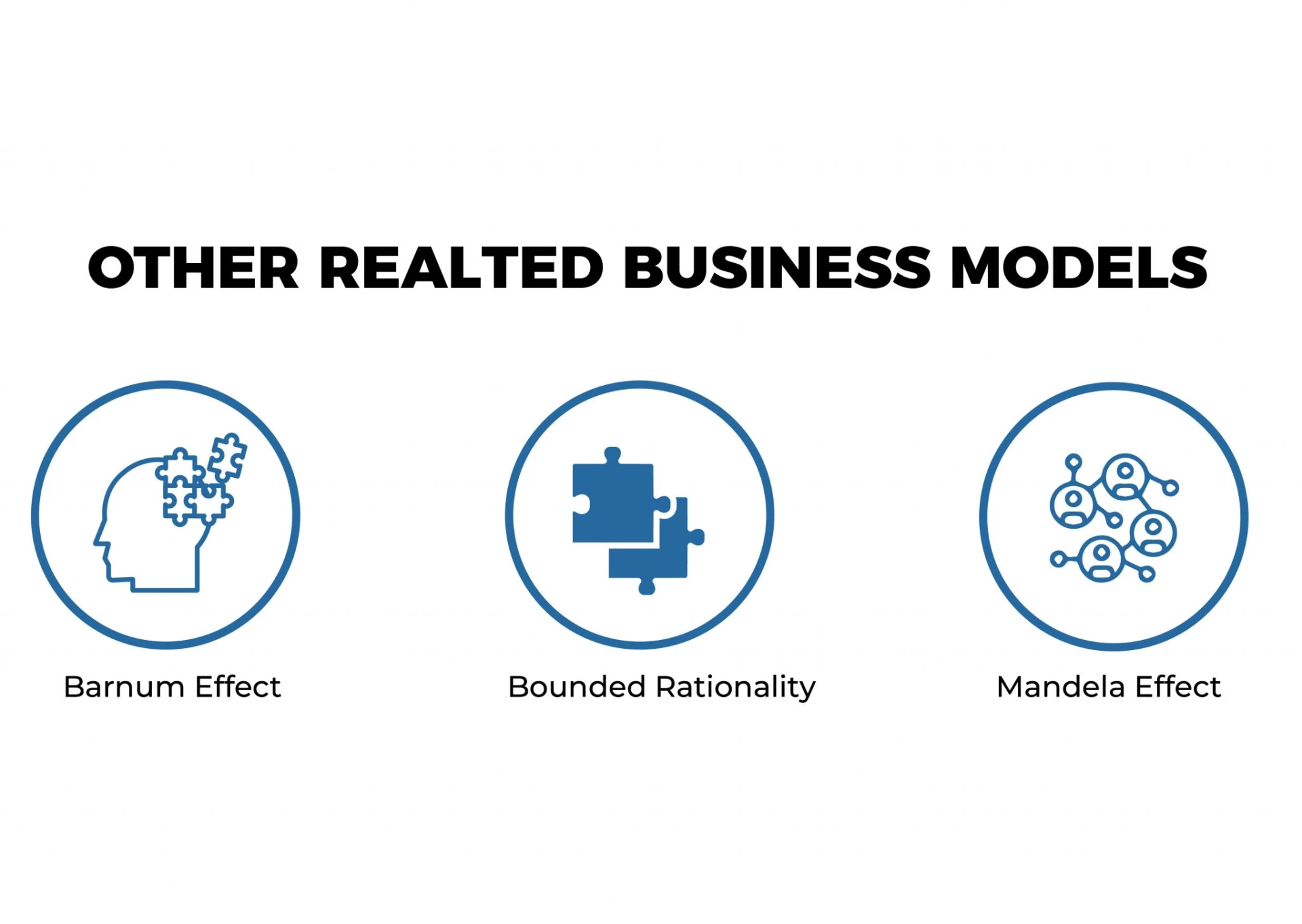
Barnum Effect
Barnum Effect, also known as Forer Effect, is also a psychological model or phenomenon explaining an individual’s perception and thinking process. In specific, the effect explains the process when an individual perceives the generic information as highly specific information tailored for them.
Barnum Effect can be explained as the cognitive bias, and it was first presented by psychologist Bertram R. Forer. He named it the fallacy of personal validation.
It’s important to explain how Barnum Effect relates to businesses and how it can be used.
If you look at digital companies like Netflix, Spotify, Amazon, Facebook, etc., they employ the “recommended for you” features for every individual.
Apparently, it sounds like the product is tailored for every individual. However, in reality, the information is generic for a certain group of people having similar demographic, choices, history, etc.
Bounded Rationality
Bounded rationality is also a behavioral concept widely used in political and business decision-making. It was proposed by an economist and political scientist, Herbert Simon.
The idea behind bounded rationality closely relates to the Ladder of Inference as it also explains how individuals make decisions in the real world.
The concept of Bounded Rationality explains that an individual doesn’t use optimization principles for decision making. Rather, an individual follows satisficing(satisfy & suffice). Simply put, we avoid the consequences that don’t satisfy us or look for the decisions that satisfy us rather than seeking the best possible decisions for the given facts and data.
A simple example of bounded rationality is to consider that you went to the grocery store to buy eggs. After looking at different brands, you finally decide to go for cage-free eggs.
In this scenario, you have chosen the option that best satisfies your desire to support ethical behaviors by buying eggs that are from the hens that are not kept in cages. The concept of bounded rationality intervenes in this example because you never considered what could be the other meanings of the label cage-free.
You didn’t have all the information available to decide if the phrase cage-free actually meant what you had perceived. Therefore, this decision is taken with bounded rationality, given the constraints of information availability.
The concept of bounded reality applies here as you, as a consumer, have limited rational decision-making driven by cognitive bias/ability, limited information, and time constraint. Similarly, businesses process the information in front of consumers to make suboptimal decisions driven by different factors.
The Mandela Effect
Finally, the Mandela Effect also relates to the idea of the Ladder of Inference as it also explains the thinking process and cognitive abilities of an individual. It implies that a group of people has distorted memories regarding a specific event. People remember the important events falsely, and this model was generated from the death of Nelson Mandela.
Fiona Broome believed that Nelson Mandela died in prison during the 1980s. However, in reality, he was released from prison in 1990, and he died 23 years later. Despite the contrary facts, Broome remembered how news coverage of his death in prison was aired with a speech from his widow.
This event never happened, but Fiona Broome discovered that she was not the only person to have a recollection of events in the said fashion.
The businesses might get hurt by the Mandela Effect internally and externally. For instance, a client gave certain requirements for completing a project, but the employees of the business completed a task in a whole different way because they never listened to what was actually communicated as deliverables.
They had distorted or false memory of what was said and explained. Similarly, it can happen on the consumer side of your business when the customers are expecting something that the product/service never promised to deliver.
Mandela Effect also signifies the cognitive bias of the individuals that results in the false memories leading to undesired results. Follow up, listening carefully, having written communications, and weekly reports can help businesses overcome the Mandela effect’s adversities.
Useful Resources
Mastering any mental model and getting over your personal bias takes time and effort.
Now that you have understood the concept and theory of Ladder of Inference and understood how you can use it in your personal and professional life, let’s take it a step further.
In this chapter, I will share some useful resources and worksheets that will help you further sharpen your decision-making process.
- Videos
I have found the following lectures on Ladder of Inference extremely useful in understanding the basic concepts and implementing them in practical situations.
Using the Ladder of Inference by HarvardX
The Ladder of Inference by Steve Zuieback
- Worksheets
I have found this worksheet very useful to monitor and review every step on the Ladder of Inference. You can use it while following the step-by-step guide to using the Ladder of Inference.
Conclusion
Congratulations on completing this guide!
You took the first step toward becoming better at decision-making.
Now you have all the information you need to improve the quality of your decisions in your personal as well as your professional life.
Remember — taking action and staying momentum is the key to your success. Keep applying the tips and techniques to improve the quality of your decisions with each new cycle, based on learning.
Do you have any experience of climbing up the Ladder of Inference too fast?
Which tips did you find useful?
Which part of this guide was most valuable to you?
Do you have any questions that I left unanswered?
Let me know in the comments section and I’ll make sure I address all your queries.
