Interested in learning how to become a life coach?
It's a great way to help people and make a real difference in their lives. If you feel drawn to guiding others and enjoy seeing them succeed, this could be the perfect path for you.
In this article, we'll walk you through five key steps to kick-start your career in life coaching.
Following these steps will make you a successful life coach and help you create a fantastic business that draws in hundreds of clients.
Let’s start!
In Brief :How To Become A Life Coach In 5 Steps
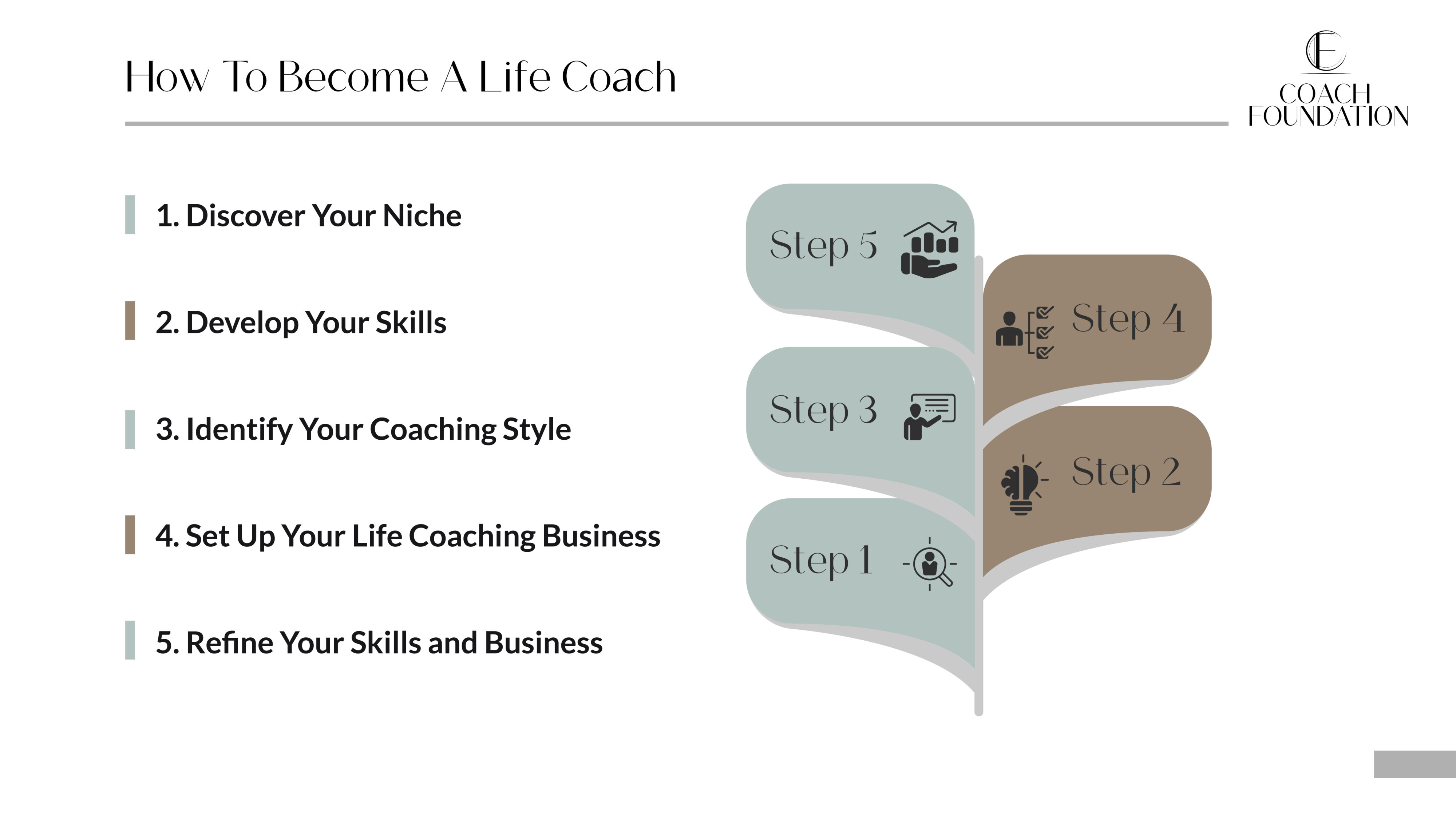
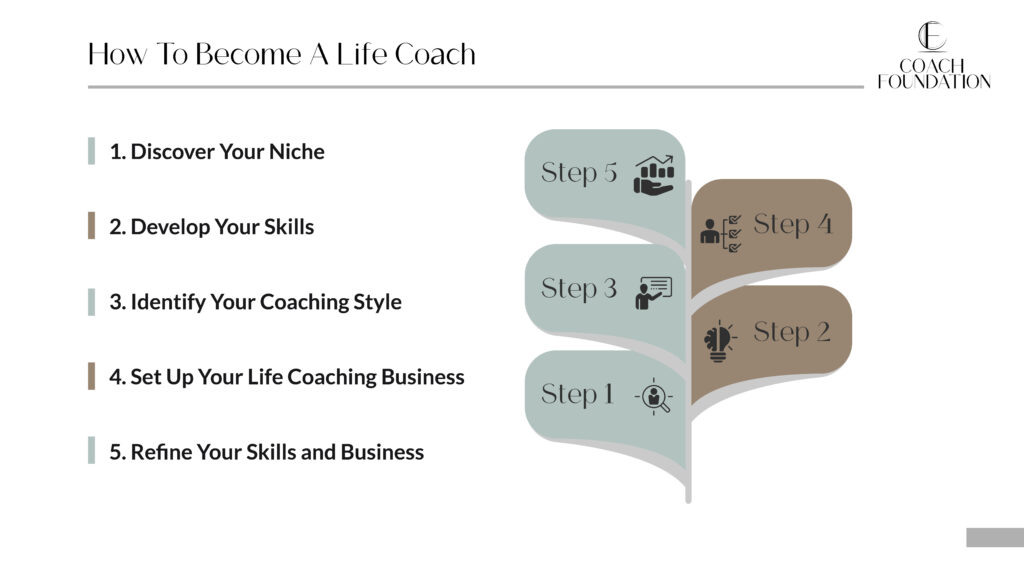
Step 1: 🎯 Discover Your Niche- Identify and specialize in a specific area that caters to the unique needs of a targeted demographic, enhancing the effectiveness of your coaching.
Step 2: 🛠️ Develop Your Skills - Enhance your coaching proficiency through formal training and the cultivation of essential soft skills such as empathy and adaptability.
Step 3: 🌟 Identify Your Coaching Style - Determine the optimal coaching format and session dynamics that best suit your methods and client preferences.
Step 4: 🏗️ Set Up Your Life Coaching Business - Establish a solid foundation for your coaching business by addressing legal requirements, creating a strong brand, and developing a robust marketing strategy.
A life coach is someone who supports and helps people figure out what they really want in their life and how they can achieve it.
They don't give you the answers straight away. A life coach asks you the right questions to help you understand your own goals, dreams, and the obstacles you face.
As a life coach, you help your clients define their objectives. You identify the barriers that prevent them from achieving these goals. You develop plans of action to overcome each challenge.
You focus on your clients' unique talents and gifts when creating these strategies. Assist them in maximizing their talents by providing the support they need. This support helps them make lasting changes.
Although all you need to become a life coach may be exceptional listening skills and a lot of compassion, choosing to become one is actually a business decision. Understanding how to start a coaching business is essential to translating these skills into a sustainable professional practice.
How to become a Life coach in 5 steps
Hear me out. These 5 steps I have listed are all it takes to become a life coach:
Step 1: Discover your Niche
Becoming a life coach starts with identifying and understanding your niche. It is the backbone of your coaching practice.
A niche is a specific area where you focus your work, offering something special that meets the needs of a particular group of people.
It's about finding your unique spot in a larger market.
A well-defined niche not only helps you attract the right clients but also sets the stage for developing tailored coaching strategies that address specific needs.
For example, as a dating coach, your niche could be:
"I empower single parents to confidently re-enter the dating scene by providing tailored coaching focused on balancing parenting responsibilities with personal relationships. My unique methodology includes personalized sessions, self-esteem workshops, and supportive community groups, all designed to help single parents navigate dating with confidence and ease. Together, we work towards the ultimate goal of fostering fulfilling romantic relationships that complement their busy lives as devoted parents."
Sounds complicated? Let me break it down for you.
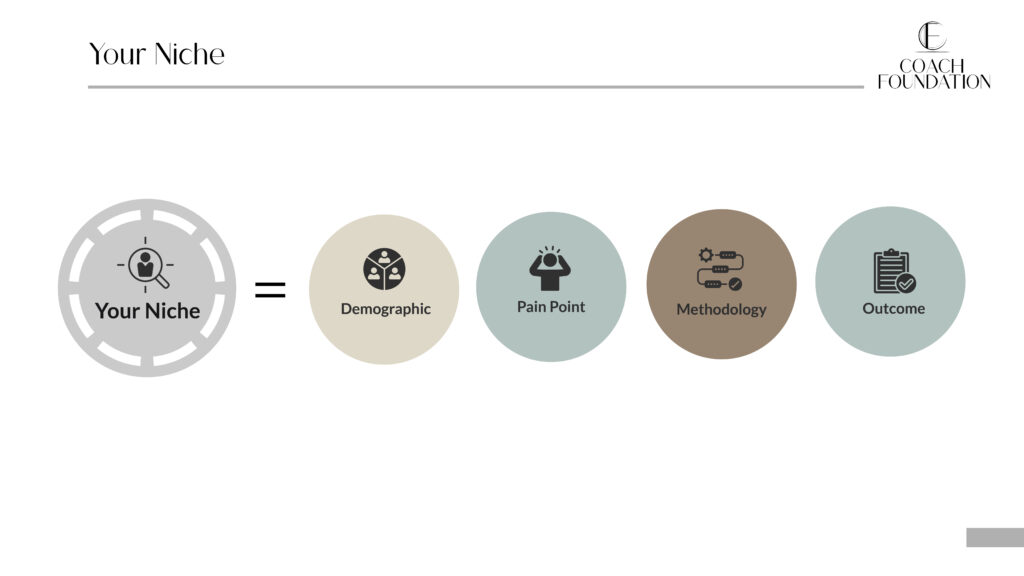
Your coaching niche can be broken down into four parts. These characteristics define your coaching practice. Ask yourself:
Identify Your Demographic
Stating your target audience clearly makes sure you attract exactly the people who will benefit most from their services.
To identify your demographic, start by asking yourself who you are most passionate about helping. This could be based on your personal experiences, professional background, or areas where you naturally excel.
In the above example, the target demographic is "single parents".
You can also target a specific age group, region, or cluster of people that appeal to you.
A demographic isn't just a group of people; it's a segment of individuals who share similar characteristics and challenges.
Fun Fact: According to the Global Coaching Study by ICF[1], in 2023, the majority of coaching clients were women and predominantly fell within the 35–44 age group. Followed closely by those in the 45–54 age range.
Also, a significant number of coaching clients were managers (31%) and executives (25%).
Addressing Pain Points
These are the specific issues or challenges people face that your coaching will address.
Circling back to the above niche, the pain point the dating coach is addressing is "confidently re-enter the dating scene".
It is the main hurdle or challenge that your coaching helps clients overcome.
Why does it matter?
This tells your potential clients exactly what they can expect to achieve with your help. It makes your service highly relevant to their specific needs.
Understanding these will also help you create coaching programs that provide practical solutions and are directly relevant to your clients.
Problem Solving
With a clear grasp of the pain points you will address, outline how your coaching will help solve these problems.
This involves setting a clear framework for your sessions that includes goal setting, progress tracking, and problem-solving methodologies tailored to your demographic.
For instance, in the above niche, the coach aims to help their client by "providing tailored coaching focused on balancing parenting responsibilities with personal relationships. Their unique methodology includes personalized sessions, self-esteem workshops, and supportive community groups, all designed to help single parents navigate dating with confidence and ease."
You can also choose to name your unique methodology—something that resonates with you and the problem you're solving.
The key is to develop and implement a coaching plan that not only addresses the pain points but also encourages sustainable change.
It paints a picture of the journey. Clients can visualize what working with you will look like and understand the tools that will be used to help them succeed.
Delivering Outcomes
Finally, it's crucial to define the outcomes you aim to deliver through your coaching. Clients come to coaches not just for discussions but for tangible changes and achievements.
Outline what success looks like for your clients and how your coaching helps them reach these milestones.
For reference, in the above niche, the final outcome is "fostering fulfilling romantic relationships that complement their busy lives as devoted parents."
This commitment to delivering specific outcomes boosts your credibility. It also increases the chances of client satisfaction and referrals.
So, there you have it—a niche statement is like a map. It shows who you help, what problem you solve, how you solve it, and what the treasure (outcome) is at the end of the journey.
Your niche can be further be refined once you have defined the core parts of it.
Step 2: Develop Your Skills: Training, Certifications and Soft Skills
Developing your skills as a life coach is crucial for providing effective guidance and building a reputable practice.
Here's a closer look at the training and soft skills you might consider to elevate your coaching career.
Training and Certification
In the journey to become a life coach, a certification is not a mandatory requirement, but training is!
I can assure you that you can have a successful coaching business without a certification.
I have had many clients who made it big without any certification to their name (including me!)
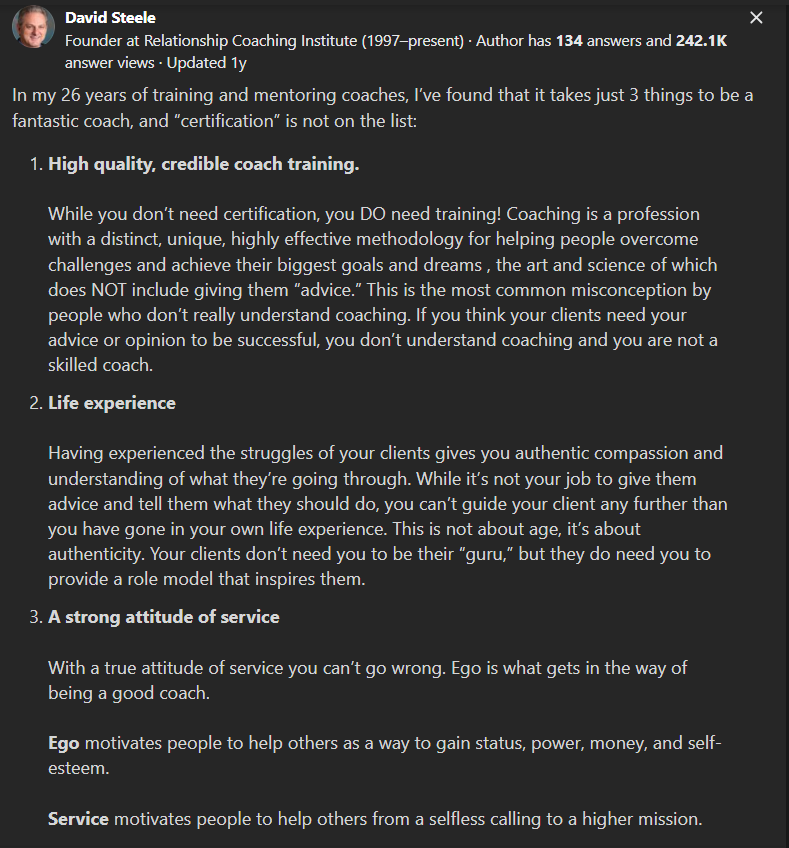
David Steele, founder of Relationship Coaching Institute, believes the secret to being the best coach out there is good training, first-hand experience with the pain point you're addressing, and a good attitude towards your coaching. And I couldn't agree with him more.
Despite the unpopular opinion on Quora, 80% of the coaches surveyed by ICF in 2022 agree that clients expect them to be certified, and 85% of coaches actually hold a certification in life coaching[1].
Having a certification would boost your credibility in the eyes of your potential clients. But you need proper training to put your services to use properly.
There are programs that often provide structured learning covering various aspects of coaching, including techniques, ethics, and business practices.
These programs can also offer you a framework for understanding the complexities of human behavior and the dynamics of change.
In addition to any formal training, to become a life coach, you must have several key soft skills:
These soft skills are often innate but can be enhanced through practice and reflection. They are fundamental to building strong relationships with clients and delivering effective coaching.
Step 3: Develop Your Coaching Methodology
When you're on your way to becoming a life coach, it's important to not just learn from others but also to create your own unique way of coaching.
It is all about creating your own way of coaching that works well for both you and the people you coach. This means finding a style that feels right and helps you make a real difference in your clients' lives
Here's how you can do that:
Make Use of Effective Tools and Techniques
Coaching comes in many forms, each with its own set of tools and techniques. Start by familiarizing yourself with these various styles.
Do not limit yourself to choosing just one; feel free to combine elements from different methods to best align with your coaching preferences.
Explore what resonates with you and integrates seamlessly with your natural coaching style. This personalized approach will help you feel more authentic and effective as a coach.
Experiment with these tools to discover what works best for you and your clients, enhancing your ability to facilitate meaningful change.
Develop Your Coaching Framework
This part is about setting up the structure of your coaching sessions. You need to decide:
It's also good to think about creating something special that sets you apart, like a set of questions that really get to the heart of what your clients want from life or an exercise that helps them see their choices more clearly.
A strong framework makes your coaching better because it gives you and your clients a clear path to follow.
As you use your coaching framework in practice, you'll recognize ways to improve upon it. This recognition might come in the form of client feedback as well as self-realization.
Keep developing your coaching methodology based on it.
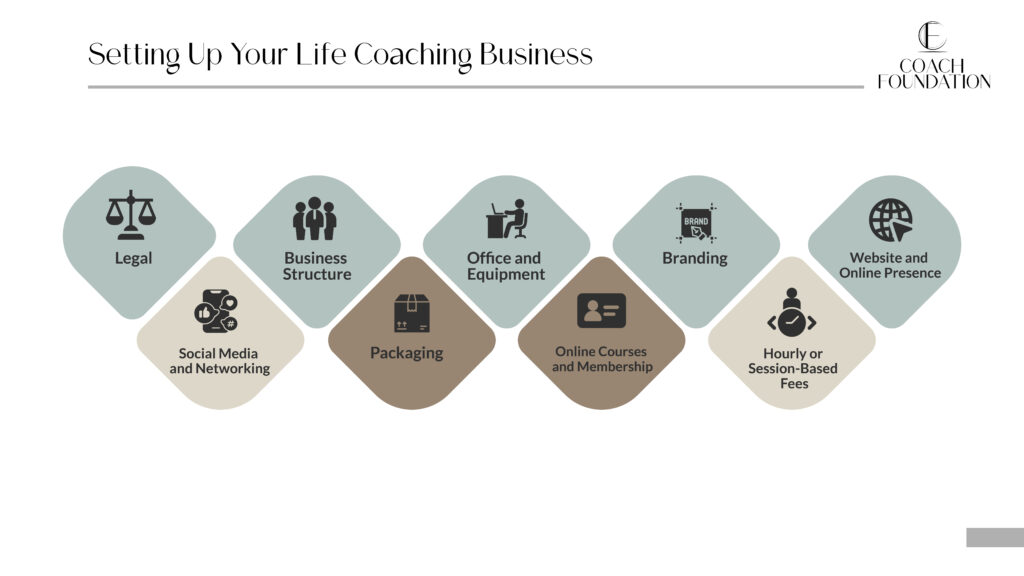
Step 4: Setting Up Your Life Coaching Business
Everyone who aspires to become a life coach has to have a coaching business set up.
Starting a life coaching business involves more than just understanding how to coach others—it requires a solid business strategy and the know-how to sustain and grow your practice.
Here are the essential steps to setting up your life coaching business effectively.
Business Fundamentals
First things first, you'll need to lay the basic foundation of your business. This includes:
Grand View Research[2] shows that in 2022, more than half of the market's revenue (53.2%) came from virtual coaching, which grew a lot because it's easy to access and many coaches moved online during the COVID-19 pandemic.
Despite this, some people still prefer meeting their coach in person because it feels more personal and trustworthy, especially among older clients. But the demand for in-person coaching has dropped since the pandemic started.
Marketing Strategies
This includes getting the word out about your coaching services:
Revenue Models
When I started as a life coach I thought the only way to charge clients was by the hour. I later discovered there are so many better ways to make your revenue model effect. Take a look -
Building a business in a field you’re passionate about might seem easy, but it comes with its fair share of obstacles.
It might seem big and a bit scary, but you’ve got support. We’re here to help you make a business that changes lives and makes you money.
Let’s take it step by step and make sure you have everything you need to start strong.
Step 5: Refine your business and Skills
Refining and enhancing your life coaching business isn't just a one-time effort—it's an ongoing process.
It ensures your services remain top-notch and responsive to the evolving needs of your clients.
Here’s how to keep improving your setup and skills over time.
Continuous Education for Becoming a Life Coach
I cannot stress enough the importance of continuous learning. You need to ensure that you provide the best support to your clients.
For that, you need to stay updated with the latest trends in your niche, continually improve on your skills, and broaden your knowledge.
This will lead to better client outcomes and professional credibility.
Receiving Feedback
Receiving feedback is important because it helps you understand how well you're doing and what you could improve on.
It offers you a chance to see things from someone else's perspective, which can reveal blind spots and areas for growth.
Conclusion
Becoming a life coach is about understanding people, caring for their feelings, talking well, and meeting their needs.
Mastering the five steps—defining your niche, developing your skillset, identifying your coaching style, setting up your life coaching business, and refining your skills and business further—is your key to successfully becoming a life coach.
If this article resonated with you, consider this your invitation to begin a meaningful coaching career.
In case you have questions, doubts, or just want to share your thoughts, put them in the comments below!
I can't wait to see you live your dream and become a life coach!
Resources
Becoming a life coach can be confusing without the right kind of learning. It’s crucial to have the right resources at your fingertips. We've put together a curated list to support your journey to become a life coach.
This list includes certifications, books, and guides.
The time it takes to become a life coach can vary significantly depending on several factors, including the type of coaching you want to do, the depth of training you pursue, and your personal schedule for completing the coursework. Generally, it can take anywhere from a few months to a year or more to become a life coach.
How Much Does A Life Coach Make?
Globally, life coaches earned an average of $52,800 in 2022, while those in the United States had an average income of about $67,800. In North America, the average annual income is reported to be around $62,500
What Are The Education Requirements Or Qualifications Needed To Become A Life Coach?
Although there are no federal or state-mandated educational or licensing requirements to become a life coach, there is industry-wide agreement on education and training. Completing a coach training programis strongly advised to be a successful coach and to showcase your competence to potential clients and employers.
Who Can Become A Life Coach?
Being a life coach requires you to be affable, personable, helpful, and kind. You should have patience, be eager and be sympathetic. These characteristics play a key role in helping coaches make new business contacts and attract new clients. In light of this, someone who possesses these traits can work as a life coach.