
DiSC Profiling: The Definitive Guide
Last updated: March 2026
DiSC PROFILING
The Definitive Guide
Personality assessments have long been a part of coaching because it helps coaches understand their clients on a deeper level. There are many personality tests that have been in use for decades, and among them is DiSC profiling.
But what is DiSC profiling and how can you use it to enrich your clients’ lives?
My definitive guide to DiSC profiling compiles everything you need to know in one place; you will never have to scour the internet for information about DiSC profiling again!
So if you are looking to:
- Learn about DiSC profiling and how it works
- Adapt a new way of understanding your clients via DiSC profiling
- Use it effectively to help your clients improve their lives
Then you will thoroughly enjoy this detailed guide.
Let’s begin!
Contents


Chapter 2
A Deep Dive into the Personality Types
Chapter 3
How does DiSC profiling work?

Chapter 4
Understanding the Results

Chapter 5
How can coaches use DiSC profiling?

Chapter 6
Criticisms of the DiSC Model

Chapter 7
Resources
Chapter 1:
The Fundamentals
In this chapter, I will help you develop a basic understanding of the wonderful world of DiSC profiling by covering the elementary aspects of DiSC profiling.
This includes exploring what the acronym stands for, what the personality assessment tool helps with, the origins and history behind DiSC Profiling, and why it is still used today.

What is DiSC profiling?
DiSC is a personality assessment tool that is used to improve personal and professional skills such as teamwork, communication, and productivity. Hundreds of organizations, including government entities and Fortune 500 companies, use DiSC profiling to build stronger and more effective working relationships.
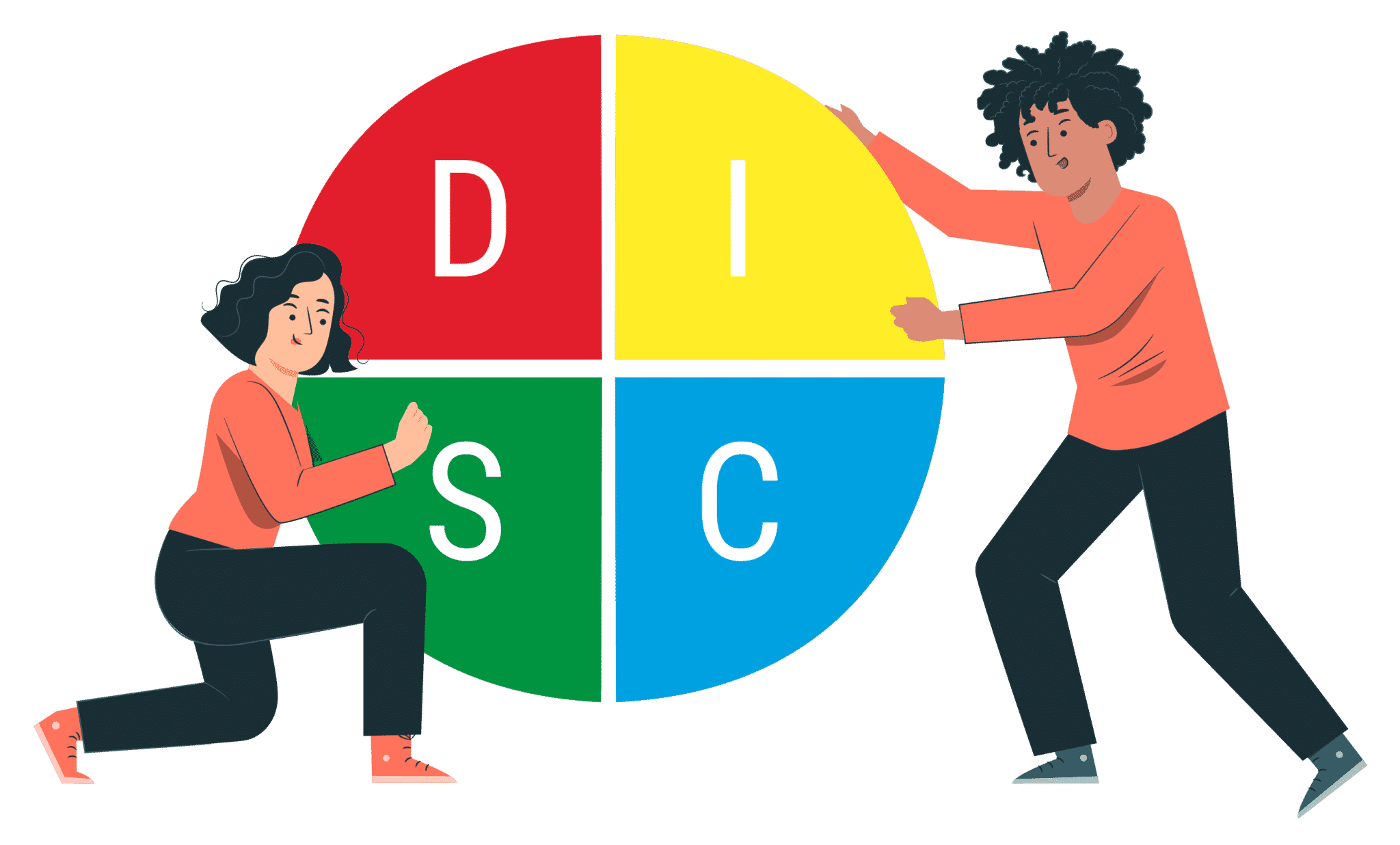
DiSC is actually an acronym of the four overarching personality types it measures: Dominance, influence, Steadiness and Conscientiousness.
I’ll be doing a deep dive into each of these and their variants in Chapter 2. But first let’s take a look at the origins and history of the personality assessment tool.
Origins & History of DiSC Profiling
The DiSC assessment has a long and detailed history based on research and real-world applications. This means that before there was a DiSC assessment, there was a DiSC Model of Behavior.
Proposed in 1928 by psychologist William Moulton Marston, the model argues that the four behavioral types — Dominance, influence, Steadiness and Conscientiousness — came from people's sense of self, and their interaction with the environment.
However, while Marston developed the model, he did not actually develop the DiSC profiling tool as we know it today.
The first DiSC-based assessment was developed in the 1950’s by psychologist Walter Clarke.
He and other researchers developed something called the “Self Description” test. This was used by psychologist John Geier in the 1970s to create what is known as the Personal Profile System.
With time, Geier’s version of the DiSC test morphed into the DiSC Classic profiling tool, which is now owned by John Wiley and Sons.
Today, while coaches like you can still use the DiSC Classic profiling tool, you can also use the Everything DiSC suite of assessments that continue to refine and build on Marston’s work.
I’ll circle back to the Everything DiSC program a little bit later in this article and explain further. But first — what does DiSC profiling actually offer coaches, as a tool?
Why use DiSC profiling?
Like most behavior or personality assessment tools out there today, DiSC measures how people process information internally.
But what makes DiSC profiling unique is that it also measures how people interact with the environment around them. This is what makes it the perfect tool for coaches like you to use.
For starters, it can help your client understand themselves better, which in turn helps you understand them a lot better too. This understanding can be helpful in developing unique and personalized coaching techniques for each of your clients, based on what DiSC personality traits they exhibit.
I’ll be expanding on how coaches can use DiSC profiling to its maximum potential in Chapter 5.
Let’s move on to exploring the different personality types for now.
Chapter 2:
A Deep Dive into the Personality Types
As mentioned above, DiSC profiling is a measure of four key personality traits: Dominance (D), influence (i), Steadiness (S), and Conscientiousness (C).
In this chapter, I will break down each of the four personality types, identify key traits in each one, and talk about the variants of each.

What are the variants of the four personality types?
As I mentioned above, DiSC profiling aims to categorize people into four main personality types. Each one has two variant personality types as well.
Let me explain how this works.
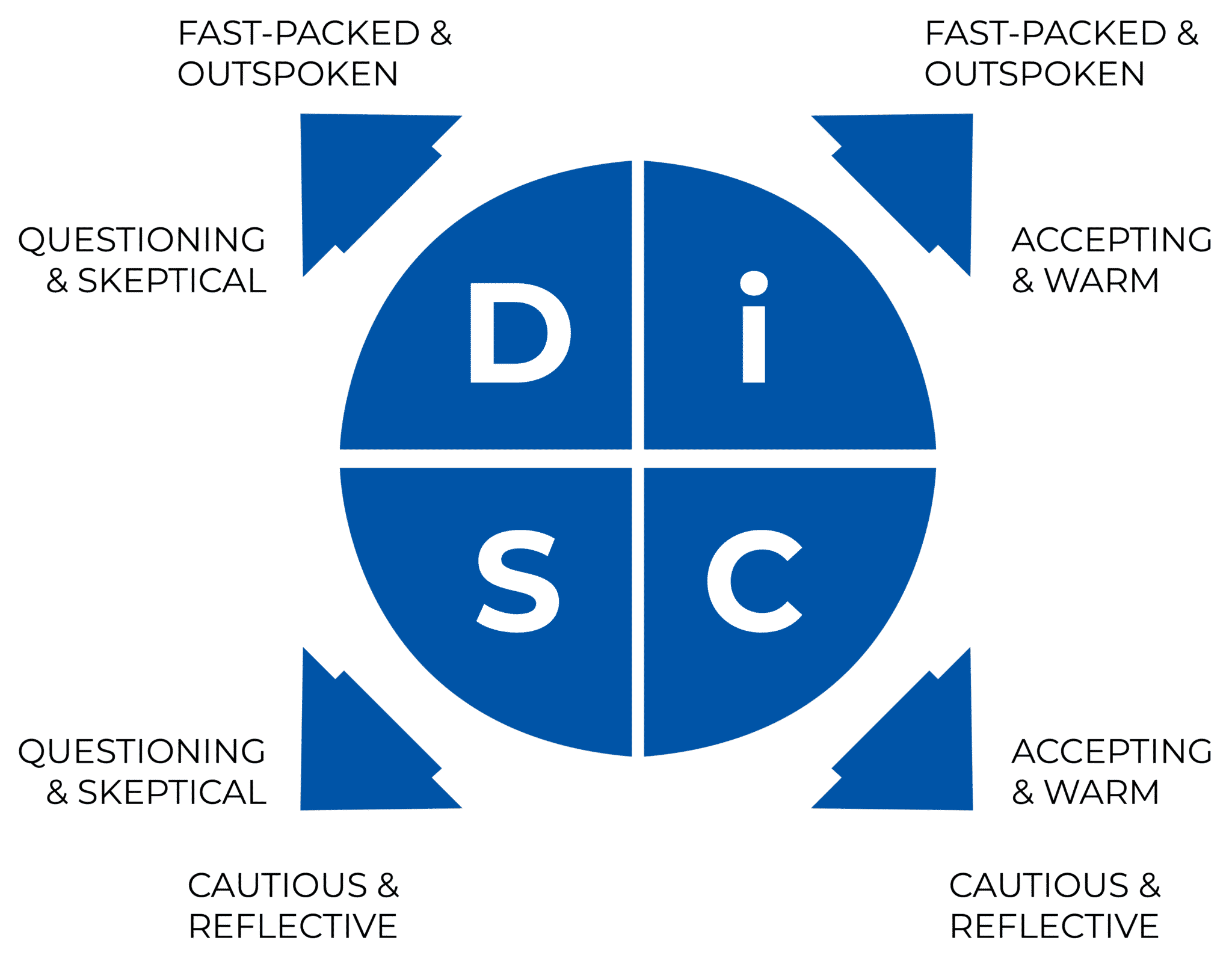
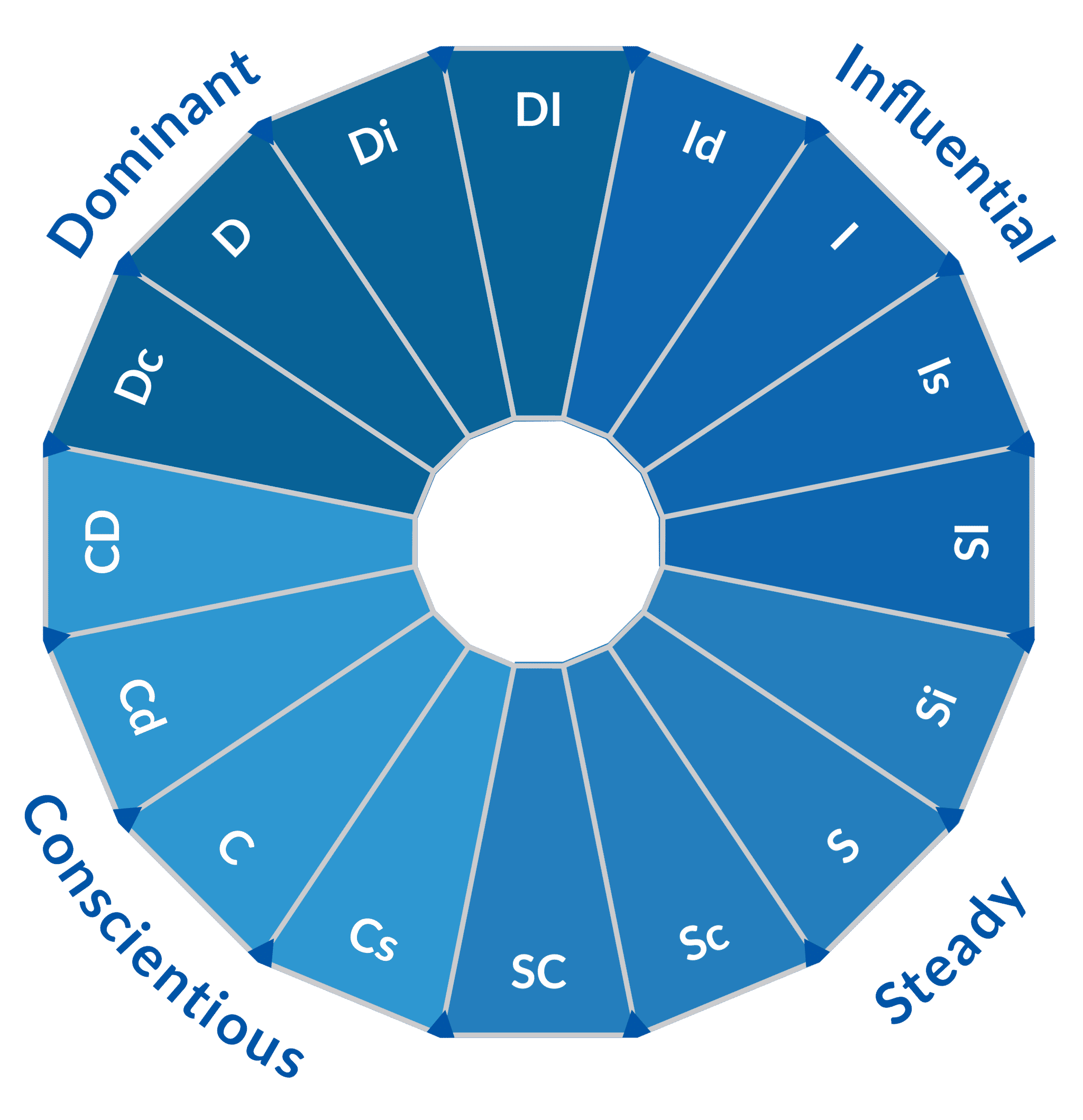
If you look at the above circular diagram, you will see that each personality type makes up one of four quadrants - D, i, S, and C. Each quadrant is further surrounded by two others, for example D is surrounded by i and C.
This is important because while every person is a mixture of all four personality types, people usually showcase key traits of two of them.
Upon taking the DiSC assessment, many people can fall in between two quadrants, meaning that they can exhibit traits of both personality types.
So going by this example, if one of your clients falls on the cusp of D and either i or C, they can have the Di, or DC variant personality.
Let us now look at each of the four personality types and their variations.
D = Dominance
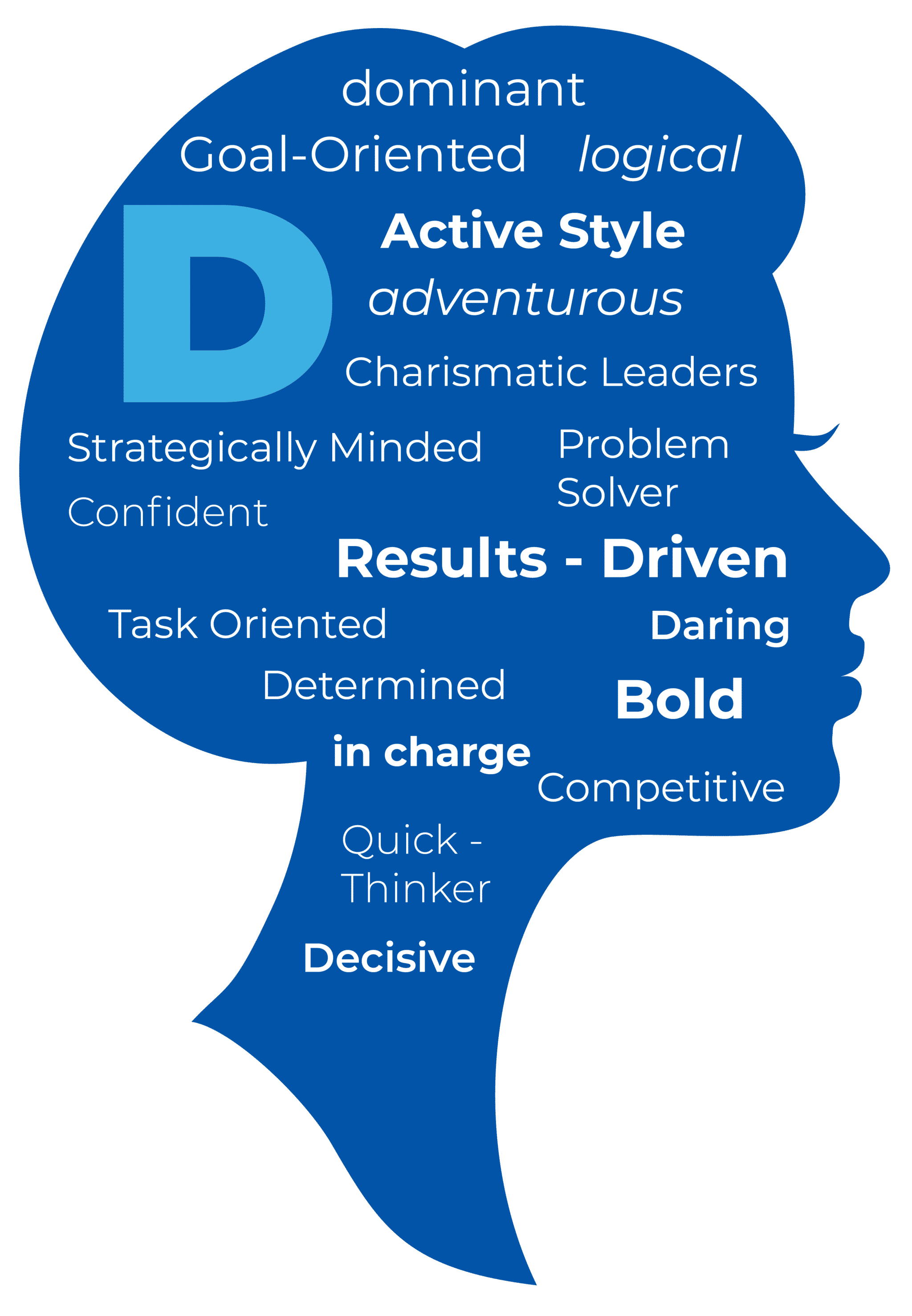
Often described as “The Winner,” people with D-style personalities are motivated by winning, competition, and success. This means that people with this personality type are usually strong-willed, confident, and result-oriented.
They can make for creative and outspoken leaders who value autonomy, but can also be skeptical and questioning of others. Their goals usually look like attaining independence, gaining control, and overcoming obstacles to find results.
However, people with this personality type can sometimes be impatient, insensitive, and commanding, which can often make them unlikable to others. They could do with being more collaborative and patient with others.
What are the most notable good and bad qualities of people with D-style personalities?
Key traits: Assertiveness, confidence, decisiveness, honesty.
Areas of improvement: Patience, sensitivity, acceptance, competitiveness.
Variations
Since D is surrounded by i and C on the chart, its variant personality types are Di and DC. Let’s take a closer look at them.
The Di style
The Di variant personality combines the overarching traits of Dominance and influence.
This means that people in this category are a dynamic mix of result-oriented and persuasive personality traits. Influencing others with their charm and hard work, Di personalities seek new opportunities to stretch boundaries and receive results.
While they are also inquisitive and persuasive, Di-style personalities can be impatient and inconsiderate of others’ feelings. They often struggle with humility too, and could do with being more inclusive and collaborative.
The DC style
The DC style combines the key traits of Dominance and Conscientiousness, so people under this umbrella are usually diligent, creative, analytical, and ready to overcome any challenge. Their eye for detail and thirst for perfection also makes them the kind of people who take initiative and carry every project across the finish line.
People who fall into the DC variant can often be resolute to the point of stubbornness, and can also be very blunt and critical sometimes.
While they influence others through their high standards and determination, they could do with a more empathy-driven approach.
i = Influence
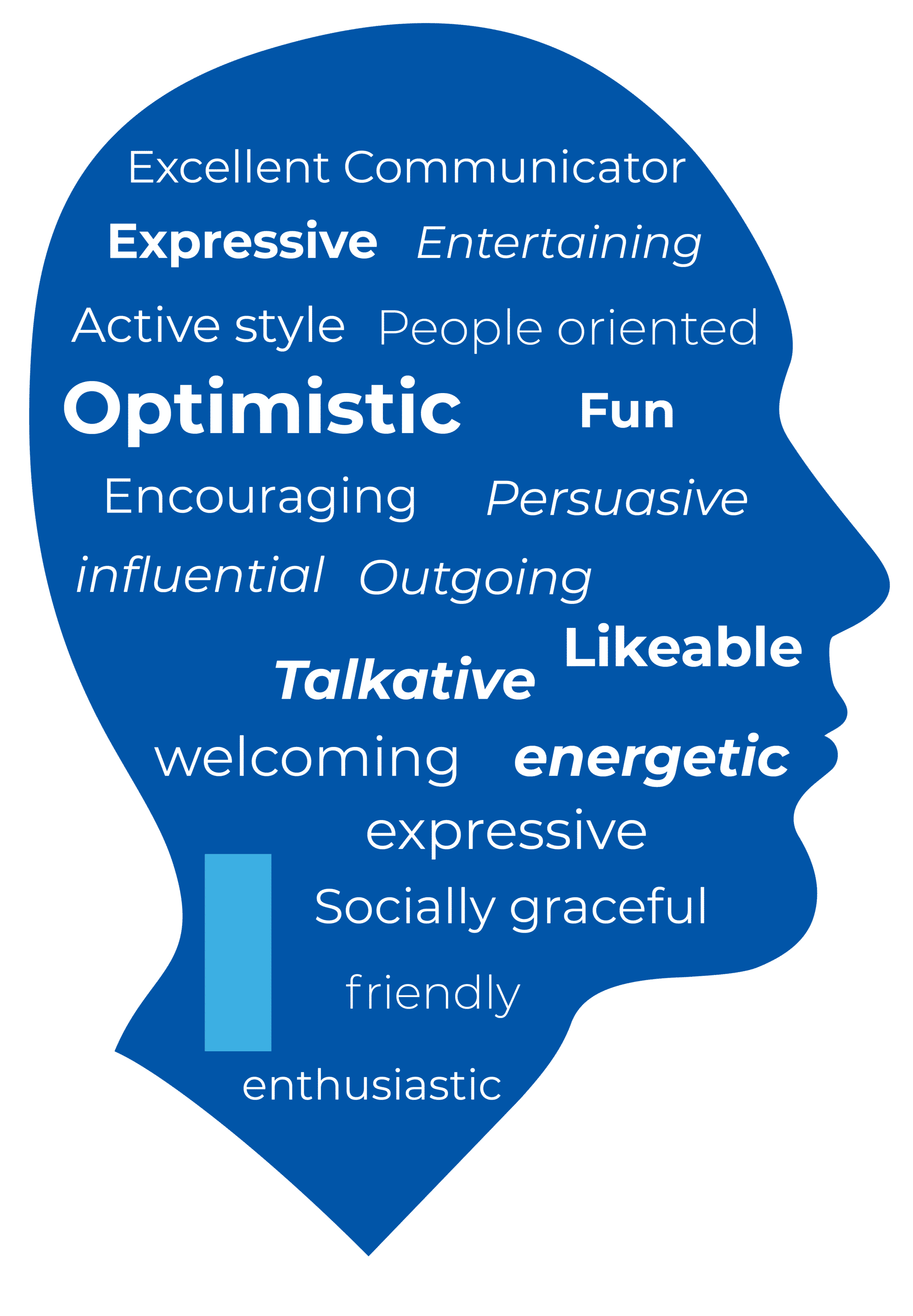
Described as “The Enthusiast,” people in this quadrant are driven by social interactions, such as group activities and relationships. This means that people with this personality type tend to be people-centric, collaborative, and enthusiastic in nature.
In leadership positions, people with i-style personalities are outgoing and impulsive with socially-oriented goals like forming new friendships, seeking approval of and generating excitement in others, and even coaching other people.
However, they can often get lost in the chaos and lose their objectivity. Fuelled by a fear of disapproval and loss of influence, their style of communication can also be indirect and insincere.
Common challenges that i-style personalities face include getting organized, staying focused, and resisting impulses. They could expend more energy trying to speak more candidly.
Why is the ‘i’ in DiSC in lowercase?
The lower-case ‘i’ in the word DiSC is part of the original ‘Everything DiSC and DiSC Classic’ family of products produced by Wiley, a trademark held by Wiley and Sons.
When setting up DiSC profiling for your clients, make sure to identify the lowercase ‘i’ so you know that you are using the official assessment tool that is researched, validated, and published by Wiley.
What are the most notable good and bad qualities of people with i-style personalities?
Key traits: Enthusiasm, encouragement, innovation, optimism, persuasiveness.
Areas of improvement: Impulsiveness, vagueness, focus, follow-through.
Variations
Since ‘i’ is surrounded by D and S on the chart, its variant personality types are iD and iS.
Let us take a closer look at them.
The iD style
The iD style combines the overarching traits of influence and Dominance.
So people with this personality type tend to be high-energy, charismatic, and adventurous in nature. Their bold and curious nature means that they are always seeking new opportunities to stretch boundaries while inspiring action in others.
As leaders, iD-style personalities can be motivational and determined but they can sometimes be perceived as pushy and intimidating. They could improve these qualities by practicing patience, consideration, and attention to detail.
The iS style
The iS style combines the overarching traits of influence and Steadiness.
Unlike the previous variant, which is more bold and self-promoting, people with iS personalities are a lot more sociable, friendly, and warm. They lead with empathy and agreeableness, sometimes out of their fear of pressure and of being disliked by others.
Their empathetic and collaborative nature makes them supportive and respectful leaders, but they can also be indirect and conflict-averse. In the same vein, they can also be too patient with others and might struggle to stick to deadlines.
People with iS-style personalities could do with being more upfront, confrontational, and questioning of others.
S = Steadiness
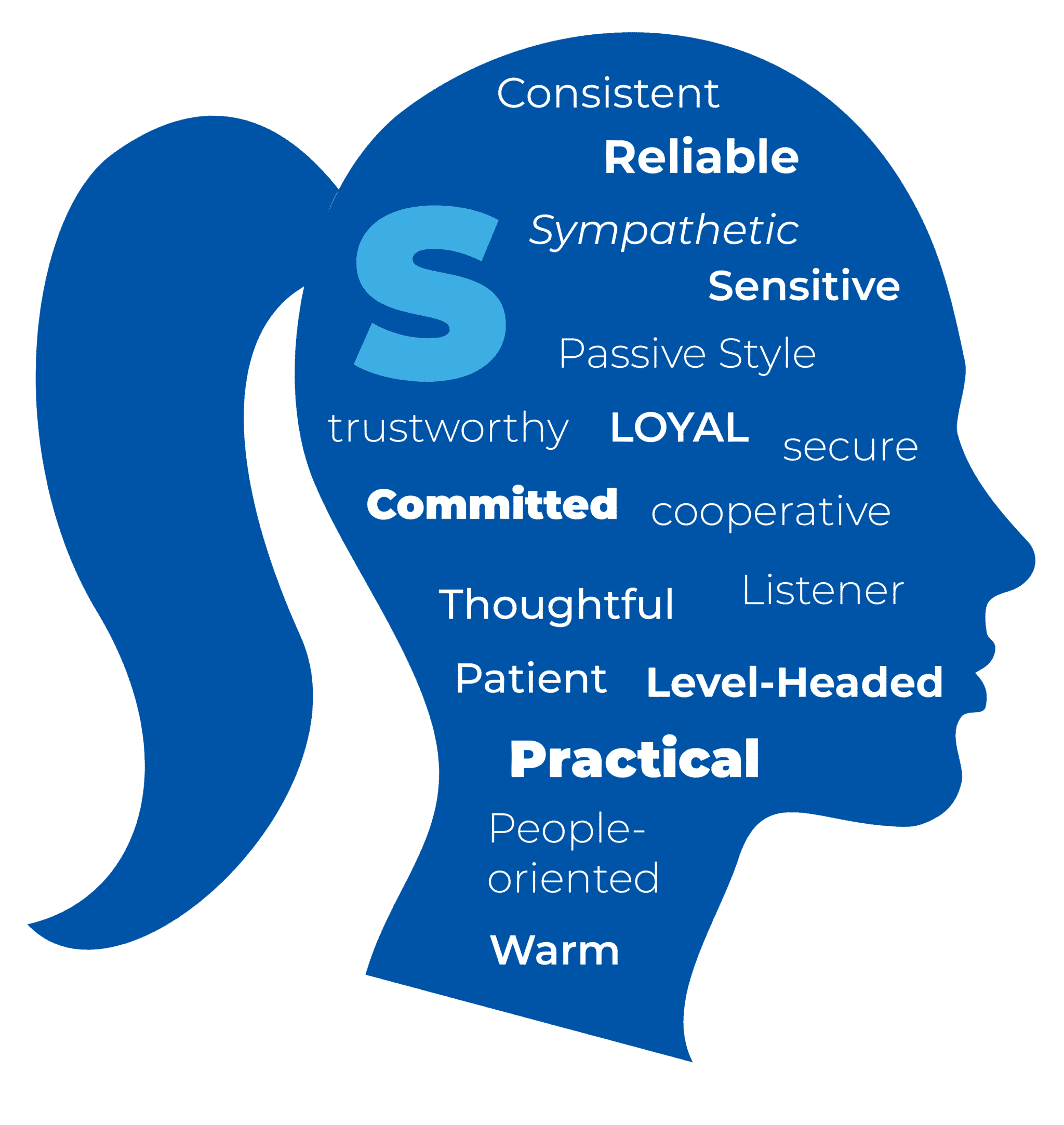
People who fall into the S personality type are often labeled “Peacekeepers” due to their stable, supportive, and easy-going nature.
Driven by cooperation, altruism, and appreciation, S-style personalities value helping others and are always seeking a sense of loyalty and security.
As for leadership roles, they tend to be inclusive and democratic, with priorities like supporting others and maintaining stability. They use their inner calmness and patience to ensure cooperation and achieve goals as a team.
Unfortunately, this innate patience can sometimes be a disadvantage. People with S personality types tend to be too trusting and accommodating of others. They often suppress their own needs to fulfill those of others, a trait that people can take advantage of.
People facing this issue could do with being more upfront and displaying more self-confidence.
What are the most notable good and bad qualities of people with S-style personalities?
Key traits: Humbleness, consistency, cooperation, inclusivity, agreeability.
Areas of improvement: Confrontation, indecision, self-confidence, passiveness, multitasking.
Variations
Since S is surrounded by i and C on the diagram above, its variant personality types are Si and SC.
Let us take a closer look at them.
The Si style
The Si style combines the overarching traits of Steadiness and influence.
This means that people with Si personalities are usually very agreeable, collaborative, and influential. Usually well-liked by others, Si personalities thrive in social situations and often have goals that are based around social interactions, such as acceptance and forming close relationships.
As leaders, they tend to be easy going and encouraging of people around them.
In fact, much like the iS personality type — another variant personality combining Steadiness and influence — Si personalities too can be conflict-averse and overly patient with others. Because of their team-spirited and collaborative nature, Si-type people can also struggle with asserting boundaries and confronting problems.
The SC style
The SC style combines the overarching traits of Steadiness and Conscientiousness. Therefore, people who fall into this personality type are accommodating and reliable, with goals like creating a calm environment and making steady progress.
They also tend to be humble, consistent, and patient people, which make them soft-spoken but fair-minded leaders. Their innate steadiness means that they usually deliver what is asked of them.
Often fearful of uncertainty and chaos, SC personalities work hard to maintain diplomacy. But this diplomatic tendency also means that they retreat from conflict and let others lead and deal with the confrontation. Their keenness to maintain the status quo can sometimes make them behave in an overly cautious, inflexible, and predictable manner.
C = Conscientiousness
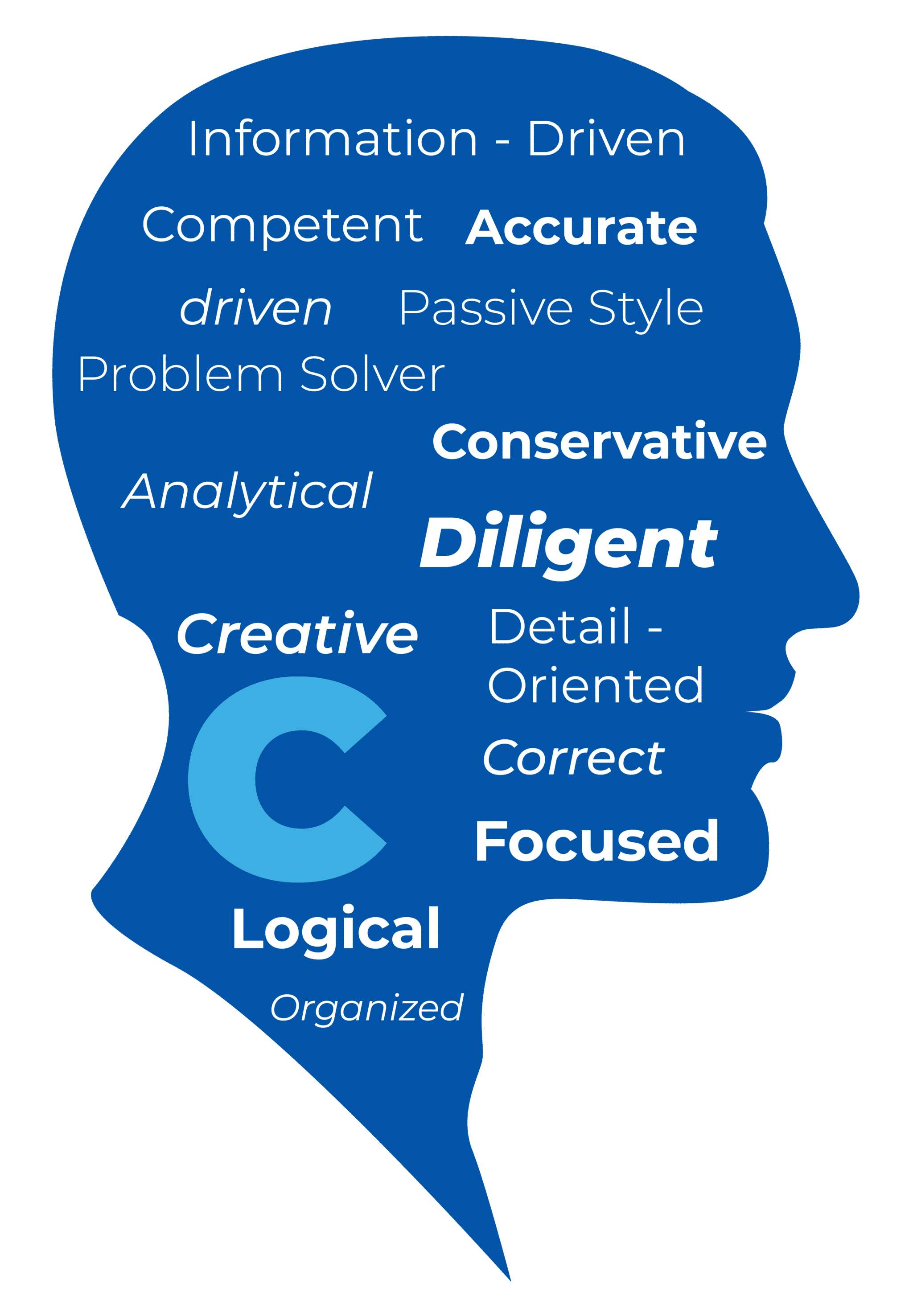
Often given the label of “The Analyst,” people in this DiSC quadrant are motivated by challenging assumptions, gaining more knowledge, and showcasing their knowledge to others.
Innately analytical and tactful, C-style personalities value accuracy and quality over everything else. This quality, along with their conscientious and disciplined nature, makes them a good fit for leadership roles.
C-style personalities can also make for perfectionistic and risk-averse leaders, who rely on data to ensure accuracy, clarity, and objectivity.
However, this overly logical quality can play out in other ways too. As they tend to be over analytical and uncompromising, they are unable to make on-the-spot decisions.
People of this personality type can sometimes struggle to let go and just have fun, and could do with embracing the human element more.
What are the most notable good and bad qualities of people with C-style personalities?
Key traits: Tactfulness, attention to detail, discipline, cautiousness, knowledge.
Areas of improvement: Over analysis, delegation, emotionality, perfectionism, collaboration.
Variations
Since C is surrounded by D and S on the diagram above, its variant personality types are CD and CS.
Let us take a closer look at them.
The CD style
The CD style combines the overarching traits of Steadiness and Dominance. Therefore, people with this personality type can be disciplined, determined, and dependable. They hold themselves to strict high standards and influence others with their resolute approach as well.
The questioning and skeptical nature of CD-style people makes for independent and bold leaders, but this means that they can also be extremely cynical and critical of others. Their fear of losing control means that they can also be perceived as stubborn, passive aggressive, negative, and blunt.
People with this personality type often struggle with being cooperative and should pay attention to the needs of others.
The CS style
The CS style combines the overarching traits of Conscientiousness and Steadiness. This means that people who fall into this personality type tend to be cautious, precise, and practical. They value stability and reliability, and are often reflective, orderly, analytical, detail-oriented, and self-controlled individuals.
While their even temper makes them fair-minded and modest leaders, this trait can also make them appear unemotional and disconnected sometimes. Driven by their fear of ambiguity and emotional situations, CS style personalities also tend to play things safe and overuse traditional methods.
The challenges that CS personalities typically face include being flexible, showing decisiveness, and shaking up the status quo. They could circumvent these issues by adopting a more emotion-driven and laid-back approach.
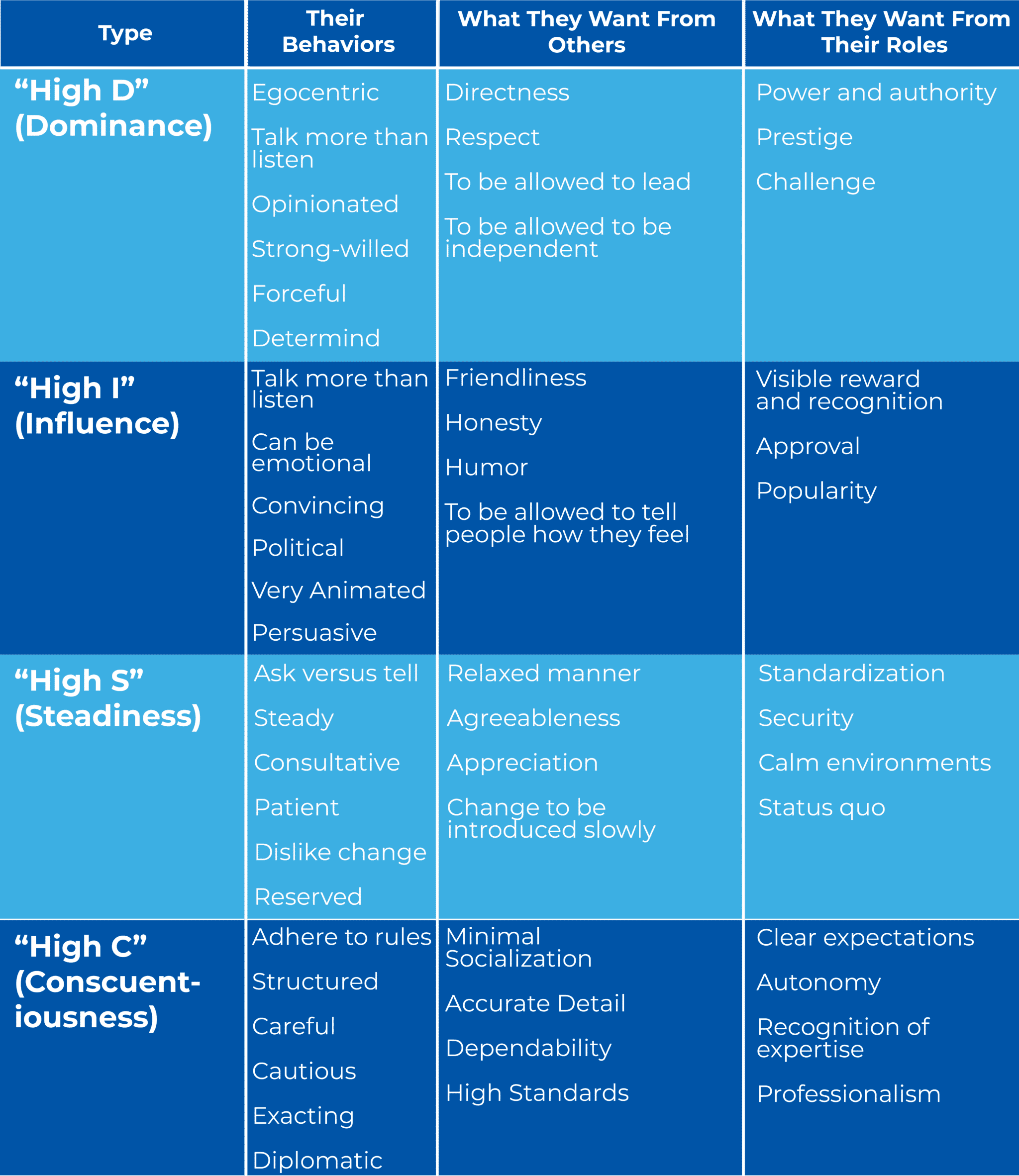
Here is a table that summarizes the traits of each DiSC personality type:
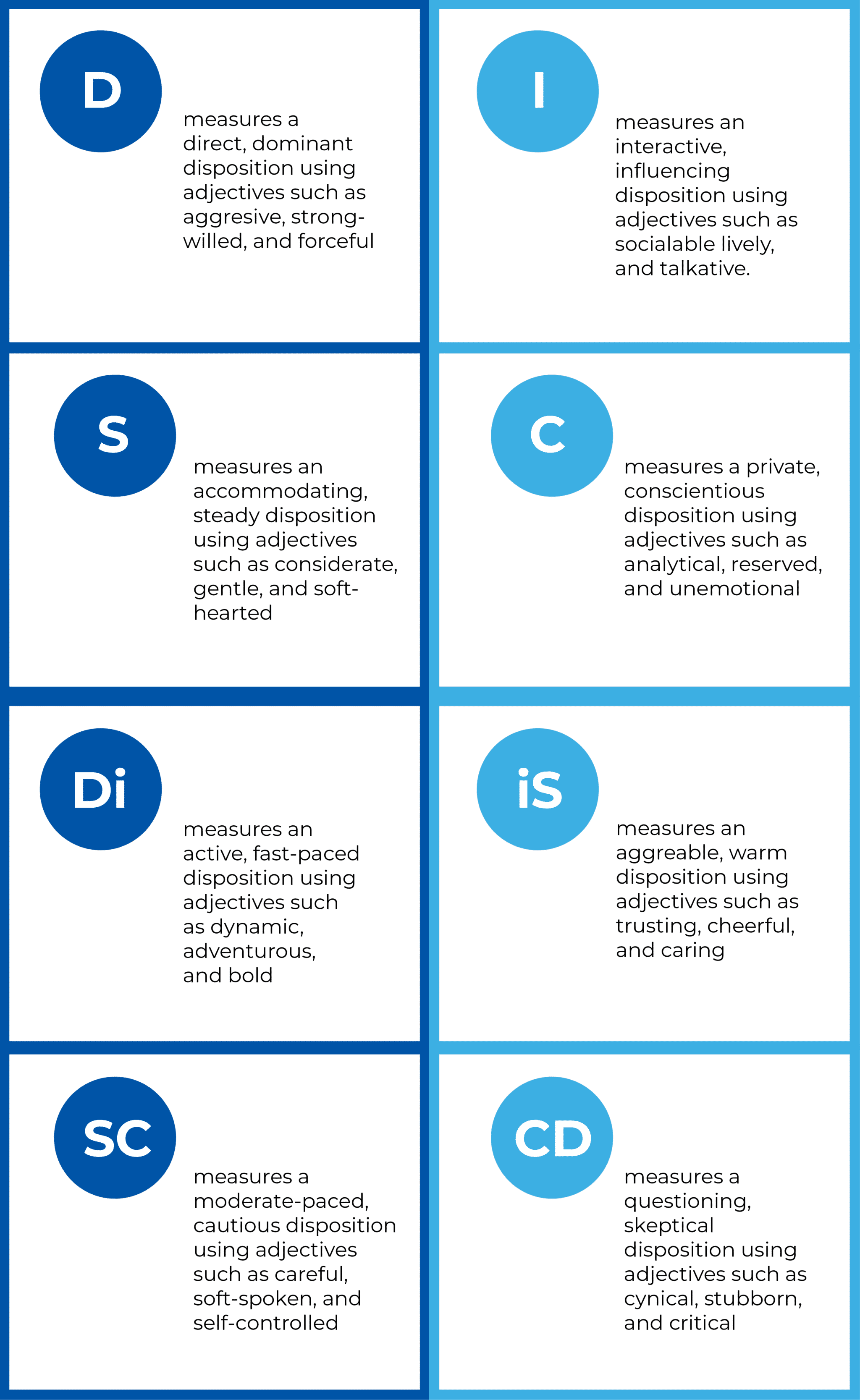
Meanwhile, this chart summarizes each of the four personality types as well as the variants of each one:
Now that you have a better understanding of what the different DiSC personality types are, you will better understand how the assessment works
Chapter 3:
How does DiSC profiling work?
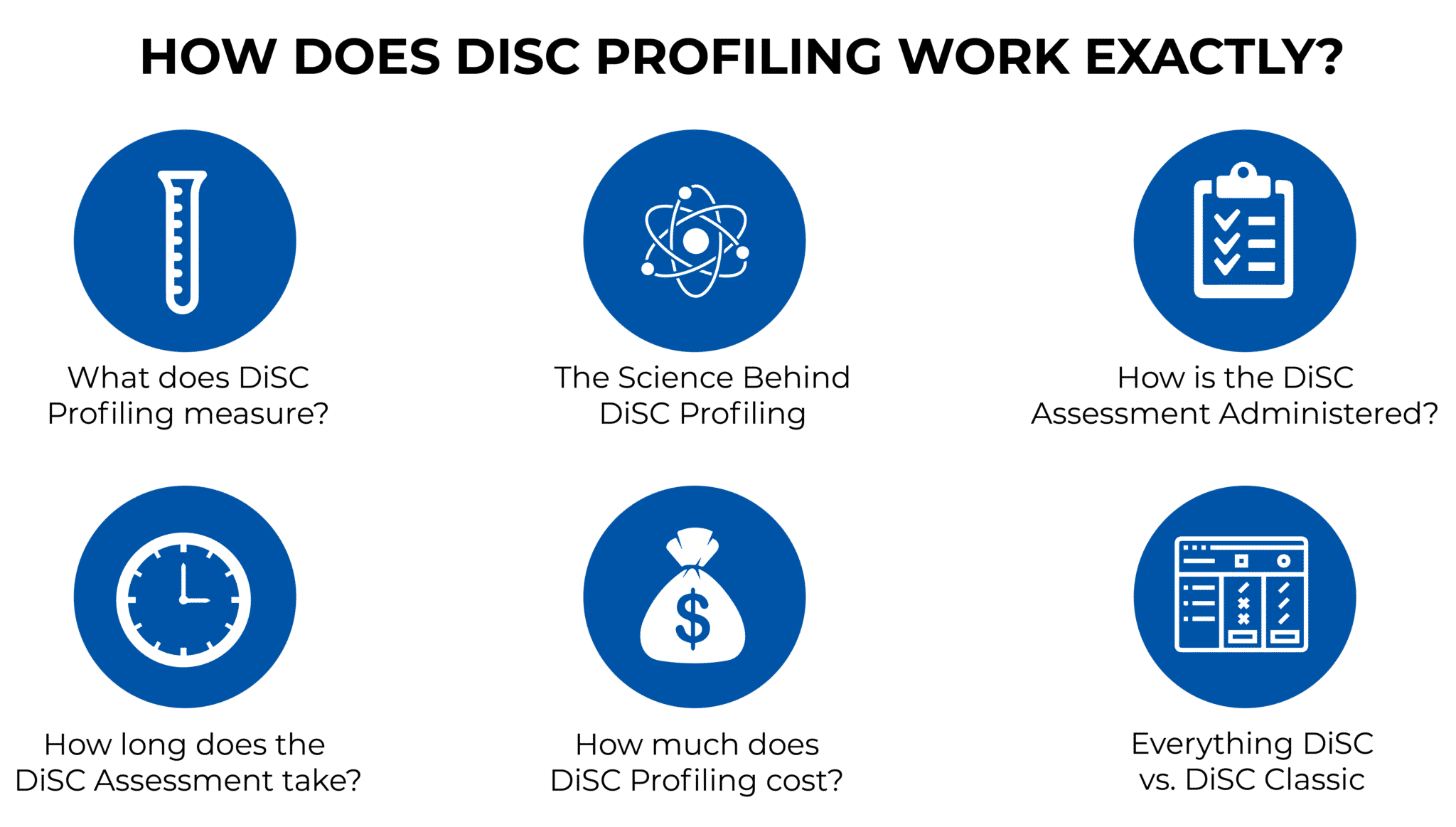
So far, we have talked about what DiSC is and how it came to be. Now that you’re clued in on the fundamentals, it’s time to explore how the assessment actually works.
In this chapter, I will break down the science of DiSC profiling and give you a step-by-step breakdown of the assessment itself. I will also provide you with other essential information, such as the cost and duration.
What does DiSC profiling measure, exactly?
DiSC profiling measures dimensions of one’s personality, and how they interact with their environment. It focuses on understanding how a person overcomes challenges, interacts with others, and responds to rules. It can help you understand your tendencies better, without any judgment on your ability or intelligence.
DiSC profiling is not diagnostic in nature.
Unlike other psychological tests, DiSC does not measure intelligence, mental health, or aptitude
The Science Behind DiSC Profiling
You already know from Chapter 1 that the original DiSC Model was created by psychologist William Marston in his 1928 book, Emotions of Normal People.
This model has since formed the basis of multiple assessment tools, including the DiSC Classic and the Everything DiSC suite of assessments by Wiley. I will go into more differences between Everything DiSC and DiSC classic later in this chapter as well, but let us cover some key scientific differences between them for now
While DiSC Classic only measures Marston’s four original personality traits — Dominance, influence, Steadiness, and Conscientiousness — Everything DiSC has built on this model and also includes the variant personalities that I talked about in Chapter 2. So in total, Everything DiSC measures eight scales as compared to DiSC Classic’s four.
Another factor that makes Everything DiSC different from DiSC Classic, is that it uses an intuitive circumplex (or circle-shaped graph) for results. This means that every person who takes a DiSC assessment will have a black dot plotted for them on a graph like the one below:
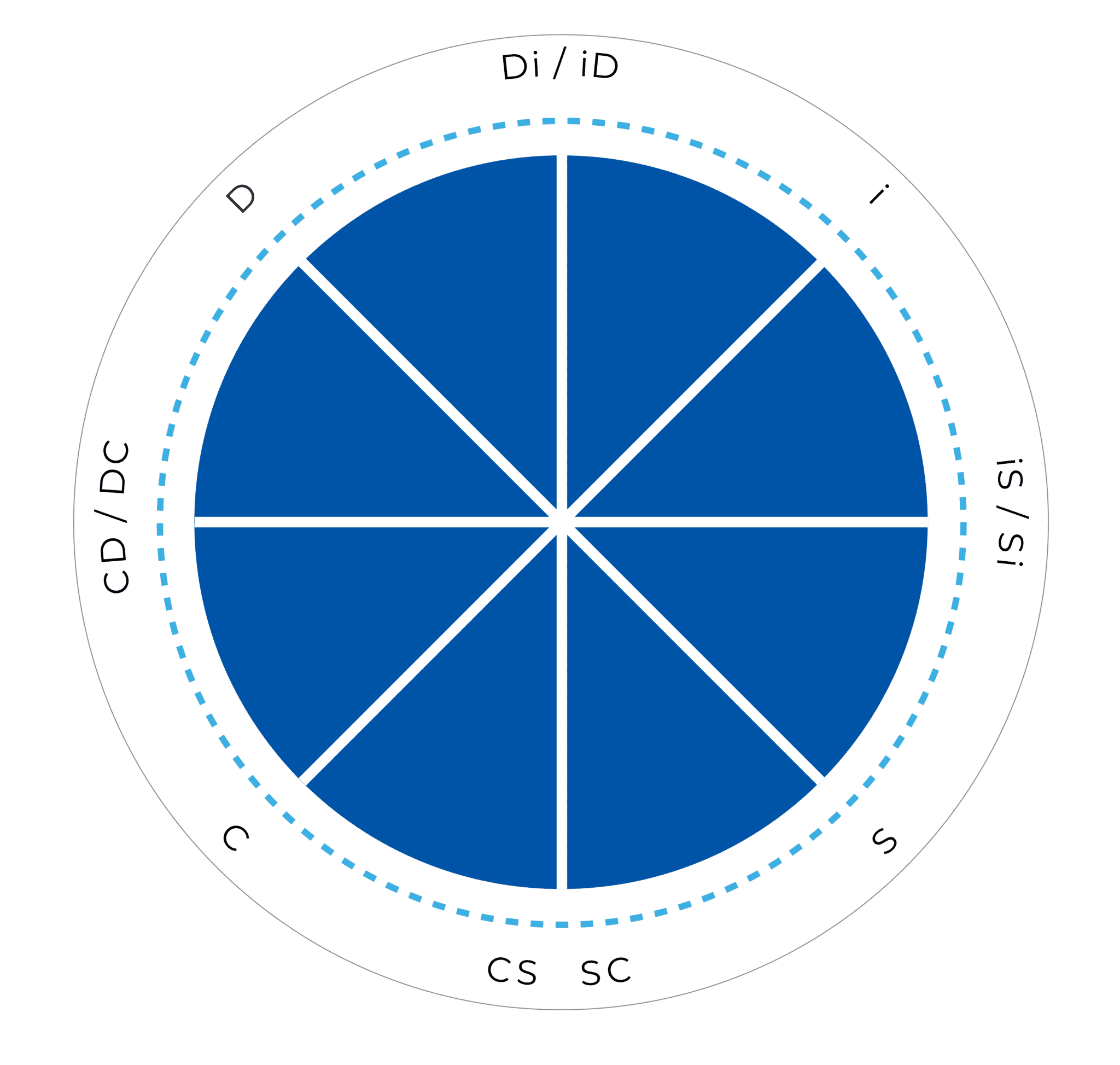
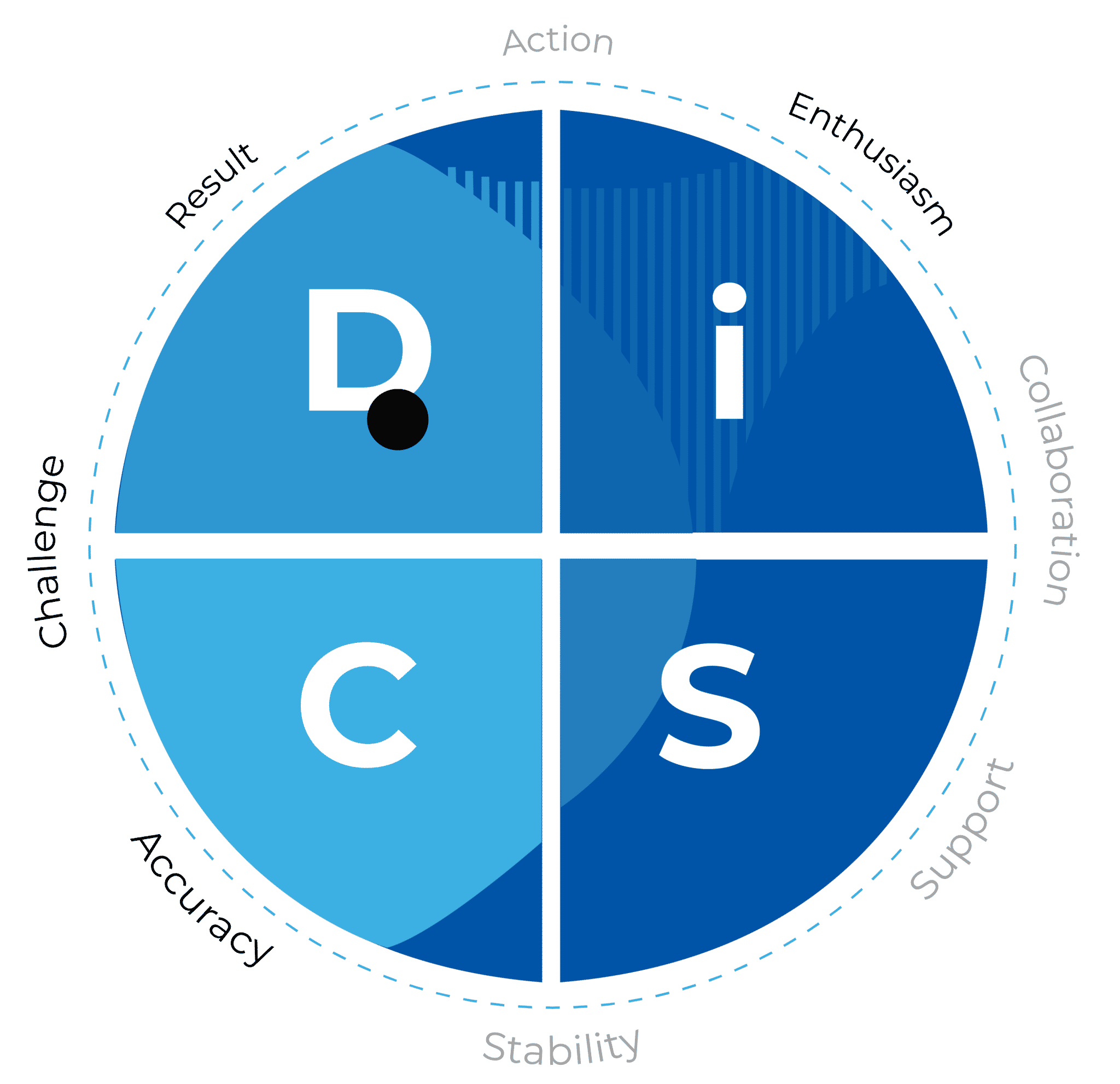
In addition to measuring a person’s personality type on the eight scales mentioned above, the Everything DiSC profiling tool also measures their priorities. On the list of priorities is enthusiasm, support, results, accuracy, stability, collaboration, challenge, and action.
This priority assessment is an additional measure that is unique to Everything DiSC. As the Everything DiSC Manual explains: “The priority scales measure much more narrow constructs. For example, the i DiSC scale measures a sociable, lively disposition. The priority scale of Enthusiasm measures only liveliness.”
These priorities are usually measured separately from the person’s DiSC style, but there can be a lot of overlap. This means that while you may have the same DiSC style as someone else, your priorities can still be different from them. Each individual dot is not likely to overlap, even if placed in the same quadrant on the circumplex.
Below is an example circumplex that shows a D-style person’s priorities — accuracy, challenge, and results — as well as an additional unique priority of enthusiasm.
How is the DiSC assessment administered?
In simple terms, a DiSC assessment is a personal questionnaire that is made up of different statements.
People taking the test can rate each statement on a five-point scale:
- I strongly agree
- I agree
- I am neutral
- I disagree
- I strongly disagree
DiSC profiling today is usually done online or electronically, thanks to the Everything DiSC suite of programmes by Wiley. However, they also offer the DiSC Classic assessment, which uses the traditional pen and paper version.
The questions in the DiSC Classic test are fewer than its electronic counterpart, but they both measure the same thing.
How long does the DiSC assessment take?
The DiSC assessment, whether electronic or paper-based, takes approximately 15-20 minutes to complete.
On an average, one needs about 10-15 minutes to complete an online DISC assessment test, and an additional 5 minutes or so to score it, if completing a DISC test on paper.
How much does DiSC profiling cost?
A DiSC assessment can cost anywhere between $0-$280, depending on the kind of profile you want.
This test is for anyone who wants to gain insight into themselves, and learn how to leverage various aspects of their personality to create a life that aligns with their personal values.
Here are 5 options of varying costs you can use, based on your requirements:
| Name of DiSC Profiling Test | Description | Cost |
| Everything DiSC Management Individual Profile | Everything DiSC® Management teaches managers how to bring out the best in each employee. | $120.00 |
| Everything DiSC Work of Leaders Individual Report | Discover your leadership style and learn a 3-step process to approach relationships, based on vision, alignment and execution. | $120.00 |
| DiSC® Classic | With 30 years of proven reliability and over 40 million users, DiSC® Classic remains one of the most trusted learning instruments in the industry. It is used worldwide in dozens of training and coaching applications, including organizational development and performance improvement. | $24-$140 |
| Everything DiSC Workplace Individual Profile | 20-page report that highlights the strengths of your team members and examines how to best work together for increased productivity. | $72 |
| Everything DiSC 363 for Leaders | A comprehensive report that contains strategies for any leader to improve leadership skills and smooth interactions with team members. | $280 |
These are from DiSC Learning Solutions, a leader in providing DiSC products for over a decade. Their founder and President, Sharon Wingron, is a Certified Professional in Learning and Performance (CPLP) — the first DiSC provider in the world to achieve this credential.
What is the difference between Everything DiSC and DiSC Classic?
A DiSC Classic assessment is composed of four parts:
- A pen-and-paper assessment comprising 28 statements,
- A comprehensive 23-page profile report,
- An optional classroom experience, and
- Follow-up tools.
However, as it uses a graph model, DiSC Classic only places respondents into one of the four scales: Dominance, influence, Steadiness, and Conscientiousness, but not in their variant personality types which we discussed in Chapter 2.
As for Everything DiSC, participants are given 80 statements and have to use the same five-point rating scale to respond to them.
But unlike DiSC Classic, the Everything DiSC range of products is exclusively electronic. Also unlike DiSC Classic, Everything DiSC expands on the four quadrants and categorizes people on eight scales: D, Di, i, iS, S, SC, C, and CD.
This assessment is newer, more popular, and has a wider scope of understanding. Everything DiSC also uses a circular model, which makes for a more accurate and detailed assessment. This circular model is preferred by most coaches as it is memorable, and offers them a more holistic perspective on their clients.
Another key difference is that there are only one or two revisions of the DiSC Classic profiling tool, but Everything DiSC comprises a variety of other tools. Each of the tools under this DiSC assessment has adapted Marston’s work to help with specific problems like conflict, recruitment, sales, and leadership.
However, it is important to note that both these profiling tools are cut from the same cloth, and essentially measure the same thing, just at different levels of detail.
Chapter 4:
Understanding the Results
With an understanding of how DiSC profiling works, it’s time to now understand how to interpret the results and use them to enhance your client’s lives.
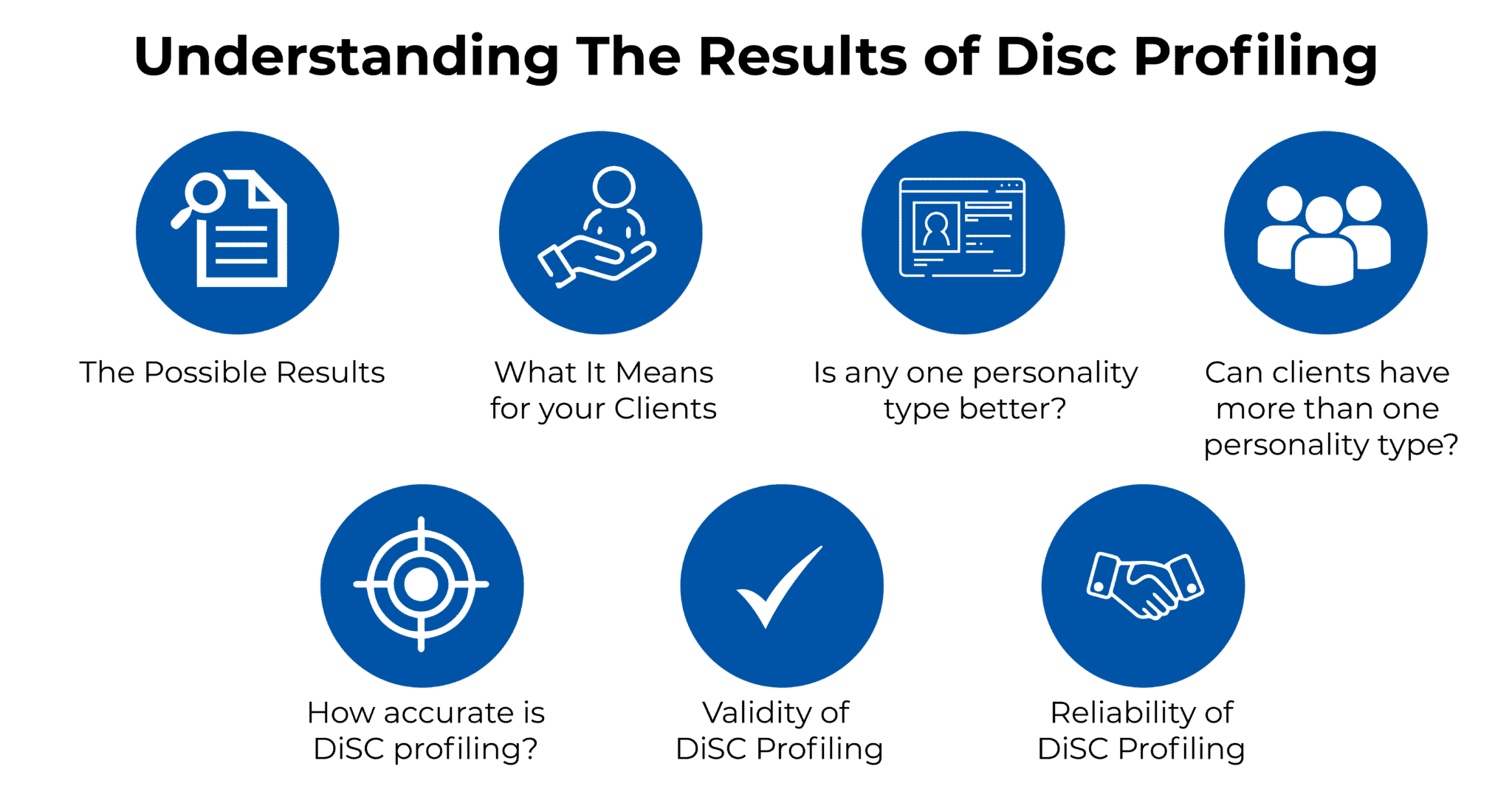
I’m going to be taking you through the possible results of DiSC Assessment, what this means for your clients, how accurate the personality assessment tool is, and much more.
Let’s dive in!
What are the possible results of DiSC assessment?
As mentioned in Chapter 3, people who take the DiSC Classic assessment can be categorized into one of the Marston’s four notable personality types: Dominant (D), influence (i), Steadiness (S), and Conscientiousness (C).
Meanwhile, those who opt for Everything DiSC can be categorized into the eight variant personality types as well: Di, DC, iD, iS, Si, SC, CS, and CD.
The Everything DiSC assessment measures a person on all scales but these scores do not show on their profile report. Instead, a person's dot placement is displayed in a circumplex — as shown in Chapter 3 — to show how they possess traits from all four of Marston’s personality types.
An Everything DiSC report also details a person’s priorities on the circumplex. This has proven to be more engaging, memorable, and informative than a series of numbers or graphs.
Coaches and facilitators can receive a specialized report which details the client’s DiSC style, priorities, and dot placement. It provides scores for all eight DiSC scales, which can be very helpful for coaches with clients whose dots are closer to the center of the circle.
What does this mean for your clients?
If you use DiSC profiling for your clients, the reports will detail their unique behavioral style, tendencies and preferences, as well as strategies for effective behavior.
In addition to explaining their personality type, the report will also include information on other DiSC styles to help your client develop a deeper understanding of the people around them.
Is one personality type better than the other?
No. Each personality type comes with its unique set of qualities and DiSC profiling does not attach value judgments to any of them.
DiSC profiling is not a pass or fail test, as there are no right or wrong answers.
Can my client have traits of more than one personality type?
Yes.
As I mentioned in Chapter 2, every person is a mixture of all four personality types but usually features only one or two.
In fact, Everything DiSC reports use a dot within a circle of styles to show that everyone exhibits traits of all four major types. This means that each personality type can blend and mold itself into other types as needed.
How accurate is DiSC profiling?
Although most respondents agree with their DiSC test results at a surface level, this cannot be considered an objective assessment of its accuracy. To effectively measure the accuracy of DiSC profiling, we have to turn to psychology and use scientific tools instead of subjective ones.
The two main ways to assess DiSC profiling is by testing its reliability and validity.
Simply put, validity is a measure of how well a tool measures what it claims to measure. The more it is able to measure what it intends to, the more valid it is.
Meanwhile, when we measure a tool’s reliability, we are actually measuring its ability to yield the same results over a period of time.
If applied to DiSC profiling, this means that a person taking the DiSC assessment twice over a period of time should get the same results both times. This is called test-retest reliability.
What is the validity of DiSC profiling?
Studies have shown that DiSC profiling is extremely valid because it is a good measure of one’s tendencies and preferences.
The correlations among all the eight scales show strong support for Marston’s DiSC model.
As per the validation results from the Everything DiSC Research Report:
“The circumplex structure of the assessment conforms well to expectations, as assessed by multidimensional scaling, scale intercorrelations, and factor analysis. The relationships among the eight scales are highly supportive of the circumplex structure and strongly reflect the expected pattern of correlations hypothesized under the DiSC® model.”
Correlations between the Everything DiSC scales and the scales of the Revised NEO Personality Inventory and the Sixteen Personality Factor Questionnaire provide additional support for the validity of the assessment.
What is the reliability of DiSC profiling?
Research on the test-retest reliability of Everything DiSC assessments suggests that results are quite stable over time.
The table below shows the test-retest reliability of each of the eight scales. A reliability score of .70 and above is considered good reliability, and higher is better.
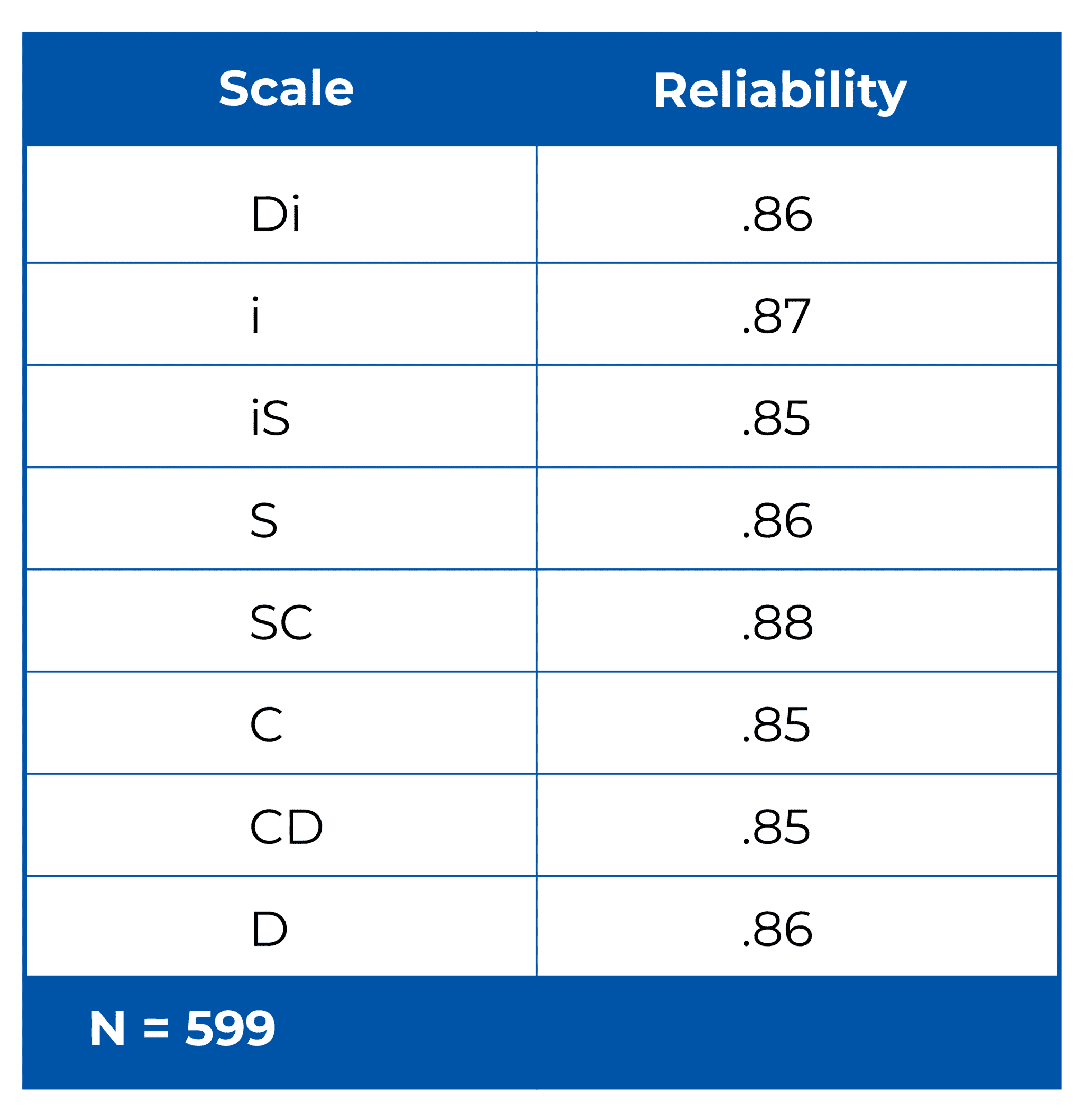
However, it is important to note that the longer the time period between two testings, the lower the test-retest reliability is expected to be.
The Everything DiSC research report explains: “This is because test results are influenced by a variety of extraneous factors that are unrelated to the characteristics that the test intends to measure. For instance, someone who is tired during one testing may answer differently than she will on a second testing when she is well-rested. Similarly, another person may respond to a test differently depending on the mood he is in.”
Chapter 5:
How can coaches use DiSC profiling?
Now that you have a deeper understanding of how DiSC profiling works, I can now get into how you can use this wonderful tool to its full potential!
In this chapter, I will talk about the various benefits of using DiSC profiling as a coach and things to keep in mind before administering it to any of your clients.

As a coach, what are the benefits of DiSC profiling?
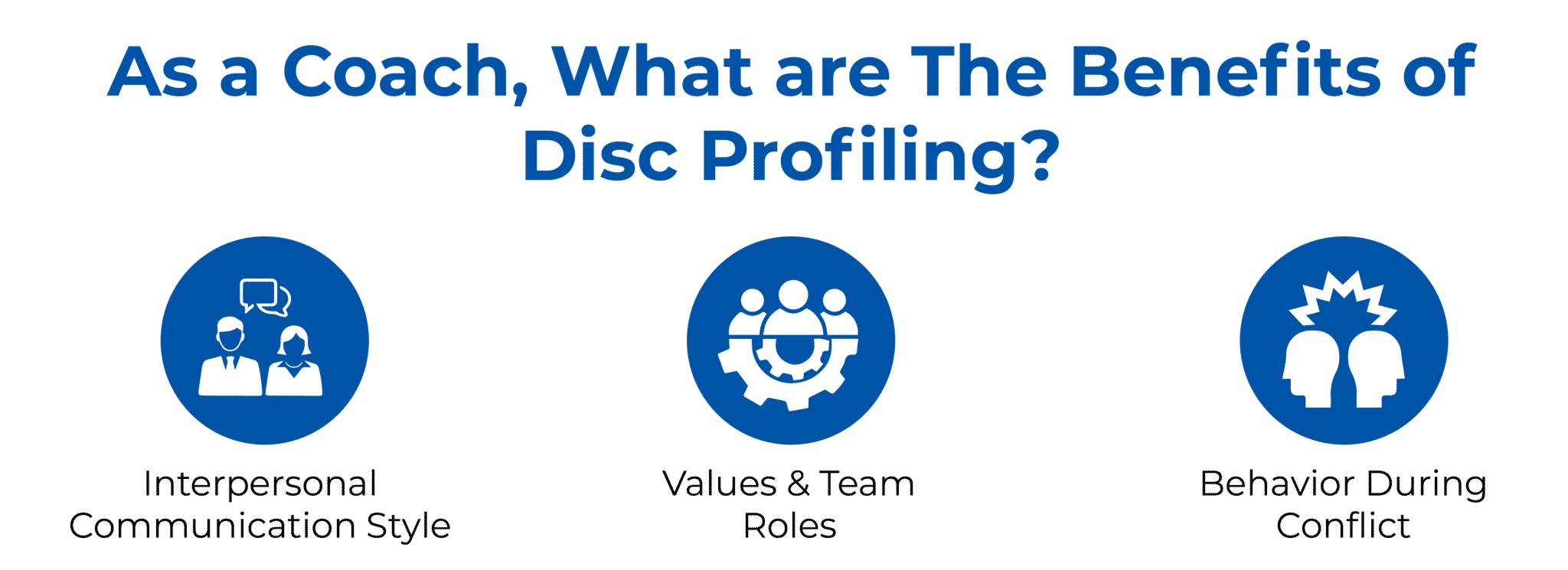
DiSC profiling helps you gain insight into various facets of your client’s personality, offering a plethora of benefits.
Let’s get into the details.
Interpersonal Communication Style
One of the most useful things that you will understand about your clients from their DiSC assessments is how they communicate with others. You can also use DiSC to predict how different personality types interact with each other.
This will help you build deeper connections with your clients, and it will go on to inform the approach you take while coaching them.
For instance, someone with a strong D-type personality will require a different, more intense coaching style than a laid-back and mellow S-type personality.
Values and Team Roles
DiSC assessments can give you insight into your clients’ values, which can ultimately guide their preferences and behavior. The client’s values also define the areas that they must invest their time and energy, which can, in turn, help you understand their goals.
Understanding your client’s innate values can help you develop a road map and step-by-step instructions that are unique to their personality.
Behavior during Conflict
The most important thing that DiSC will help you understand about your clients is how they behave in conflict.
If not handled properly and in a timely manner, conflict can quickly turn into deep-seated issues that hinder people from achieving their goals. Therefore, understanding how your clients approach conflicts will also help you understand what behavioral changes they need to make to overcome them.
Coaching your clients to efficiently deal with negative situations will also help them be more relaxed and objective.
What makes DiSC profiling a good tool for you, as a coach?
There are multiple reasons why DiSC profiling is a great tool for coaches to use.

Here are a few of them:
Value for Money
Using DiSC profiling as a coach is a great example of getting bang for your buck. It is a relatively affordable and accessible tool for coaches to use, but with the potential for big results for clients.
Furthermore, even its cheapest version can give you pages and pages of thorough, detailed results.
It is also a cost-effective profiling tool because there are so many types of DiSC assessments available at different price points. This means that you can choose the specific assessment that best suits you and your client.
As I mentioned in Chapter 3, you can choose from the DiSC Classic assessment or the Everything DiSC suite of assessments, which comprises multiple tools.
For example, you can purchase the regular Everything DiSC Workplace Profile for 72 USD, or even an Everything DiSC Group Culture Report for 150 USD, among a host of other tools. Other than the various profiles and reports, you can also purchase facilitation kits, reference guides, certifications, and other tools to enhance your Everything DiSC experience.
High Reliability and Validity
As we discussed in Chapter 4, DiSC profiling is both highly reliable and highly valid. This means that it is an effective tool to measure personality traits and it delivers consistent results.
Therefore, you can rely on DiSC profiling to provide you with accurate and consistent results.
Objectivity
While DiSC profiling does attribute a label to each person, there is no value judgment attached about their abilities and intelligence.
This is a fantastic quality for a behavioral assessment to have, because it allows you the freedom to draw your own conclusions about the individual and their needs.
How do corporations and large companies use DiSC profiling?
DiSC profiling is common in large companies as it is a cost-effective tool with multiple applications, including:
- Enhancing efficiency within the office,
- Managing conflict and resistance,
- Inspiring motivation in employees, and
- Improving communication within the office.
DiSC profiling is also used to train employees in specific roles, such as salespeople and managers. This incredible and versatile tool helps people channel their strengths and weaknesses into improving overall productivity.
Corporations also use DiSC profiling to aid recruitment and assess new hires, but this is not the best application of it. DiSC profiling can often be misused, even by the people who know the most about it, but it is important to remember that it is not a predictive tool.
As I mentioned in Chapter 4, DiSC profiling is merely a reflection of the person’s general tendencies, and not a conclusive personality assessment.
For instance, while a D-style personality might be better suited to a leadership role on paper, it does not mean that the other personality styles would fail in a similar role. Corporates can misuse DiSC profiling in a few other ways too, all of which are better detailed here.
What should I keep in mind before administering a DiSC assessment?
While DiSC profiling comprises a fairly simple process, I have a couple of tips to help you use it most effectively.
Use DiSC Profiles Only as a Guide
DiSC profiling is not a diagnostic tool, and should not be used as one either. The results are mere indicators of a person’s behavior and should be treated as an effective road map to someone’s general tendencies.
Remember, the way the results are interpreted is just as important as the tool itself!
If you are still feeling unsure about interpreting DiSC assessment results, here are some extra tips and tricks to help you.
Use the Official DiSC Assessment.
There are hundreds of companies that offer variations of DiSC profiling, so it is easy to get confused.
Make sure you are using the official DiSC assessments which are owned and trademarked by Wiley.
As mentioned in Chapter 2, the uncapitalised i in the word ‘DiSC’ is the key identifier of the real DiSC test.
Chapter 6:
Criticisms of the DiSC Model
We have now understood that DiSC profiling has a variety of uses for you and all other coaches out there. However, it is important to remember that every coaching tool will have its shortcomings.
In this chapter, let’s take you through some of those shortcomings.

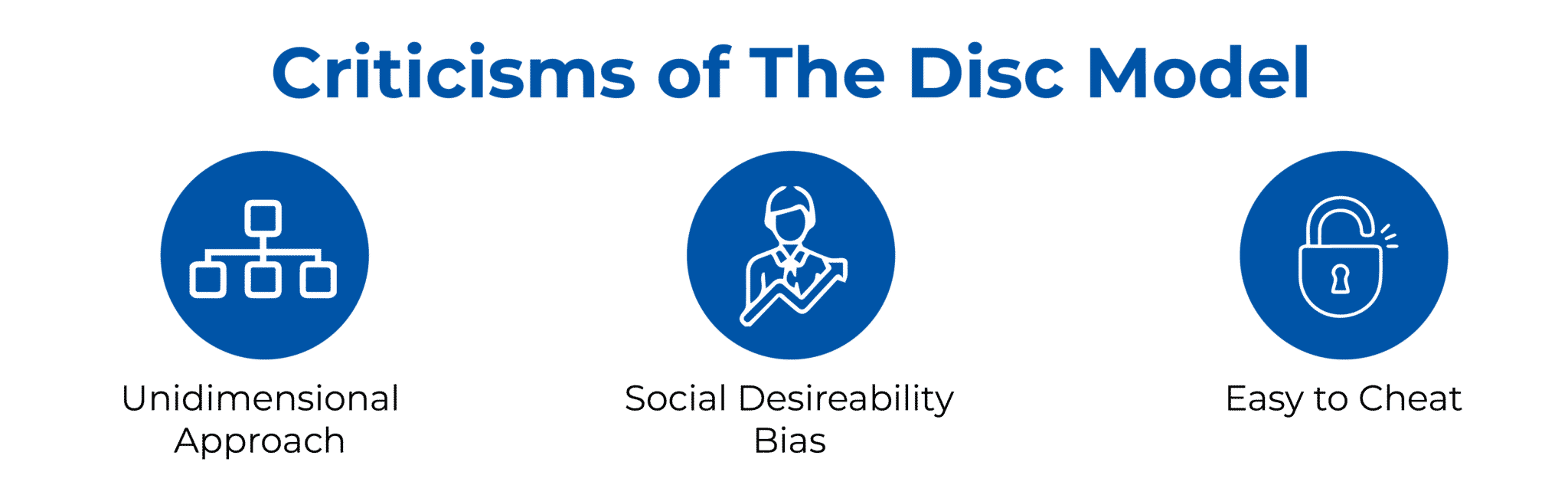
Unidimensional Approach
One of the most common criticisms of the entire DiSC universe is that the model itself has reduced human personalities into a handful of categories.
The truth is that humans are a lot more complex than that and are a mix of many layers of thoughts and experiences. One’s personality can be based on a multitude of factors, such as education and upbringing, which the DiSC model does not account for.
Social Desirability Bias
In a test like DiSC, where all the answer options are laid out in the open, respondents are likely to respond in a manner that they think will be viewed favorably by others (in this case, you).
In psychology, this is known as social desirability bias, which is a type of response bias.
Easy to Cheat
Keeping in mind that people can easily display biases in a DiSC assessment, people can also very easily cheat while filling in the questionnaire.
Since DiSC profiling is extremely common in the world of hiring, most people might have already done it and know what kind of answers will help them get hired.
This is a big criticism of DiSC profiling, because it makes them inherently flawed when it comes to accurately determining a person’s behavior.
Chapter 7:
Resources
There are many resources out there that can help you use DiSC profiling to its fullest potential. Among them are research studies, sample reports, and more.
This chapter comprises such useful additional tools which will help you kick off your DiSC profiling journey.

E-books
Learning about DiSC assessments can be hard when there is so much information about it online already, but you can use e-books to guide your approach.
You can download free e-books such as:
- Tackling the Virtual Culture Dilemma: Help Your People Work Better Together While Officing Apart
- The Invisible Drain on Your Company’s Culture by Mark Skullard
- Agility Unlocked: Revealing the Connection Between Agility and Emotional Intelligence
- Under the Hood: The Secret Engine That Drives Destructive Conflict.
You can also purchase books on the subject, like:
- Building a High Performance Team with DISC Profiling: Tools for Rapid Growth” by Craig Robinson.
- The Four People Types: And What Drives Them
In addition, you can also find downloadable posters with ample information about each of the DiSC personality types.
Research Studies
There are a variety of research reports that you can use to gain an even deeper understanding of DiSC profiling.
The most common one you can use is the Everything DiSC Research Report shared by Wiley themselves, which measures the validity and reliability of all the tools under the Everything DiSC umbrella.
This is a fantastic resource if you are looking to get more empirical evidence about the various DiSC tools available.
However, there are also research studies which apply the principles of DiSC profiling in other areas like teaching, academic success, and even professional success. These will help you see just how many sectors that DiSC profiling can be used in.
Sample Reports
Before you jump into buying DiSC profiling for all your clients, take a look at these sample reports.
Each report covers a different tool within the Everything DiSC suite of assessments, and each one will give you an idea of the kind of information you can expect to get about your clients.
Going over these before starting your clients off on their DiSC profiling journeys will help you pick the best tool for your personal coaching style.
Interactive Activities
Add some new dimension to your DiSC assessments with these activities, allowing your clients to better understand the different personality types.
For example, in the Motivate Me exercise, participants are encouraged to reflect upon their own motivators and priorities and also discuss it with people around them.
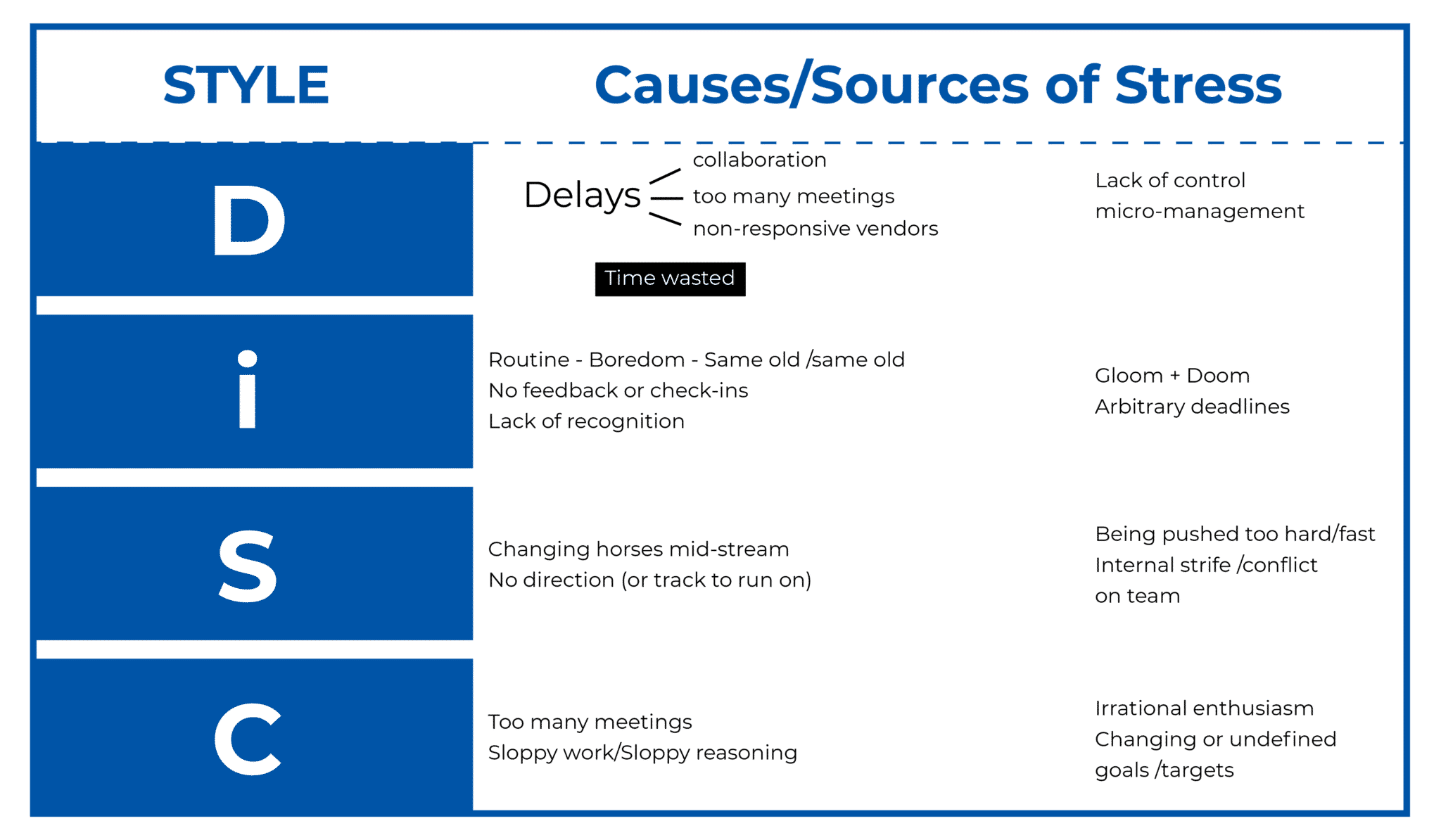
Meanwhile, in the DiSC and Stress activity, people in managerial roles specifically are pushed to understand how all personality types work, recognize when individuals on their teams might be stressed, and figure out new ways to help them.
They can then create a chart like the one below to help them understand how to manage others better.
Worksheets
The official DiSC website also offers interactive worksheets to get your clients started on their profiling journeys.
For example, you can give your clients the A Guide to Me worksheet, where they can fill out DiSC relevant details about themselves like motivators, stressors, and preferred ways to communicate with them.
There is also the Productive Conflict worksheet, which allows your client to reflect upon conflicts and learn how they operate in challenging situations.
Conclusion
Congratulations on completing my definitive guide to DiSC profiling! I hope you enjoyed reading it and found it useful.
I am most curious to know — which personality type do you think you are?
I also would love to know what you think of DiSC profiling and how you plan to use it to help your clients.
Do you have any questions that I left unanswered? We’d love to hear from you in the comments section, and I’ll make sure to address them all.
Frequently Asked Questions (FAQs)
What does DISC profile stand for?
What are the 4 DISC personality types?
D: DOMINANCE—This style is both bold and skeptical.
I: INFLUENCE—This style is both bold and accepting.
S: STEADINESS—This style is both cautious and accepting.
C: CONSCIENTIOUSNESS—This style is both cautious and skeptical.
