
OSKAR COACHING MODEL: The Definitive Guide
Last updated: March 2026
OSKAR COACHING MODEL
The Definitive Guide
This is your one-stop guide to the OSKAR coaching model, sometimes referred to as the OSCAR model.
If you have been searching for answers to what the OSKAR model is, who created it, and what its different stages are, then you have come to just the place!
If you want to:
- Become an expert in using the OSKAR coaching model
- Discover the strengths of the model, and use them to help clients attain their goals
- Have effective and engaging coaching conversations with your clients
Then read on to find out how this model can help you make your coaching practice more effective.
Let’s get started!
Contents




Benefits of the OSKAR Model
Chapter 1:
The Fundamentals
In this chapter, I will cover some fundamentals to help you achieve a holistic understanding of the OSKAR coaching model.
Apart from learning its definition and benefits, you will also gain perspective on the different types of models that exist — and why the OSKAR coaching model stands apart.
Let’s jump right into it.

What is a coaching model?
In simple terms, a coaching model is a process through which coaches bring their clients closer to their goals.
Identifying where the clients are in their journey, and where they want to see themselves is something that coaches enable.
This identification helps them come up with a framework that aligns with their coaching practice.
In a way, coaching models ensure that coaching sessions continue to be meaningful.
This means that the coach is able to develop a map that takes into consideration the potential roadblocks, as well as the milestones.
In a nutshell — it is a good idea for coaches and clients to follow a clear coaching model as it shapes the kind of coaching that eventually takes place.
Types Of Coaching Models
Before deciding which coaching model to apply in your coaching practice, it is important that you take a look at the most popular coaching methods.
This will help you weigh the advantages and drawbacks of the models, both individually and in comparison to others.
It’s also important to note that some of these models are continually evolving and can be tailored as per the client’s needs.
Let me take you through some of them —
GROW Coaching Model
The GROW model is a simple method to set goals and solve problems.
To understand it, you can think of it as a travel plan.
- First, you decide your destination.
- Then, you explore where you are currently at.
- Based on the extent of the journey you have undertaken to reach your goals, you look at different options to reach the destination.
- Finally, you make sure that you commit to the journey and take the plunge.
The GROW model involves four stages:
Goal (G)
Setting a clear objective.
Reality (R)
Assessing the client’s current position through a deep analysis of their realities.
Options (O)
Mapping out the options available to achieve the objective set in the first stage.
Way Forward (W)
Building a map for the transformation of the client, keeping in mind the possible challenges. You can read about the GROW model in more detail here.
CLEAR Coaching Model
This model was developed by Peter Hawkins in the 1980s and stands for:
Contracting (C)
In this stage, you build a conversation with your client about their aspirations.
Listening (L)
This is where the coach actively listens to the client, helps them understand their situation more intimately, and gives insights whenever necessary.
Exploring (E)
Here the coach helps their client decode a personal situation that might be standing in the way of achieving the desired outcome.
Action (A)
The coach builds an action plan to help the client attain their goals and become successful.
Review (R)
Here you reflect back on the ground covered, decisions taken and the change facilitated through coaching.
Shift Coaching Model
This powerful model brings in a change in the client’s way of thinking.
It begins with analyzing the problems faced by the client and explores what is holding them hostage in that situation.
Then, as a coach, you develop a new way of looking at the situation.
In the final stage involving Transformational Action, you put into place certain mechanisms to support positive action.
Block Removal Coaching Model
Success can be elusive sometimes.
Sometimes, clients can find it difficult to meet their goals and, as a result, their confidence and self-belief can take a hit.
Their preconceived notions and fear can exacerbate the situation. At this time, the block-removing coaching model helps coaches put the clients back on the right track.
Let us now have an in-depth look at one of my favorite coaching models – OSKAR.
What is the OSKAR coaching model?
A solution-focused model, the OSKAR coaching model is sometimes referred to as the OSCAR model.
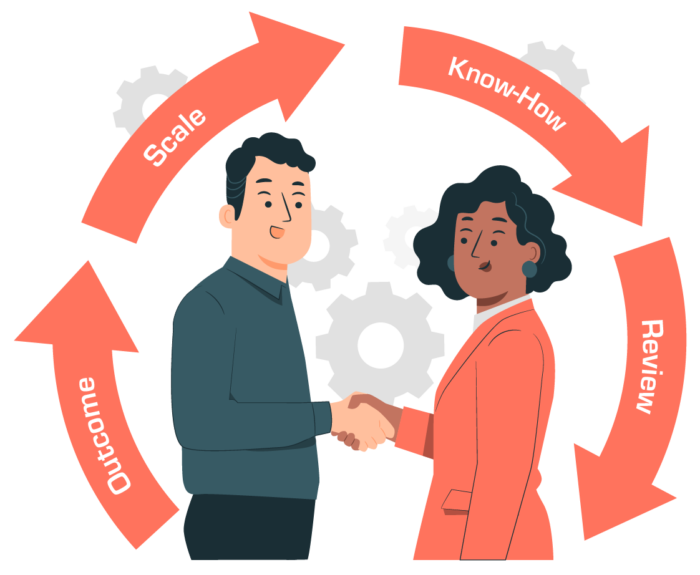
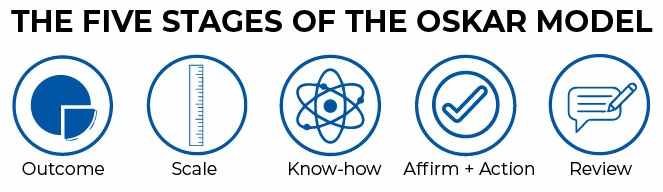
This model comprises five stages —
- Outcome
- Scaling
- Know-how
- Affirm
- Review
I will explore in detail all the five stages in Chapter 3.
While you might have heard of several other coaching models, the OSKAR coaching model’s method, compared to other models, is more coaching-oriented.
Instead of trying to align actions with the desired outcome, the OSKAR model focuses on behaviors and what causes those actions in the first place.
Let’s now look at who can use the OSKAR model and stand to benefit from it.
Who can benefit from the OSKAR coaching model?
I like the OSKAR model because it can be used by anyone as a tool of self-assessment.
To begin with — try to take a step back from your life and see where you currently are emotionally, physically, mentally, and spiritually.
Now, try to think which areas of your life you could improve in.
More specifically and importantly, what information or skill could you discover or develop to get closer to a more fulfilled and successful version of yourself?
For coaches, the OSKAR method can help build a collaborative approach to guide their client.
For managers, it is a useful problem-solving tool that helps in understanding their teammates better.
Since the method focuses on small achievements and makes you see the value in setting achievable goals, anyone who is looking for a transformational change can benefit from this model.
Now that you have learnt the fundamentals of this model, let me take you through its history and origins next.
Chapter 2:
History and Origins of the OSKAR Model
The OSKAR model was created by Mark McKergow and Paul Z Jackson around the year 2000.
It was then published in their 2002 title, “The Solutions Focus: Making Coaching and Change SIMPLE”.
Since being first published, the model has grown and been adapted into various guidelines by coaches around the world.

This proves its versatility and flexibility as a process to help clients achieve their goals – which is one of the reasons behind its growing popularity.
Moreover, the OSKAR model is a solution-focused method, rather than being problem-based.
This approach enables coaches to look for solutions based on behavior patterns, making them more sustainable.
Why is it relevant even today?
The OSKAR coaching model has been around for a while, yet its importance in the field of coaching has not diminished.
This is precisely because it is so easily applicable.
For example, workplace coaches can use the model with their clients to help manage other employees better.
In the case of life coaches, this method helps you give your clients the reassurance they need through the Affirm element.
Enabling your client to recognize the problem area and coming up with a solution together can generally improve their quality of life.
In terms of career coaches, this model can come in handy if you want your clients to learn from their actions.
Since there is enough scope for reflection, this model can help your clients set the tone for the way they take to reach their goals in the future.
Very often, conflicts can hinder progress and even sour interpersonal relationships. The OSKAR model helps you take on a solution-based approach to fix these issues.
Now that the OSKAR coaching model sounds promising to you, let’s move on to its practical aspects.
In the next chapter, I will show you how to apply this model in your coaching practice.
Chapter 3:
Applying the OSKAR Model
As I have already addressed in Chapter 1, the OSKAR coaching model is developmental in nature.
You might find, very often, that your clients have been stuck in a situation for a long time and need help figuring a way out.
Something to keep in mind is that, even though the method can be applied in any scenario, it has been often noted that applying it to reach long-term outcomes yields the best results.

In this chapter, I am going to list down the factors that comprise this method and touch upon how you can put the model to use in your coaching practice.
O - Outcome
Setting a clear objective with your client sets the tone for the rest of your coaching sessions.
Therefore, it is important that, in the first stage of the OSKAR coaching model, you help the client express what they need from your guidance.
As a coach, you might want to ask them the following questions in the Outcome stage:
- What is your long-term outcome or objective?
- How would you define success?
- How would you know that you have been successful? What changes would it bring?
- What would passing all your self-assessment checks look like?
- What is the importance of achieving the objective you have set for yourself?
- How would you feel if you were not able to achieve your objective?
- How long do you want to take to achieve this outcome?
S - Scale
The second step in the OSKAR coaching model is Scaling.
As a coach, you have to be honest in your approach towards guiding clients, as sometimes they might not have the ability to be objective in every situation.
In scaling, you measure how close your client is to achieving the goal they have in mind.
By using a simple 1-10 scale, you paint a realistic picture for your client to set attainable goals.
The following questions can help you steer this particular session:
- What is the problem that you are currently facing, and how do you feel about it?
- How is this problem impacting you and others around you?
- How do you think people around you perceive this issue?
- When did you realize you had to make some changes in your life?
K - Know-how
After you have enabled the client to situate themselves and express their aspirations, you empower them with all that they need to reach their goal.
This stage is called the know-how stage.
You start a conversation to explore the skills, qualifications, characteristics, or knowledge required to get where the client wants to be.
Having this conversation is important, because it helps the client become aware of their capabilities and what they can do differently to maximize their output.
The following questions can help your client to open up in this stage:
- What changes could you make to fix the current problem you’re facing?
- What options do you have to try and fix the situation? What are the positives and negatives of that course of action?
- Is there something that is stopping you from taking that course of action now?
- What would be your advice to someone going through what you are going through right now?
- What else could help you from taking the steps required to resolve the situation?
- What is in the way of you doing what needs to be done, according to you?
- What would you do differently, if you were not afraid of the outcome?
After the know-how stage has passed and your client has a rough plan of where they would like to be, it is time for the Affirm + Action stage.
A - Affirm + Action
The Affirm and Action stage helps your client reflect on what has already been going well.
This is when they focus on the actions and behaviors that are contributing positively to where they want to arrive in life.
Just like the Scale stage, at the Affirm+Action level, you encourage your client to rate how close they are to achieving their desired goal on a scale of 1-10.
This will not only bring in self-awareness to their approach but also give you, as a coach, a clearer picture of the traits that your client wishes to retain and hone.
Asking the following questions in your sessions can help both you and your client chart out what has been particularly impressive in the journey so far:
- Where do you see yourself right now in relation to where you want to be in the future, on a scale of 1-10?
- What actions are you willing to take to improve your chances of achieving your goal?
- When can you implement the changes you just mentioned?
- How will you maintain the drive to keep going?
- Do you need support from specific people around you to maintain your motivation?
- Have you thought about what you could do in the next 24 hours to get closer to your goal?
- How committed are you to taking the relevant steps to achieve your objective?
R - Review
In the final stage of the OSKAR coaching model, you and your client review how far you have come and your action plan for the future.
Usually, the review happens at the beginning of every other coaching session as it gives you the space to look at the progress your client has made.
Apart from reflecting on the actions that have paid off, you also hold your client accountable for their actions in the future.
This way, your client knows how they need to tweak their approach to meet their goal.
Asking a set of questions will help your client share their true thoughts about the progress they have made so far. These are:
- What do you think about the progress you have made so far?
- Do you think your actions so far have aligned with your larger goal?
- What do you think is a good measure to quantify your success?
- Would you like to change anything in our approach to rate yourself in terms of progress?
- Do you have a plan to maintain the momentum you have built up?
- Do you need any additional support from your coach to help you realize your goal?
With the end of the final stage, Review, we have covered all the elements of the OSKAR coaching model.
These stages will help you set the stage for your client to strive towards attainable goals.
The next section of my guide will deal with the advantages of using this solution-focused model, along with some limitations for you to take into consideration.
Chapter 4:
Why should you use the OSKAR coaching model?
As a coach, you must have come across all types of clients in your career.
There are some clients who want a safety net without feeling overwhelmed, and there are some who want their coaches to take on a bigger role in their lives.
The beauty of the OSKAR coaching model is that you can use it to coach both — and, really, all — types of clients.

In the following section, I am going to list various benefits of using the OSKAR coaching model, as well as some of its limitations that you, as a coach, should be aware of.
Benefits of the OSKAR Coaching Model
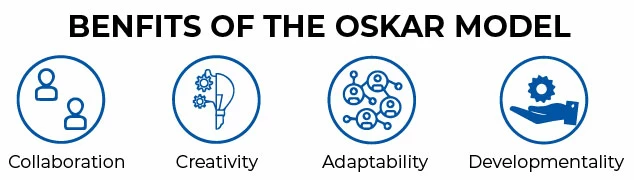
Here are some of the benefits of this model:
Collaboration
Since the model puts a lot of emphasis on building conversations with your client on where they presently are in their life, and what their aspirations are, there is a lot of room for collaboration.
In the Collaboration process, you — as a coach — become aware of what your client considers achievable, as well as your own capacity to contribute to their success.
This can often mark the beginning of an empathetic client-coach relationship.
Creativity
The OSKAR coaching model, with its diverse set of questions to help you steer a session, is a creative process.
Even though there is room for creativity in other models as well, in this particular process, the levels of ingenuity can be high, due to its focus on personal achievement.
When your client reflects on their journey and celebrates the milestones crossed, they are more likely to stay focused on the end goal.
This stability can definitely help spur creativity.
Adaptability
As I have mentioned before, this model can be used by people looking for both long-term and short-term transformations.
Here’s a tip to make this happen — think of this model as a process, and not a rigid five-step to-do list.
Do you think there are clients who could benefit from just Outcome, Scale, and Know-how?
If yes, then there is nothing stopping you from playing with the structure of the model to tailor it according to your clients’ needs.
Developmentality
This is one of the most promising features of the OSKAR coaching model.
If you are a coach who likes to let the client have more freedom and open up to different alternatives of solving problems, the freedom that this model gives you is remarkable.
Even though you can have regular check-ins with your client, this model allows you to support your client while giving them the space needed to engage in self-assessment and reflection.
Now that I have charted out the benefits of applying the OSKAR model in your coaching practice, it is important to understand the pros and cons of anything you might be potentially getting into.
I am going to address the limitations of the OSKAR coaching model in the next section.
Limitations of the OSKAR Coaching Model
While the OSKAR coaching model is a relatively easy model to use, it comes with its own set of limitations.
As a coach, it’s good to be aware of what could potentially go wrong.
- Risk of Not Addressing Negative Behavior
Ás I wrote earlier, this model is progress-focused and helps your client recognize the small achievements they have made along the way.
However, there is always a chance that your client might end up focusing on the Affirm element too much.
This will hinder progress in the long run as it will keep the client from being critical of their actions.
Since true reflection is such an integral part of the OSKAR model, this might defeat the purpose of the exercise.
- Losing Focus if the Outcome Isn’t Clear
Another drawback of this model is the possible lack of coordination between you and your client.
Even though collaboration, as discussed in the above section, forms the backbone of the OSKAR approach, it might be difficult to strike a balance between how much you and your client understand each other and commit to the process.
Now that you have familiarized yourself with the limitations of the OSKAR coaching model, it’s time to look at more ways to learn about it, and engage with the model more intimately.
For this, I’m going to share a list of resources in the next section.
Resources
By now you know that the OSKAR coaching model is a great process that can add value to your coaching practice, in collaboration with your client.
If you’d like to take your learning one step further, there are several books and courses that you can make use of.
If you are a reader, The Solutions Focus is a book by the developers of the model themselves. In this title, the authors help coaches around the world foster positive change through simple steps.
Another good read is OSCAR Coaching Model, a book by Andrew Gilbert and Karen Jane Whittleworth. If you would like to enroll in an online course that provides some structure, you can consider the program ‘Using Coaching Models’ by TalentLMS which comprises 6 mini-lessons.
Conclusion
Congratulations!
With this, you have reached the end of the guide, which means that you’ve now gained solid knowledge of the OSKAR coaching model or the OSCAR model.
Applying what you have learned in the above chapters will help you build a better relationship with your clients and take them closer to their goals.
Therefore, you should not delay in taking action and keep the momentum going.
Maybe you could start by asking yourself the most basic questions such as:
How has this guide added value to what you already knew about the OSKAR coaching model?
What techniques from the OSKAR model can you instantly start incorporating into your coaching practice?
If you think I have left any questions answered and you need more clarity on, let me know your thoughts in the comments.
You’ll also be able to gain access to a free program of mine.
Frequently Asked Questions (FAQs)
What is the Oskar modeling in coaching?
What are the steps in the grow model of team coaching?
What does R stand for in oscar model?
What are the stages of all coaching models?
1.Vision - Help your clients to visualize their goals.
2.Challenge - Challenge your clients to take the action to achieve their goals.
3.Support - Support your clients as a coach when they face doubts on their journey.
How is the Oskar coaching model different from other coaching models?
1.It specifically uses the solution-focused approach. This allows coaches and managers to experience the power of a solution-focused approach in actions.
2.It specifically allows the sharing of know-how from other people. Even the coach is asked to share the knowledge in addition to the normal coaching questions.
