

Codependency: The Definitive Guide
Last updated: March 2026
Codependency
The Definitive Guide
This is the ultimate guide to understanding Codependency. The primary goal of this article is to assist those who are experiencing Codependency in their lives. This guide will explain all about Codependency along with effective treatment strategies.
So if you want to:
- Get deeper understanding of Codependency
- Build up personality
- Want to know about comprehensive treatments of Codependency
- Want to have diverse knowledge of different therapies for Codependency
- And most importantly if you want to make yourself independent
And many more, then you will love this guide.
Let’s get started!
Contents
Codependency as a Disease






Chapter 1:
Fundamentals of Codependency
This is the first introductory chapter of Codependency which consists of basics of Codependency.
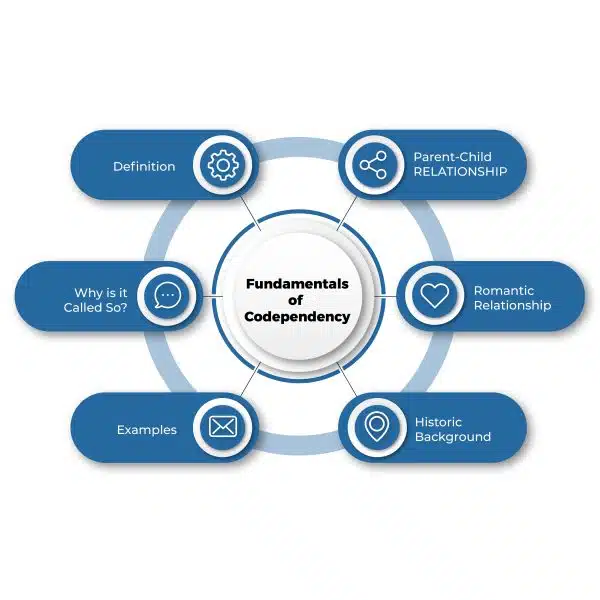
In this chapter you will look at the definition of Codependency along with some examples of codependent personalities. You will also look at the historical background of Codependency.

What is Codependency?
Codependency describes an undesirable practice of relating to others that is characterized by altruism. People who suffer from codependency are prone to prioritizing the needs of others over their own.
They repress their own wants in relationships, are hesitant to ask for things and/or express their feelings. It usually stems from an internalized conviction that they are unlovable and/or will be a burden to others if they ask for what they need and or express their emotions openly.
Definition:
It is defined as:
“Codependency is a relationship behavior in which you consistently prefer someone else over yourself and judge your mood depending on how they act.”
Codependency describes an undesirable practice of relating to others that is characterized by altruism. People who suffer from codependency are prone to prioritizing the needs of others over their own.
They repress their own wants in relationships, are hesitant to ask for things and/or express their feelings. It usually stems from an internalized conviction that they are unlovable and/or will be a burden to others if they ask for what they need and or express their emotions openly.
In Codependency you over-rely on others and their approval of you, struggle to recognize and prioritize your own needs, and have a hard time feeling yourself as different and independent from others.
Low self-esteem, obsessiveness, people-pleasing tendencies, and trouble setting boundaries are all symptoms of codependency. Understanding the prevalence of codependency can help you develop healthy relationships and set healthy boundaries.
A codependent person will plan their entire life around satisfying the other person, often known as the facilitator.
In its most basic form, a codependent relationship occurs when one partner needs the other, and the other, in turn, requires the other. The "cycle" of codependency is based on this circular interaction, which specialists refer to as the "cycle."
It is frequently the result of a family dynamic in which abuse, neglect, addiction, or alcoholism are prevalent. Childhood is often the source of codependency. A youngster frequently grows up in a family where their feelings are neglected or punished. This emotional neglect can lead to low self-esteem and shame in the child. According to research 90% of Americans are codependent.
Why is it called Codependency?
The term "codependent" was coined in the framework of Addiction Recovery and treatment for substance misuse. An individual who is addicted to a substance is said to be "dependent" on it.
Anybody who has loved an addict knows how easy it is to become engrossed in the drama and mayhem that the addiction creates. The person who loves the addict frequently finds themselves making accommodations, overcommitting themselves, and walking on eggshell powder to prevent trouble in these relationships.
Because the addict is addicted to a substance and the people who love him are dependent on it by proxy, the term codependency was coined. In some ways, the person that loves the addict is as if not more, affected by the addiction than the addict.
The meaning of the phrase codependency has developed over time, and it tends to take on slightly various meanings depending on the context in which it is used. It's been used to describe being unduly reliant on someone, being "addicted" to someone, or even being "addicted" to toxic relationships. Despite the fact that these scenarios may be true, the codependent individual does not necessarily perceive or appear to be "dependent" on another person.
Common Examples of Codependency:
Codependent people have the best of intentions. They wish to help a family member who is in need. Their efforts, however, become obsessive and harmful.
As a result of their efforts to rescue, save, and assist their loved one, the other person becomes even more reliant on them. Giving provides a codependent individual a sense of fulfillment as long as they receive recognition.
Here are some examples of codependent relationships:
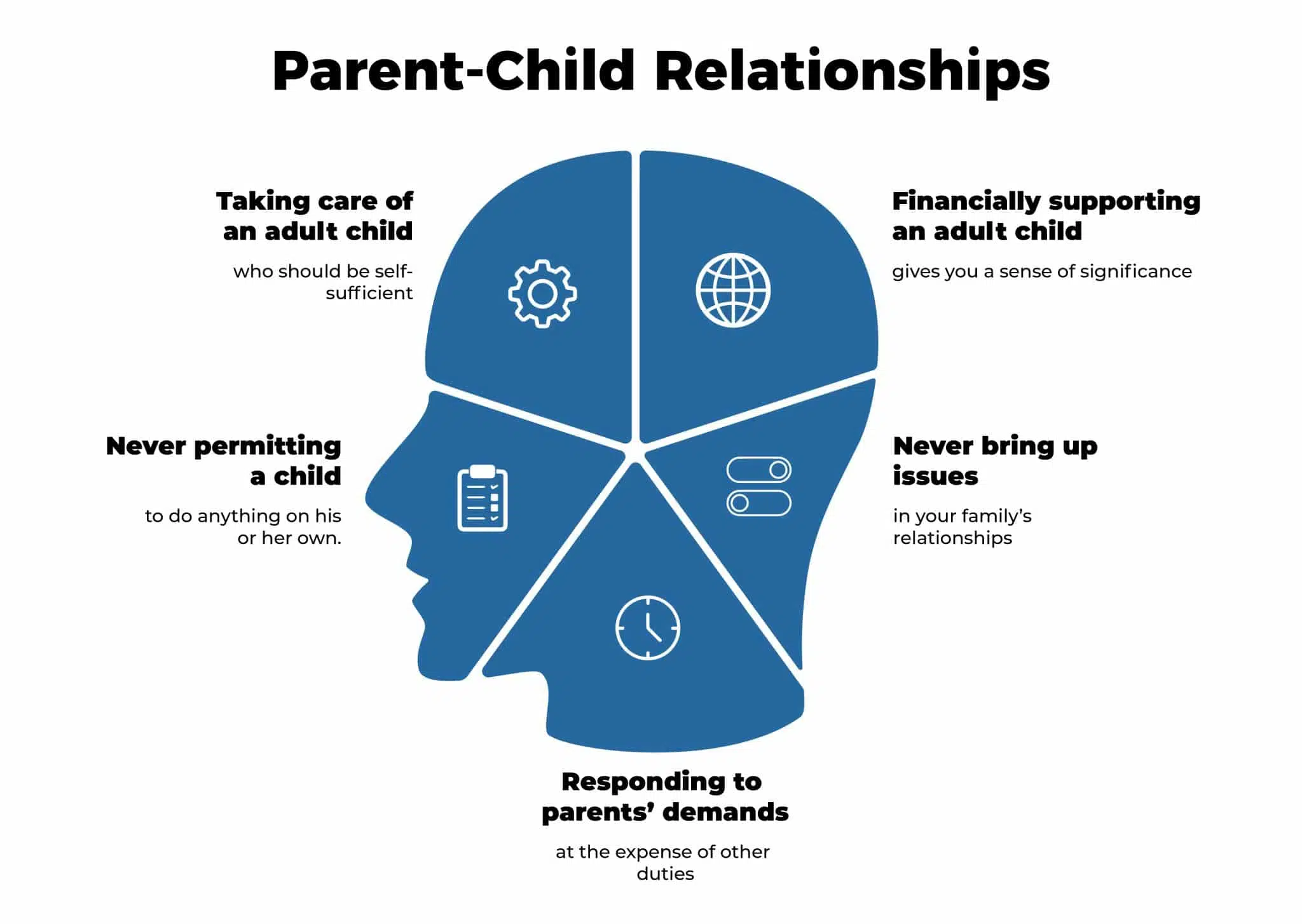
It can include the following in parent-child relationships:
- Taking care of an adult child who should be self-sufficient
- Financially supporting an adult child gives you a sense of significance or purpose.
- Never permitting a child to do anything on his or her own.
- Giving up everything to look after a parent
- Responding to parents' demands at the expense of other duties and relationships
- Never bring up issues in your family's relationships or actions.
It can include the following in romantic relationships:
- Putting a lot of effort and time into caring for a partner who has a drinking or drug problem
- Making excuses or covering for the negative actions of others
- Neglecting your own well-being, work, or other relationships in order to look after your partner
- enabling destructive or unhealthy behavior in a spouse
- Allowing your spouse to keep their independence by not allowing them to take responsibility for their own lives
Another example is in which a woman is married to an alcoholic husband. She consistently puts his demands above her own, believing that by showing him affection, she can help him become sober.
By giving him whatever he wants and covering up for his harmful conduct, she is unwittingly helping him. She holds herself responsible for many of the relationship's problems and is willing to go to any length to make it work, including sacrificing her own mental health.
Codependent relationships can take various shapes, as you can see from the examples above. If any of the above scenarios sound familiar, you may have been in a codependent relationship.
If you find yourself in this circumstance, make every effort to maintain your personal space and time alone. Learn about the effects of codependency, then talk with the other person about how you can both work to keep the relationship healthy and productive. I will guide you about treatment of codependency in depth in the following chapters.
What is the historical background of Codependency?
Codependency has been around for nearly four decades. Although it was first applied to alcoholics’ spouses, who were dubbed co-alcoholics, researchers discovered that the features of codependents were much more common in the general community than previously thought.
In fact, they discovered that you're more likely to be codependent if you were reared in a dysfunctional family or had a sick parent. Codependency is frequently the result of a family dynamic in which abuse, neglect, addiction, or alcoholism are prevalent.
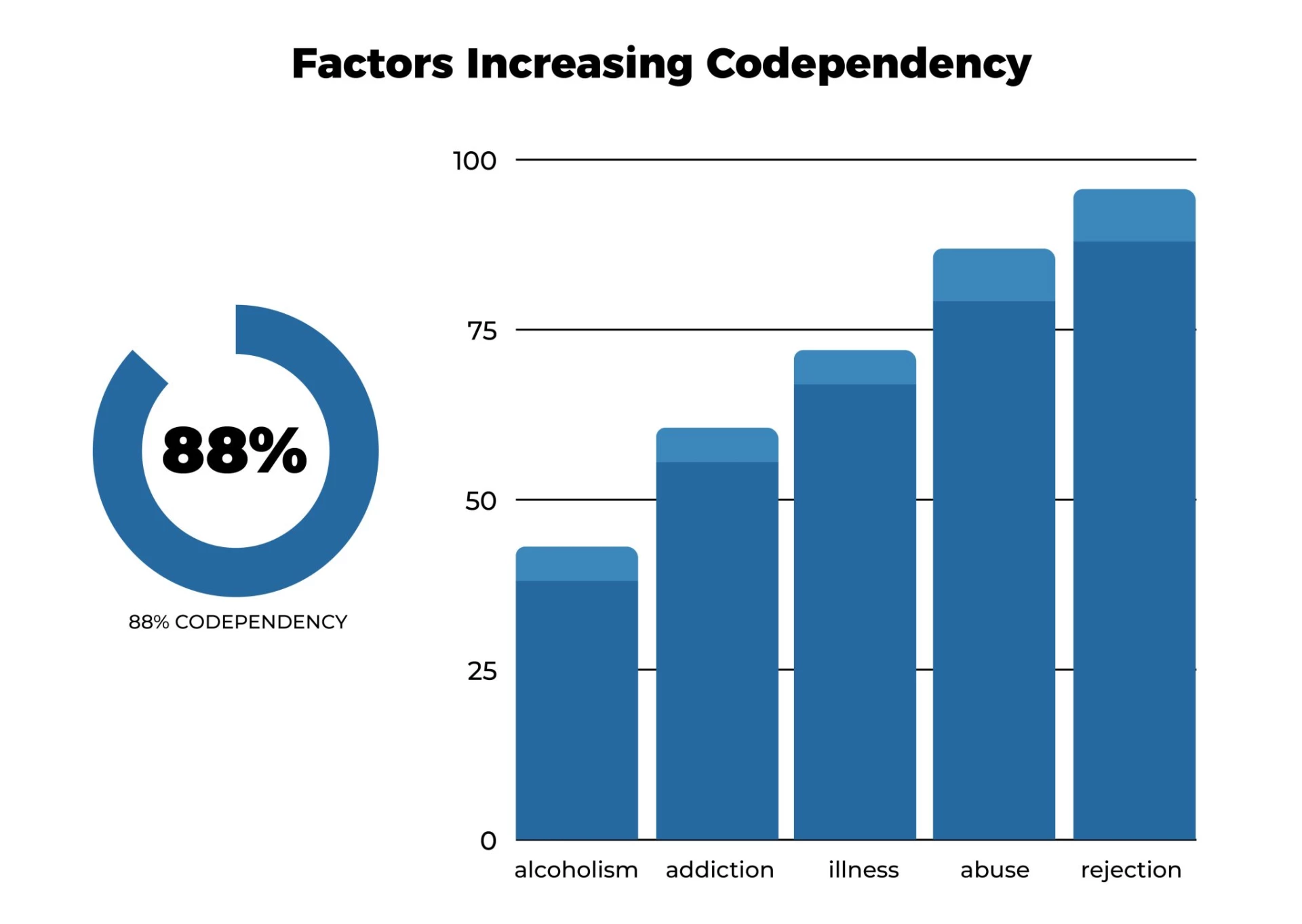
We establish codependent behaviors in order to be seen, heard, loved, acknowledged, and important, or to try to manage the pain of abuse. Codependency can manifest itself in a variety of ways, but any relationship can develop codependent characteristics. Friendships, familial relationships, colleague relationships, and romantic relationships can all be codependent
Who developed the concept of Codependency?
Karen Horney, a German psychoanalyst, may have influenced the concept of codependency. To overcome their inherent uneasiness, she advocated in 1941 that some people adopt what she called a "Moving Toward" personality style. Essentially, these people go toward others by winning their acceptance and affection, and their dependent nature allows them to manage others subconsciously. They are selfless, virtuous, martyr-like, faithful, and despite personal humiliation, they turn the other cheek. Others' approval is more essential than one's own self-respect.
As you are now aware of the basics of codependency, now I will take you to the next chapters which include causes, symptoms and risk factors of codependency.
Chapter 2:
Spread of Codependency
This is the second and one of the most important chapters for the complete concept of Codependency.
In this chapter, I will explain signs and symptoms of Codependency.
This chapter will also include risk factors and causes of Codependency.

What are some symptoms of Codependency?
It might be difficult to tell the difference between someone who is codependent and someone who is simply clinging or fascinated with another person. However, a codependent individual will usually have:
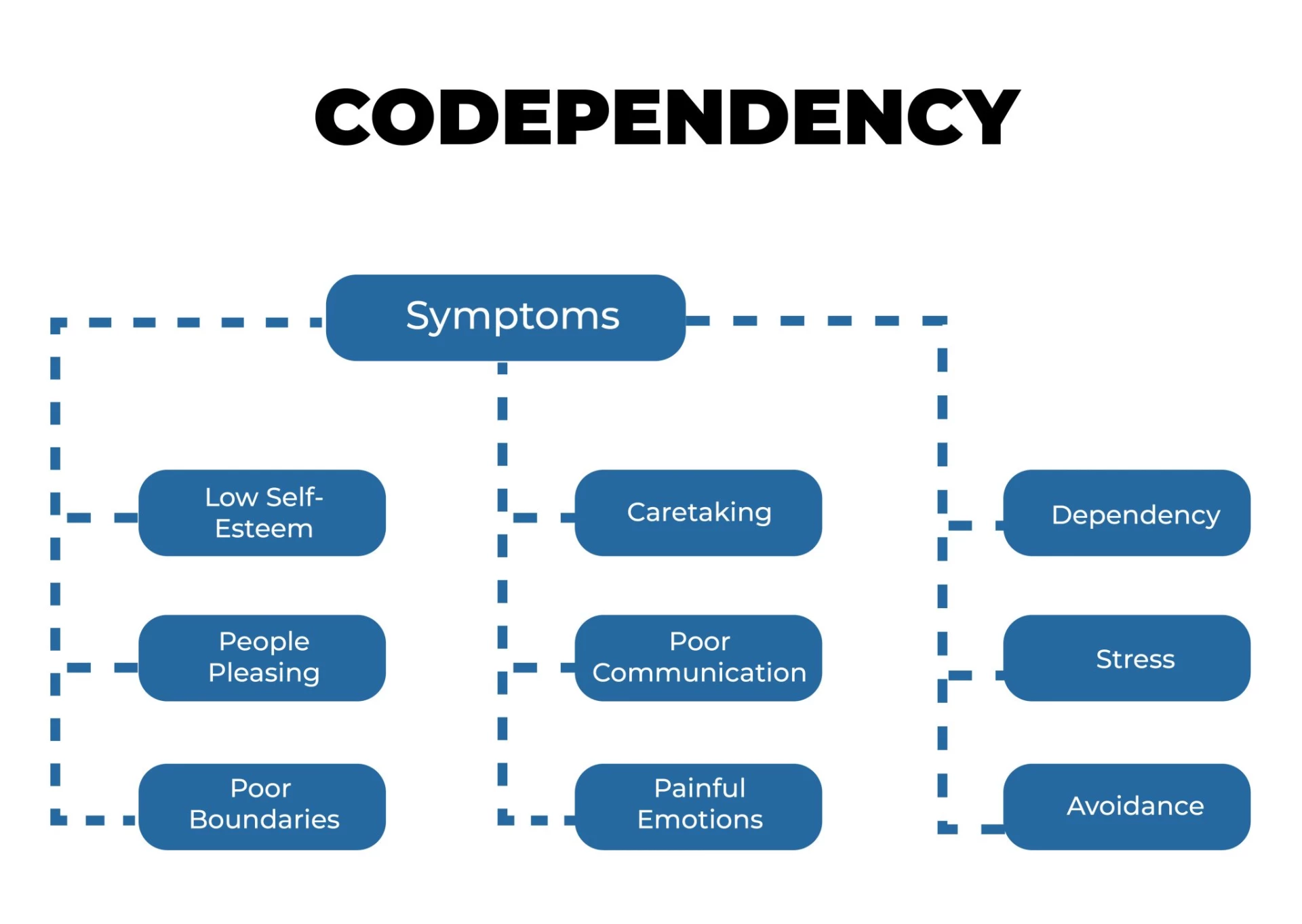
Low Self-esteem
The very first and obvious symptoms are low self- esteem. A codependent individual may not believe that they are worthy of affection or that they are good enough. To feel some sense of self-worth, they may rely on the needs and opinions of others.
Low self-esteem manifests itself in feelings of not being good enough or comparing yourself to others. The tough thing about self-esteem is that some people pretend to have high self-esteem when they really don't feel unlovable or inadequate.
Feelings of humiliation lurk beneath the surface, generally hidden from view. Low self-esteem is frequently accompanied by guilt and perfectionism. You don't feel horrible about yourself if everything is perfect.
People Pleasing
Codependent people are often pleased with everyone. It's natural to want people to like you and to want our loved ones to be happy, but there's a distinction to be made between these natural desires and the constant need to please others.
People pleasers frequently believe that they have no choice except to make others happy. They don't like to say no, even if it means sacrificing their own goals and needs to please others.
Poor Boundaries
Codependent people have poor boundaries. Boundaries are an imagined line that separates you from others. It distinguishes between what is yours and what belongs to someone else, and this includes not only your body, money, and possessions, but also your feelings, thoughts, and wants.
That's where codependents get into difficulty the most. They have hazy or flimsy borders. They blame others for other people's feelings and issues, or they blame themselves for their own. Following hierarchy shows the causes of poor boundaries and stages in which a person becomes codependent.
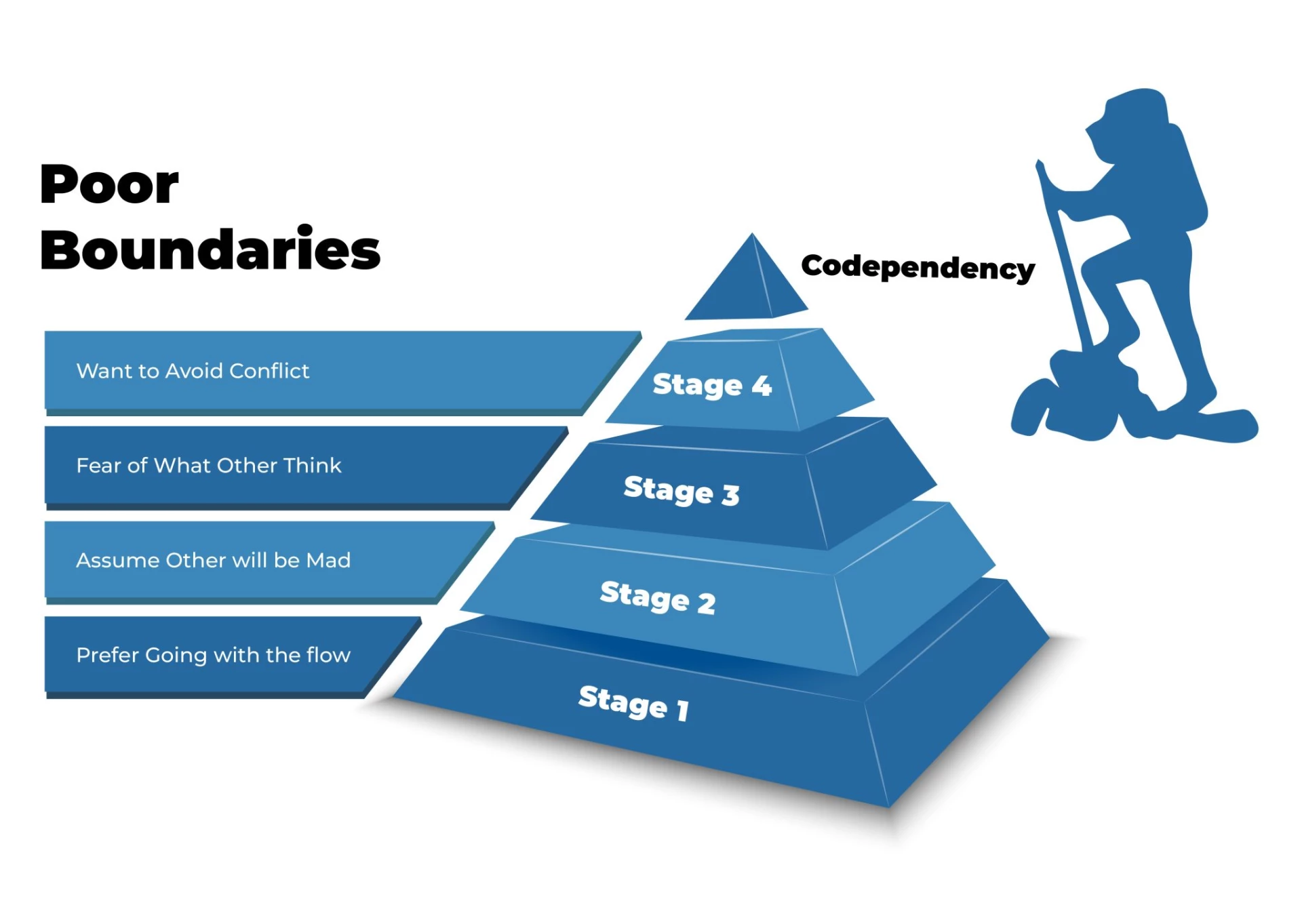
The boundaries of some codependents are set in stone. They are closed off and reclusive, making it difficult for others to approach them. People can swing back and forth between having flimsy boundaries and having strict ones.
It also entails accepting that you are not responsible for the happiness of others. People in codependent relationships frequently have an issue where one partner fails to recognize limits and the other refuses to enforce them.
As a result, one person is domineering and manipulative, while the other is submissive and unable to exert his or her own will. One of the most crucial skills that families must acquire in family counseling is how to set and maintain boundaries.
Caretaking
Another consequence of weak boundaries is that if someone else has a problem, you feel compelled to help them to the point of sacrificing yourself.
It's natural to feel sympathy and empathy for others, but codependents begin to prioritize others over themselves. In reality, they require assistance and may feel rejected if another person refuses.
Furthermore, they continue to try to help and mend the other person, even when it is evident that the other person is not listening to their advice. This usually stems from childhood, when the caretaker learns that failing to meet a parent's demands can have disastrous effects.
Most people can manage on their own, and worrying that things will go horribly wrong if you don't look after them is a sign of codependency. When you feel obligated to look after everyone all of the time, this is an indication of codependency.
Poor Communication
They always have no and poor communication. The dependent individual may have a pattern of communicating in an untruthful manner, preferring to keep control over truly communicating. Another important skill to develop in family therapy is communication
. Both parties must learn to communicate efficiently and honestly. When it comes to articulating their thoughts, feelings, and desires, codependents struggle, of course, this becomes an issue if you don't know what you think, feel, or require.
You know what's going on other times, but you won't admit it. You're frightened of upsetting someone else, so you're hesitant to be honest. Instead of stating, "I don't like it," you may act as if everything is fine. When you try to manipulate the other person out of fear, communication becomes dishonest and unclear.
Painful Emotions
Codependency causes tension and a range of unpleasant emotions. Shame and poor self-esteem cause worry and fear of being judged, rejected, or abandoned; making errors; failing; and feeling trapped by proximity or solitude.
Other signs and symptoms include rage and resentment, melancholy, hopelessness, and despair. When emotions become overwhelming, you may experience numbness.
Dependency
Dependency, of course, is a fundamental factor in codependency. Each person is dependent on the other in some way. Because of addiction, one person's material demands must be satisfied.
To feel good about themselves, codependents require the approval of others. Even though they are capable of functioning on their own, they are scared of being rejected or abandoned. Others need to be in a relationship all of the time since being alone for too long makes them unhappy or lonely.
This characteristic makes it difficult for individuals to terminate a relationship, even if it is painful or abusive. They become stuck as a result.
Stress
Codependent individuals are more stressed than normal individuals. Any of these issues, as you might think, may put a lot of strain on a relationship.
You're bound to have issues if you can't communicate or respect boundaries. The caretaker is frequently stressed out about doing everything correctly, while the dependent person is frequently fearful of being abandoned by the caretaker.
Both are scared of being alone, yet neither is content. Even if there aren't many disagreements since one partner is usually dedicated to keeping the other happy, both partners are likely to be anxious.
Avoidance of Conflict At All Costs
Out of fear of offending or upsetting the other person, one person suppresses their thoughts, opinions, interests, demands, and other significant things to them. To avoid being perceived as tough, people may agree to do things they don't want to do or embrace viewpoints that aren't their own.
This can take the form of "going along to get along" in order to avoid controversy. Poor communication and assertiveness skills might result from not speaking up or advocating for oneself.
Furthermore, a codependent generally feels driven to look after others and has a strong need to be loved by everyone. Intimacy problems, fear of desertion, and mistaking love for pity are all typical characteristics.
These symptoms are specific to a single person or family, as opposed to dependent personality disorder, which has symptoms that affect the entire social network.
What are the causes of Codependency?
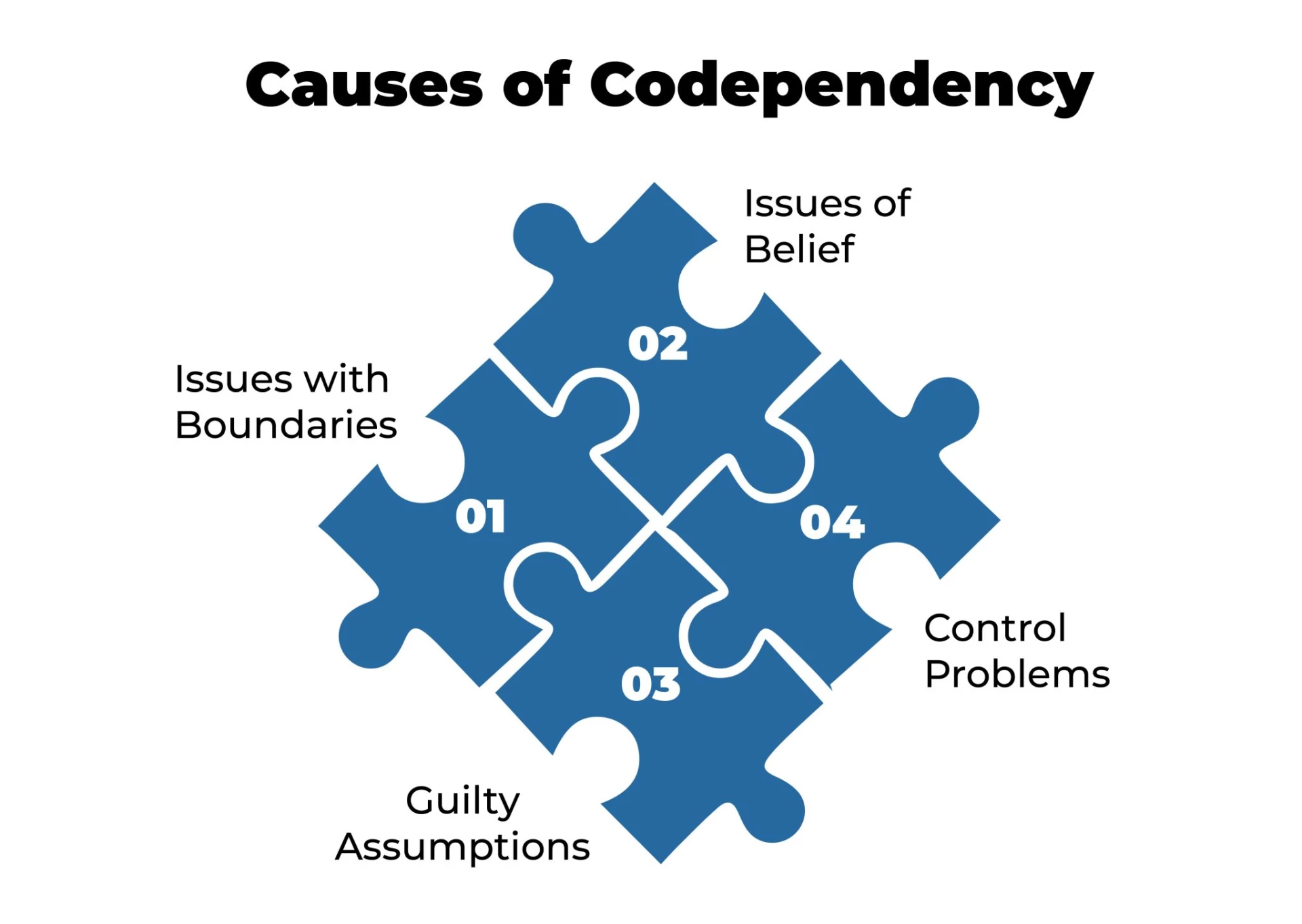
Codependency can be caused by a number of factors. In the past, one person may have had a codependent relationship with a parent. These habits have carried over into their love connection. A pair may go through a traumatic event together, which fosters codependency. Infidelity can cause trust issues, which can lead to codependency.
Issues with Boundaries
Interfere with boundaries is the main cause of codependency. Someone who grew up in a dysfunctional family may have a distorted sense of limits. This has the potential to go either way.
Their boundaries may be so frail that they give in too readily and are treated as if they were a "doormat." Their boundaries can also be so strict that they shut people out completely, making it difficult to maintain good connections.
Guilty Assumption
A persistent sense of underlying guilt is another prevalent concern among those who have come from dysfunctional environments.
They may feel guilty for not being able to improve their home situation, which can lead to intense guilt when something good happens to them. They may believe they don't deserve to be happy as a result of their guilt.
Issues of Belief
Over Beliefs often lead to codependency. A childhood filled with frequent lies and betrayals could lead to adulthood with trust issues. These individuals may constantly doubt the motives of those close to them, making it difficult to create satisfying relationships. In maturity, this can lead to intense feelings of isolation or loneliness.
Control Problems
A codependent individual may be consumed with control or responsibility to an unhealthy degree.
When a youngster is forced to grow up too quickly and accept responsibilities that are above their age or maturity level, they may cling to things they can control when life becomes chaotic. Relationships can be severely strained as a result of this.
Causes of Codependency may further include:
- Abuse of any kind, whether it's physical, emotional, or sexual.
- A caregiver with a personality disorder, such as borderline, narcissistic, or dependent personality disorder, who may push you to repress your self-identity to accommodate them, or a parent or caregiver who ignores a child's needs in favor of their own.
- Controlling or overprotective parents that prevent a child from learning to set healthy boundaries and learning to set appropriate limits
- one or both parents abandoning the family, making you fearful of being abandoned in the future.
- Caregivers who alternate between being caring and present and being aloof and inaccessible contribute to a tense attachment.
- Parental, sibling, or peer criticism and bullying that leaves you feeling insecure in your relationships.
These were some of the major causes of codependency.
What are some Risk Factors of Codependency?
The factors which are highly responsible for codependency are called risk factors of codependency. While anyone can end up in a codependent relationship, there are some elements that make it more which include the following list:
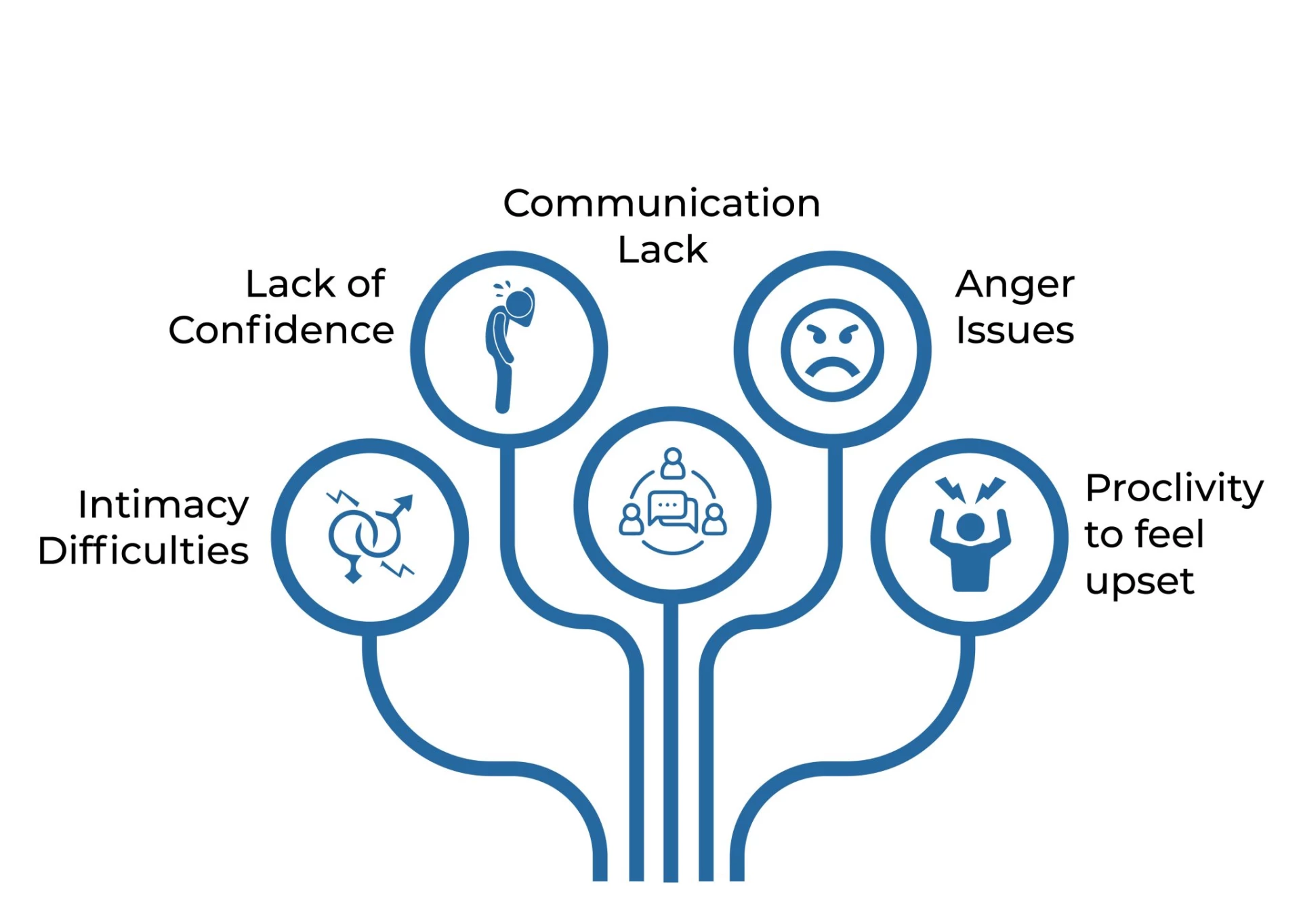
- Lack of confidence in oneself or others
- Fear of being abandoned or alone
- A desire to exert control over others
- Anger issues Consistently lying
- Communication abilities are lacking.
- Having difficulty making judgments
- Intimacy difficulties
- Setting boundaries is difficult.
- Having difficulty adjusting to change
- A strong desire for acceptance and acknowledgment; a proclivity to feel upset when others do not acknowledge their efforts
- A constant desire to do more than their fair share of the work A proclivity to conflate love with pity
- An inflated sense of personal responsibility for others' actions
Now, I will take you to the next important chapter which includes the difference between Codependency and Interdependency.
Chapter 3:
Codependency v/s Interdependency
The third chapter of this article will define a new correlating term called interdependency and will differentiate two correlating terms.
In this chapter, I will clear the difference between Codependency and Interdependency.

What is Interdependency? Difference between Codependency and Interdependency.
“Interdependency is the dependence of two or more people or things on each other.”
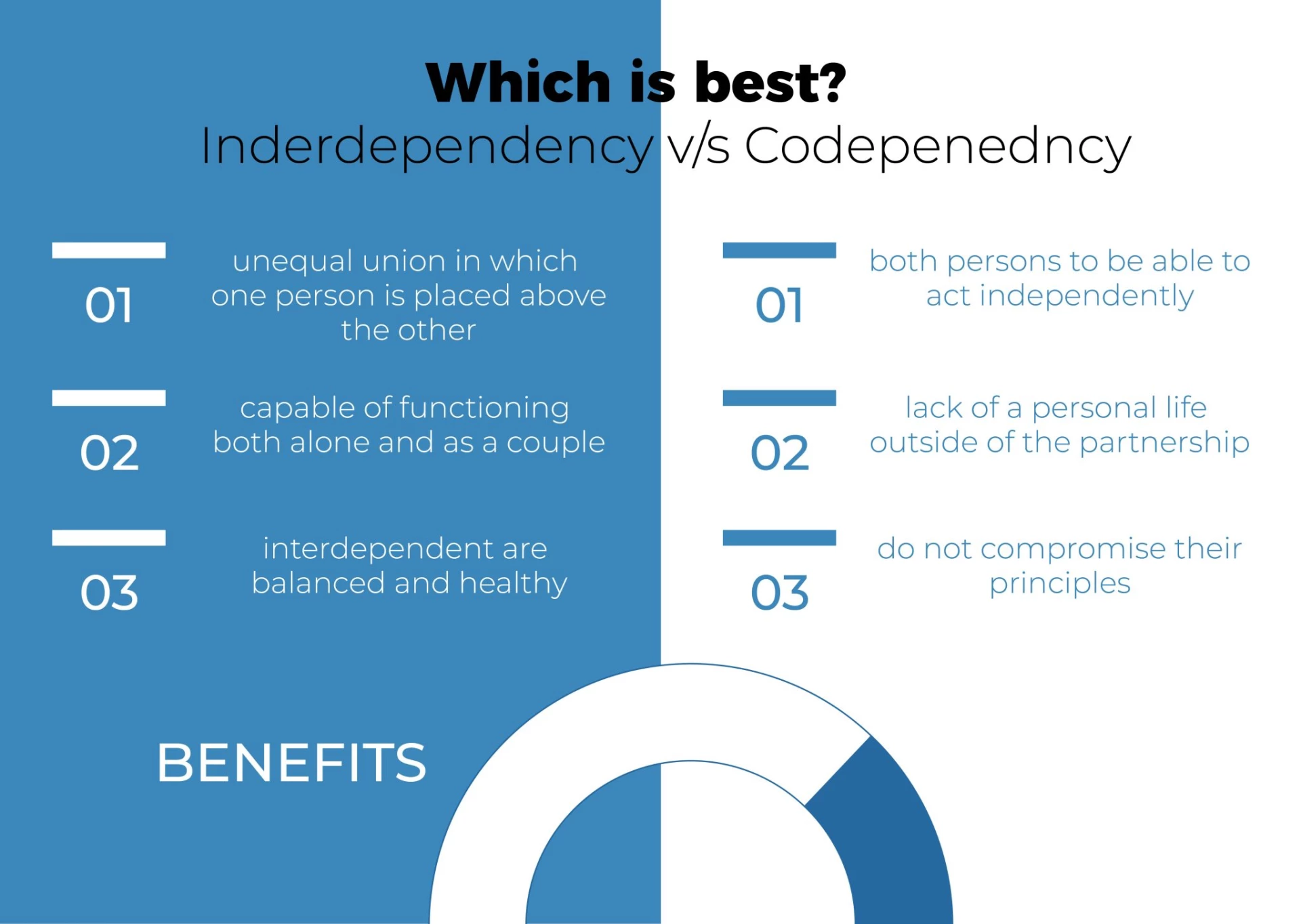
Codependency's healthy relative, interdependency, is a good thing. Interdependency requires both persons to be able to act independently, whereas codependency is an unequal union in which one person is placed above the other.
Our society talks about dependency as if it's something we should avoid at all costs. We admire people who maintain their independence and mock others who are overly reliant.
The truth is that extremes are seldom healthy, but there is a happy medium. Interdependence is the midway ground. Interdependent relationships allow you to be yourself and express your individuality while also providing a safe base, ensuring that you have someone who is there to support you at all times.
People in interdependent relationships will maintain a strong sense of self and purpose while yet wanting to be connected to the other. They will still care for each other and enjoy their partner's praise, but they will no longer rely on these things for their own self-worth.
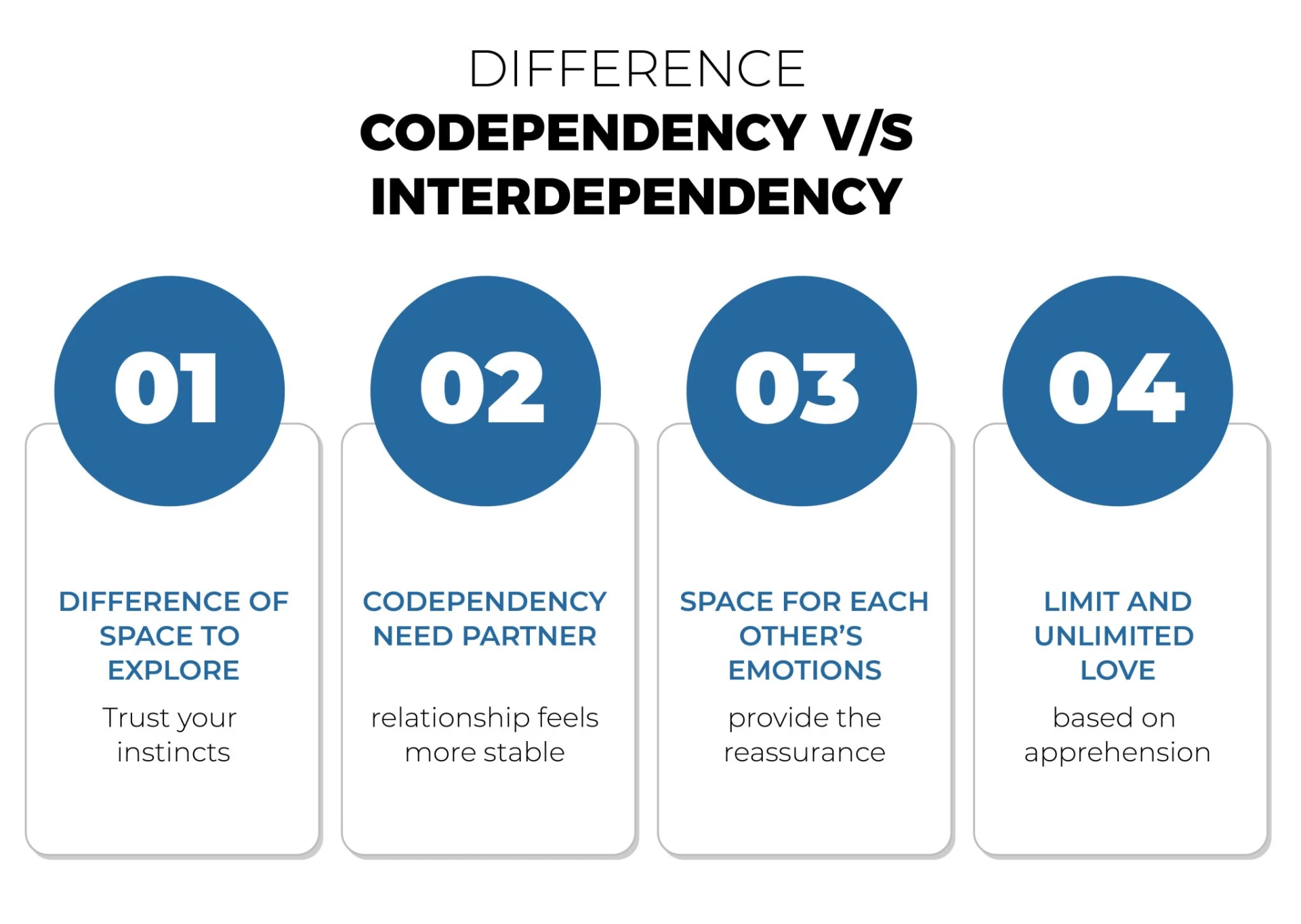
These are some points which are discussing the difference between codependency and interdependency.
1. Difference of Space to explore
Codependency is a result of growing up in a tangled household that doesn't value your individuality. Your concentration begins to wander when your space is not respected and your boundaries are continually broken. Because you live in an environment where your needs and wants are unimportant, you stop thinking about them.
As a result, you look for validation from others. You look for answers outside of yourself, which leads to harmful relationships because you don't trust your instincts about who is toxic and who's healthy.
An interdependent relationship, on the other hand, allows you to develop a strong sense of self by pursuing your own interests. You have the freedom to trust your intuition and reach your full potential.
2. Codependency need partner
You rely on your partner to give you comfort in a codependent relationship. You need to feel good when you don't have a sense of self. You require their affirmation that you are lovely.
You require them to express their affection for you. You require their availability at all times. In essence, you require them to meet your own requirements.
Everything feels natural and secure in an interdependent relationship. You're sure of who you are and what you're worth. You don't ask your partner to accomplish anything; you accept them for who they are, which allows them to show their love for you without fear of rejection.
Interdependent couples come from an empowered place of wanting their partner, not needing them, which allows them to bring their highest selves to the table because they are in charge of their life and achieving their own meaning. As a result, the relationship feels more stable and secure.
3. Space for each other’s emotions
It's natural for us to project our prior hurts onto others, particularly our partner. In fact, the unconscious projection of our own worries and anxieties is a hallmark of codependent relationships.
Interdependence, on the other hand, acknowledges each individual's emotions without taking it personally. When your partner is envious or insecure, you stand by them and provide the reassurance they require while allowing them to handle their own emotions.
After all, you're both aware that you're to blame for your own prior traumas and wounds. When they rise to the surface, you identify them and work through them in order to let them go – both collectively and individually.
This level of empathy and understanding is an excellent basis for a lovely, loving relationship that encourages both of you to develop and heal.
4. Limit and Unlimited Love
The basic sensation in a codependent relationship is I love me if you love me, which means the love you have for each other is limited. Because the foundation of this form of love is unstable to begin with, it will never be stable.
Instead, it's based on apprehension. It has restrictions and limitations. That isn't how interdependent relationships work. Interdependence loves both yourself and another person at the same time, and your love for each other is as genuine as it gets. Regardless of hurdles, arguments, or circumstances, you love each other.
Interdependence v/s Codependency: Which is best?
Although both of these terms are mixing, both of them are very different and each have their own unique meaning. Interdependency requires both persons to be able to act independently, whereas codependency is an unequal union in which one person is placed above the other.
In codependent bad relationships, manipulation, warped communication, and dominating behaviors are all too prevalent. Also evident are emotional intimacy issues, as well as a lack of a personal life outside of the partnership. Individuals in interdependent relationships, on the other hand, are capable of autonomy.
They are capable of functioning both alone and as a couple; they are attached to, close to, and reliant on one another.
Codependent people, despite their need for one another, do not compromise their principles or give up their freedom. Relationships that are interdependent are balanced and healthy. Making interdependence a habit in your relationship is a terrific way to build a healthy, mutually happy partnership in which you both value the tie you share.
Couples in good relationships will feel close and intertwined while still being able to make their own decisions.
So, no doubt interdependency seems to be best between the two. However it totally depends on how a particular person wants to spend his life.
Now, I will move to the next important chapter which is about treatment of Codependency.
Chapter 4:
Recovery from Codependency
This chapter will explain effective treatments to overcome codependency.
This chapter will also explain A’s treatment for Codependency and different therapies for codependency.

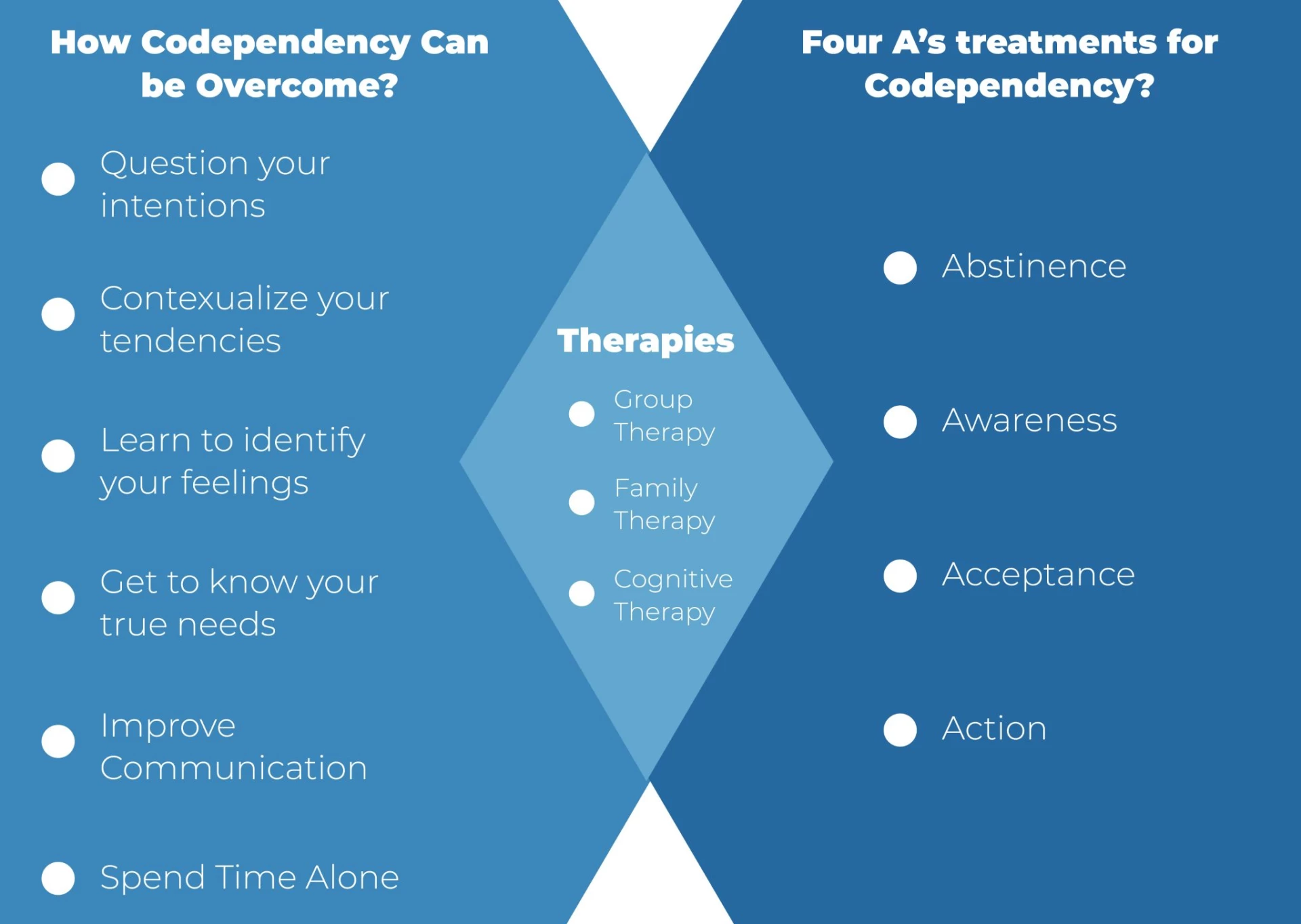
How Codependency Can be overcome?
Some people are able to break free from codependency on their own. Some people may be able to change their behavior just by learning what it is to be codependent and the harm it causes. You can overcome codependence by taking the following steps:
1. Question your Intentions
It's common in codependency patterns for us to lose our path when it comes to relational decision-making. Consider whether your aims are primarily for your own benefit or for the benefit of your spouse.
We become more prone to neglecting ourselves and generating anger towards our relationship when we consistently put our partner's wants and needs ahead of our own. Understanding the motivation behind our actions allows us to behave from a position of strength rather than reacting to our partner's perceived feelings.
2. Contextualize your Codependent Tendencies
In our hyper-dependent culture, codependency gets a bad rap. People who are struggling with it start by practicing compassion for themselves when they become stuck in codependent loops.
Many of the attributes that individualistic societies consider "codependent" are celebrated in communalistic civilizations. For instance, putting others first, self-sacrifice for the greater good, and a nuanced understanding of others' needs. Codependency does not imply that you are weak or imperfect, or that you have "failed" to look after yourself. It denotes your status as a relational survivor.
3. Learn to Identify Your own Feelings
Over-identification with our partner's feelings and under-identification with our own feelings is a frequent codependency dynamic.
Feelings may provide a lot of useful information and direction. So, regardless of our own emotions, if we consistently pay more attention to our partner's sentiments, we are more than likely acting in a more serving and attentive manner to them.
4. Get to Know your Own True Needs
Separate genuine needs from fear and avoidance. Is it more important to avoid someone's condemnation at all costs, or is it more important to prevent burning oneself out by giving too much?
Is it more important to avoid making a mistake, or is it more important to offer you some grace and allow yourself to be human at this moment? Slow down, soothe yourself, and check in with what you truly require on a regular basis.
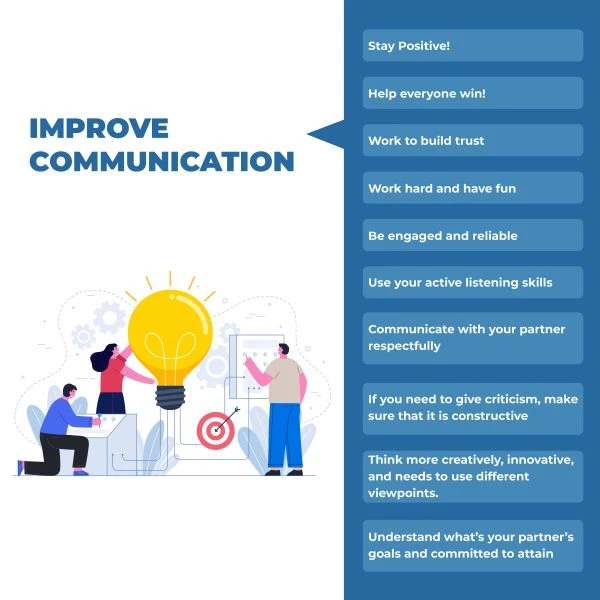
5. Improve Communication
Improvement in communication is one of the fastest ways to overcome codependency. When feasible, learn to be bravely direct in your communication with people, leaving as little opportunity for interpretation as possible.
If someone asks you if you're free tonight, respond "No, I'm not free tonight," rather than "Well, I'm feeling a little fatigued." Clear communication starts with clear communication with oneself. Allow others to perceive you for more than your "pleasing," peacekeeping, or diplomatic persona.
6. Spend Time Alone
When we begin to utilize other people to cope with our own discomfort and emotions, codependency patterns emerge. Not only do we require quiet time and space to identify our feelings, but we also require time alone to establish trust in our ability to care for ourselves and our emotions.
Trust takes time to develop in any relationship, and our relationship with ourselves is no exception. Allow yourself space outside of your relationship to get to know yourself.
7. Build Trust in your Fence
Build trust in others and be kind to others. When you find yourself worrying about how others view you or what they think about anything you said or did, remember that you have no control over what goes on in other people's heads.
People should be trusted to find their own path and solve their own problems. Even when you disappoint others, your own kindness shows through.
A few more factors can aid in the development of a positive, balanced relationship:
- People in codependent relationships may need to take little actions toward separating themselves from their partners. They may need to discover a pastime or interest outside of the relationship that they like.
- A codependent individual should make an effort to spend time with supportive family or friends.
- The enabler must determine that allowing their codependent partner to make significant sacrifices is not helping them.
People in codependent relationships benefit greatly from individual or group counseling, an expert can assist people in recognizing and expressing sentiments that may have been suppressed since childhood.
People who have been abused must learn to recognize past abuse and re-experience their own needs and feelings.
Finally, both partners in a codependent relationship must learn to recognize certain patterns of behavior, such as "needing to be needed" and expecting the other to revolve their lives around them.
These measures are difficult to follow, but they are well worth the effort since they will assist both sides in learning how to have a balanced, two-sided relationship.
What are four A’s treatments for Codependency?
The Four A's are four steps in several codependency therapy approaches:
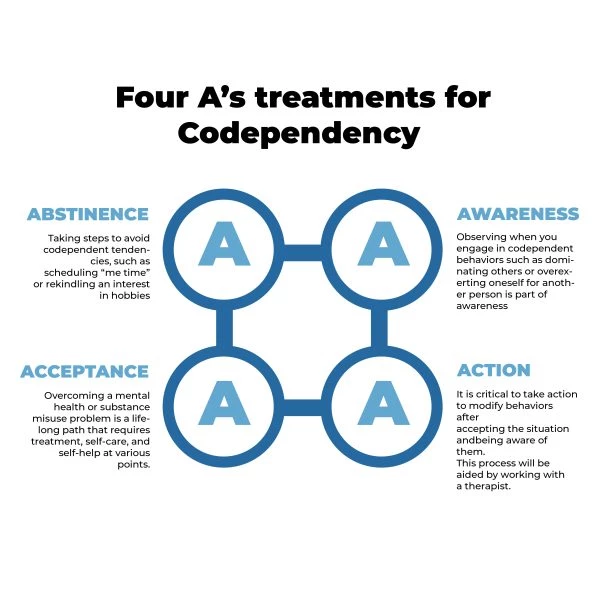
Abstinence
This entails taking steps to avoid codependent tendencies, such as scheduling "me time" or rekindling an interest in hobbies.
Awareness
Recognizing that codependency is a problem, like recognizing that substance misuse is a problem, is a critical first step toward seeking assistance and putting an end to problematic behaviors.
Observing when you engage in codependent behaviors such as dominating others or overexerting oneself for another person is part of awareness.
Acceptance
Overcoming a mental health or substance misuse problem is a lifelong path that requires treatment, self-care, and self-help at various points.
Action
It is critical to take action to modify behaviors after accepting the situation and being aware of them. This process will be aided by working with a therapist.
Which forms of therapies are available for Codependency?
There are three forms of therapies available for Codependency that are mainly group therapy, family therapy and cognitive therapy. Let me walk you over each one of them in detail.
Group Therapy
There are various potential group interventions for codependency that may be beneficial. Individuals can build healthier relationships in a safe environment thanks to the group dynamic.
Giving positive feedback and holding people accountable are common in group therapy. The methods used in group therapy may differ. Some of them incorporate cognitive behavioral therapy, in which participants are taught specific skill-building techniques.
The 12-step program is followed by other codependency groups. Individuals learn about their relationship addiction in the same manner that other 12-step groups do. Goals could include improving self-awareness, self-esteem, and emotional expression.
Family Therapy
The dysfunctional family dynamics are the focus of family therapy. Members of the family learn to recognize their problematic tendencies so that they can improve their relationships. A common goal of family therapy is to improve communication.
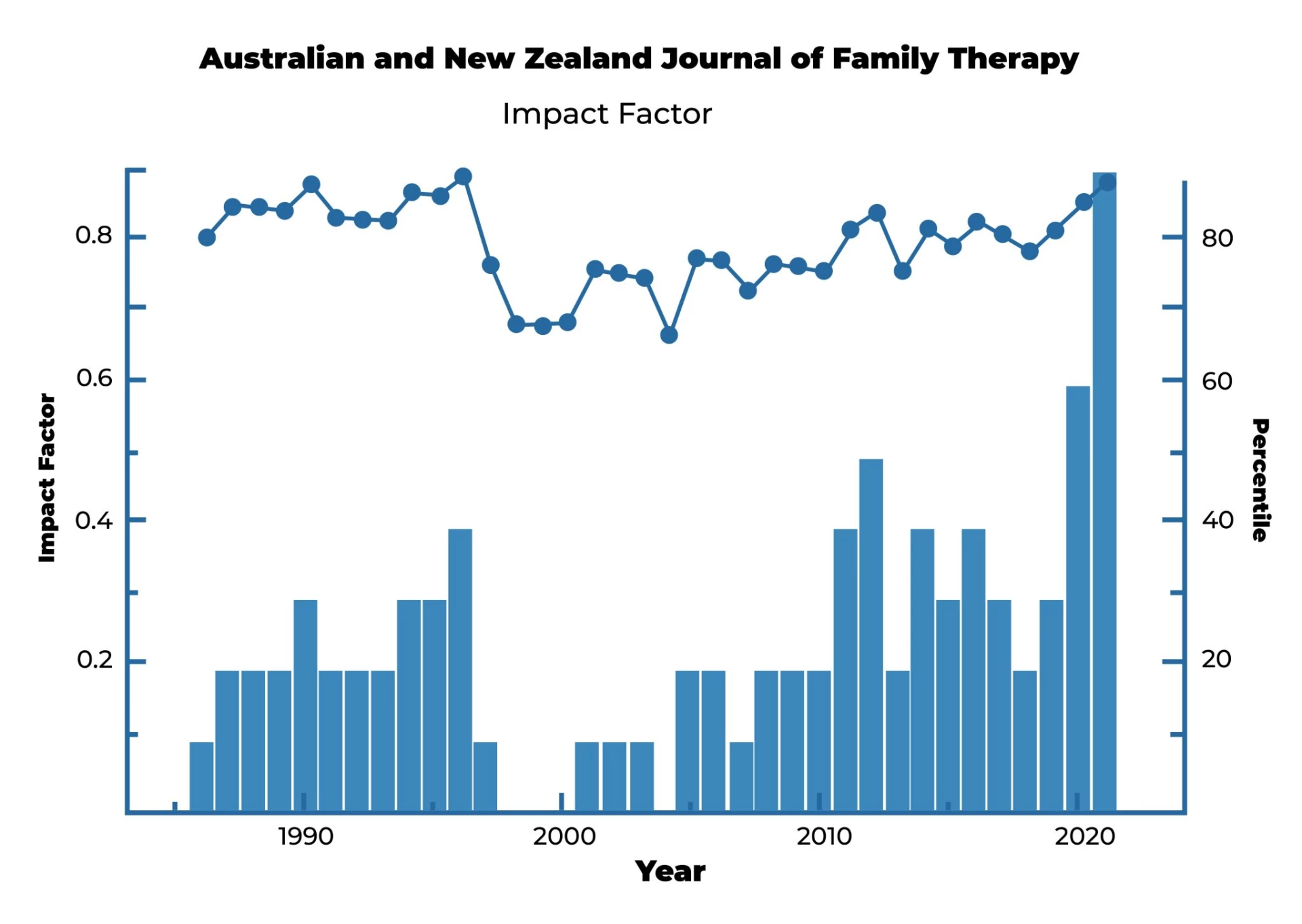
In therapy, issues that have never been handled in the family may be brought up. When one person makes a change such as getting sober or pushing someone to be more independent, the entire family dynamic might alter. Let us look at the example. Following chart explains the progress of family therapy in Australian and New Zealand:
Cognitive Therapy
The ideas that contribute to dysfunctional relationship patterns can be targeted using cognitive therapy. For example, someone who believes, "I can't tolerate being alone," is likely to go to considerable lengths to keep the relationship going, even if it is unhealthy. Learning to accept unpleasant feelings and correcting erroneous thinking may be the emphasis of therapy sessions.
The goal is most likely to result in good behavior adjustments and allow the other person to take more personal responsibility for their actions. Because most codependent people model their relationships after the ones they saw as children, treatment may dive into a person's childhood. Therapy can help someone reconnect with their emotions and re-experience a wide spectrum of emotions.
Now I will move to the next chapterwhich contains information about prevalence of codependency in adults, children, men and women.
Chapter 5:
Prevalence of Codependency
The proportion of people with codependency in different age groups is known as prevalence.
This chapter will discuss the prevalence of codependency in adults, children and women.
How Codependency occurs in different individuals?
Although it is impossible to determine the actual incidence of codependency in the general community, particular populations are thought to have greater rates. Codependency may be more common in people who have experienced early childhood trauma, are in a close relationship with someone who has a substance use disorder, or have personality traits that make them vulnerable to codependency, such as a high anxiety score, a need for approval, or soul thoughts.
Codependency in Men v/s Women:
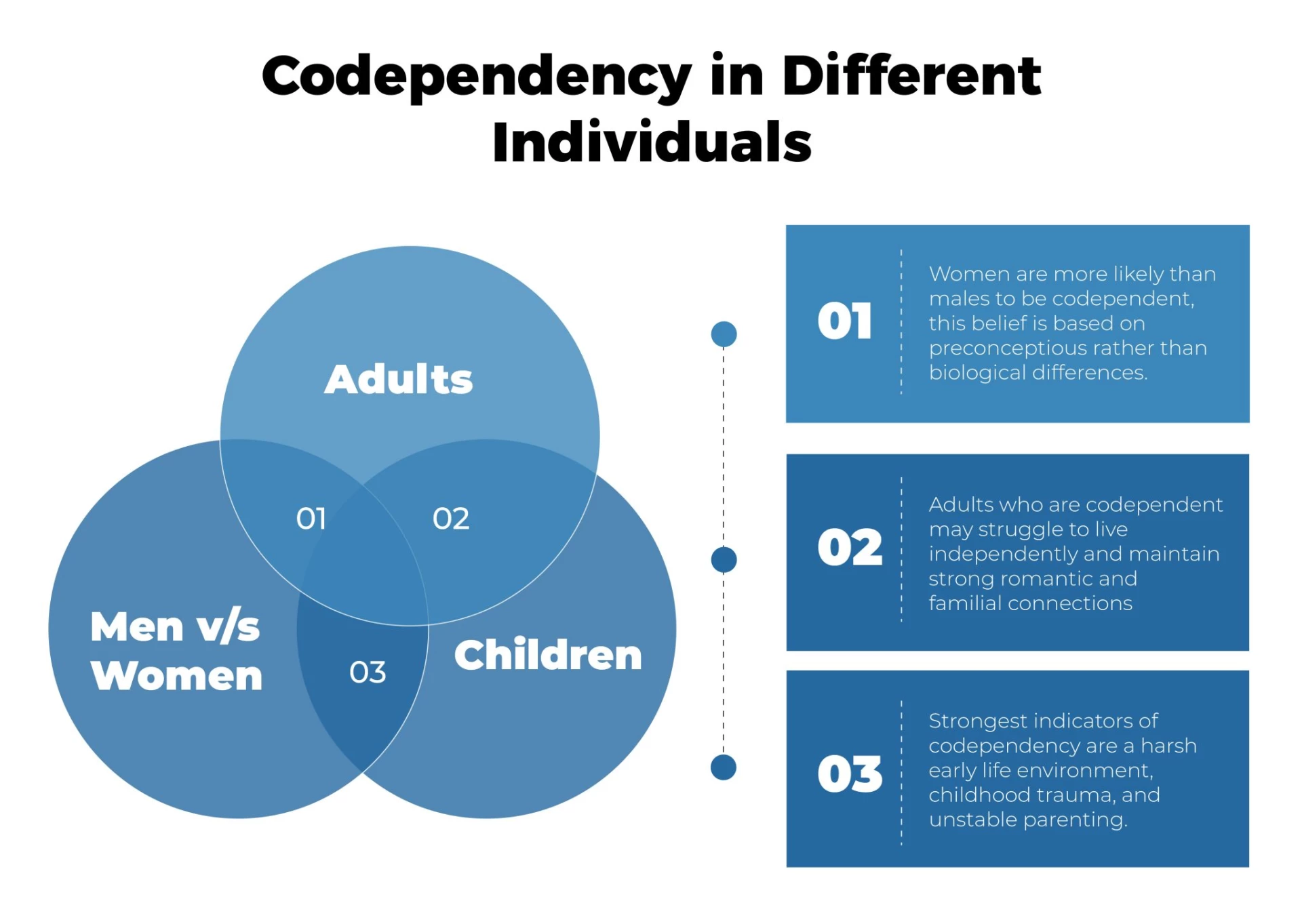
While it is true that women are more likely than males to be codependent, this belief is based on preconceptions rather than biological differences.
Different rates of substance use among men and women may also be linked to gender disparities in codependency. Codependency may be linked to personality rather than gender, according to studies.
Codependency in Adults:
Codependency can be a recurrent experience because it is commonly passed down through generations. Adult codependency is frequently linked to having grown up in difficult or stressful family situations, such as those involving addiction or mental illness.
Low self-esteem, people-pleasing, difficulty controlling emotions and communication, and excessive thinking are all signs of codependency in adulthood. Adults who are codependent may struggle to live independently and maintain strong romantic and familial connections.
Codependency in Children:
Children that have a codependent parent typically pick up on their parent's codependent behaviors.
Children with a codependent parent or substance abuse in the household may believe that their self-worth is related to satisfying their parent, or they may feel uncomfortable or nervous about the parent-child relation, perpetuating the emotional neediness cycle.
Some of the strongest indicators of codependency are a harsh early life environment, childhood trauma, and unstable parenting.
How to Tell If You Are in a Codependent Relationship?
Someone else, in a variety of roles, models our codependent behaviors for us. Codependent behaviors are typically displayed by a major person in our lives with whom we have had a close relationship, teaching us that this is how love is supposed to look.
Codependency is frequently the result of a family dynamic in which abuse, neglect, addiction, or alcoholism are prevalent. We establish codependent behaviors in order to be seen, heard, loved, acknowledged, and important, or to try to manage the pain of abuse.
Those codependent relationships can sometimes be traced back to childhood, especially if there were issues with a parent who taught them that their own needs were less important than their parents'. Children in these situations can be taught to prioritize the needs of their parents over their own. Parents who are in need may teach their children that if they desire something for themselves, they are being selfish or greedy.
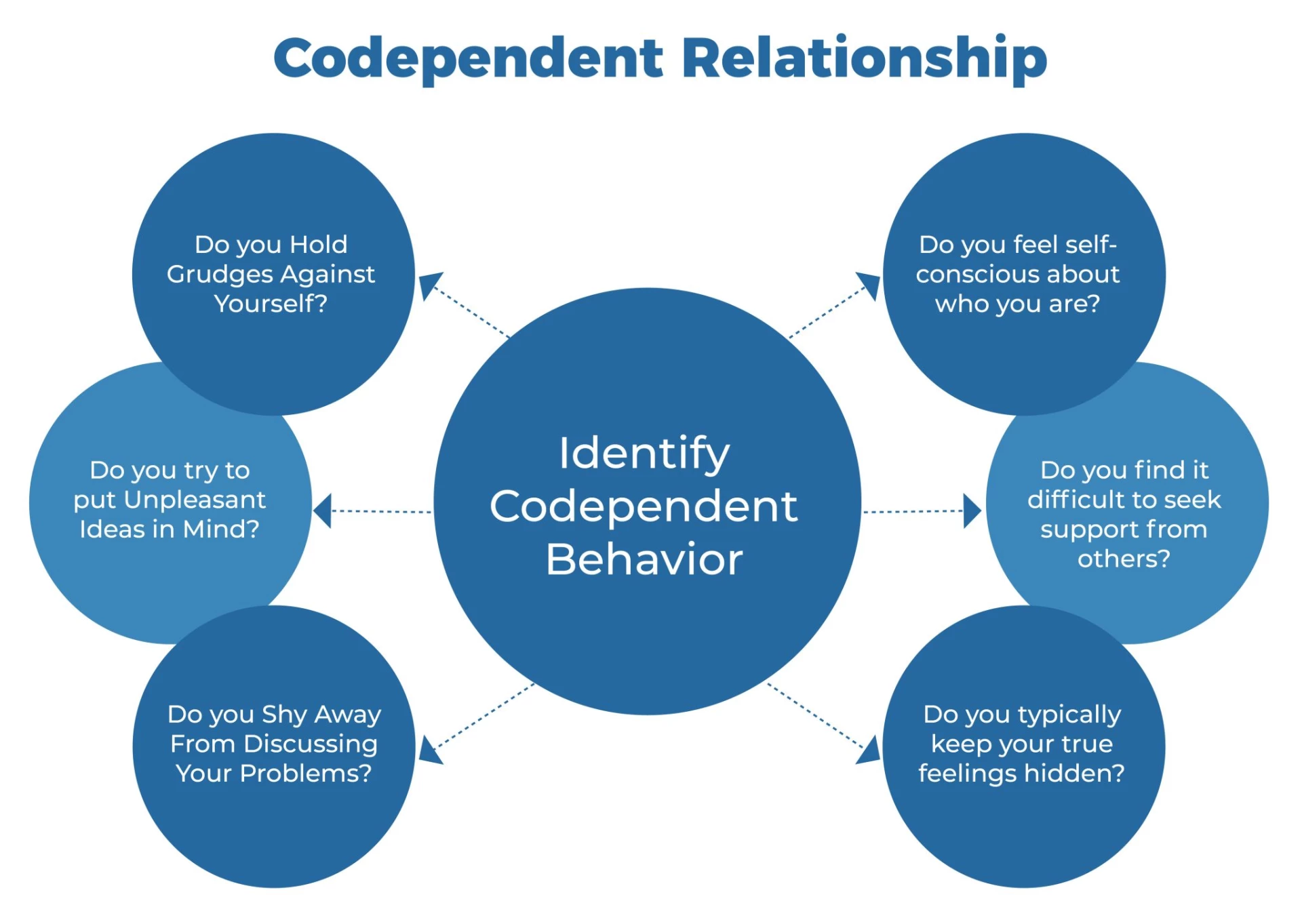
While codependency cannot be detected through a lab test or a brain scan, there are certain questions you can ask yourself to help you identify codependent behavior.
- Do you feel obliged to assist others?
- Do you strive to exert control over events and how others should act?
- Are you terrified of letting others be themselves and allowing circumstances to unfold naturally?
- Do you feel self-conscious about who you are?
- Do you use helplessness, guilt, coercion, threats, advice-giving, manipulation, or domination to try to control events and people?
- Do you find it difficult to seek support from others?
- Do you feel compelled or obligated to assist others in resolving their difficulties
- Do you typically keep your true feelings hidden?
- Do you shy away from discussing your problems?
- Do you try to put unpleasant ideas and feelings out of your mind?
- Do you hold grudges against yourself and knock yourself down?
If you answered yes to many of these questions, your relationships may be exhibiting codependent behavior patterns. Detecting these tendencies is a crucial step in learning how to break free from codependency.
As I have briefly explained about the prevalence of codependency, now I will move to the next chapter which is about Development of Codependence Relationship.
Chapter 6:
Development of Codependence Relationship
This chapter will explain how codependency relationships are developed by following certain paths.
It will also list out some of the ways to change codependent relationships.

How does a Codependent relationship develop?
Codependency is a taught tendency that is often the result of previous behavioral patterns and emotional challenges. Living with an alcoholic father was once assumed to be the cause. Codependency can now be caused by a variety of factors, according to experts.
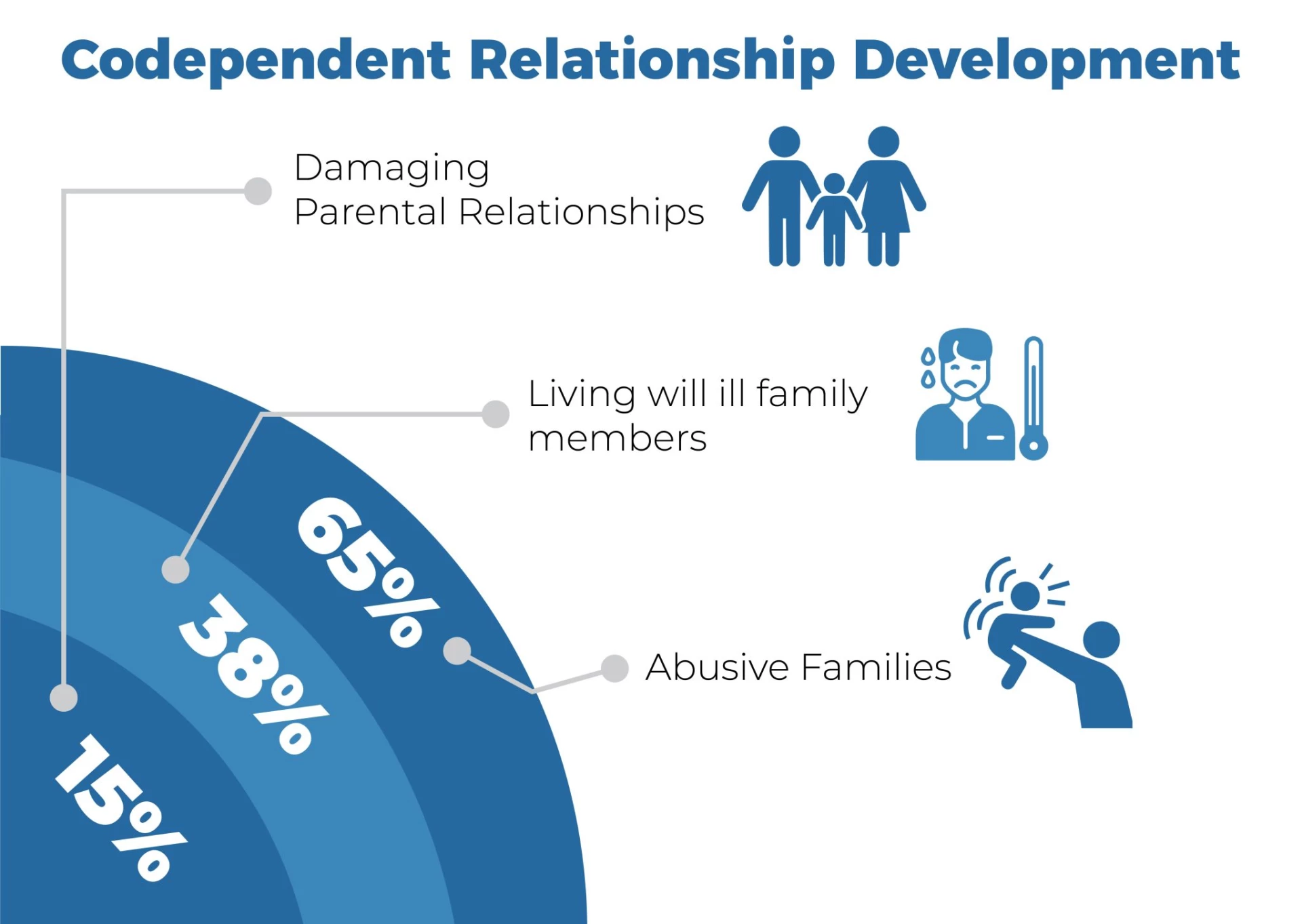
Damaging Parental relationships:
People who are codependent as adults frequently have issues with their parents as children or teenagers.
They may have been taught that their own needs were secondary to, or even unimportant to, those of their parents. In these households, the child may be trained to prioritize the needs of the parents and to never think about themselves.
Needy parents may educate their children that if they desire something for themselves, they are selfish or greedy.
As a result, the child learns to put their own wants aside and focus solely on what they can do for others.
One of the parents in these scenarios may have:
- a lack of maturity and emotional growth resulting in their own self-centeredness
- alcohol or drug addiction problem
These circumstances cause a child's emotional development to be stunted, enabling them to seek out codependent relationships later in life.
Living will ill family members:
Caring for a chronically ill person can potentially lead to codependency. Being a caregiver, especially at a young age, might cause a young person to disregard their own needs and develop a habit of solely assisting others.
Being required by another person and receiving nothing in return might shape a person's self-worth. Codependency does not emerge in many people who live with a sick family member.
However, it is possible in these types of family contexts, especially if the family's parent or primary caregiver exhibits the dysfunctional behaviors outlined above.
Abusive Families:
Physical, emotional, and sexual abuse can lead to long-term mental health issues that can persist for years or even a lifetime. Codependency is one of the many difficulties that can occur as a result of past trauma.
As a protective mechanism against the anguish of abuse, a child or teenager who has been mistreated will learn to repress their feelings. As an adult, this acquired behavior leads to them only caring about the sentiments of others while ignoring their own needs.
Because they are only experienced with abusive relationships, people who have been abused may seek out harmful relationships afterwards. Codependent relationships are a common example of this.
How to change Codependent relationships?
Individuals that are self-sufficient concentrate on their own capabilities. Instead of seeking counsel from others, they prefer to follow their own instincts and inclinations. Individuals who place a strong emphasis on their independence may find it difficult to form interdependent connections.
As a result, if one of the partners is self-sufficient, intimate connection may be difficult.
Interdependence, on the other hand, is something we can learn and cultivate in our relationships. We can, for example, change codependence by:
- Being genuine
- Having the courage to be vulnerable
- Having the courage to ask for what we require
- Appreciating our uniqueness and sincerity
- When it's necessary, saying "no"
- Hobbies and strong interactions with others are important.
- People-pleasing should be avoided at all costs.
There are solutions for codependency, even if it may appear that there are none. Many novels about codependency have been written, providing intimate glimpses into real lives, stories of suffering, and stories of recovery.
The key to resolving a codependent relationship is to understand the subconscious motivations of both individuals. When the meaning and purpose of our lives are dependent on the existence of another person, the solution to our rehabilitation is to reposition our lives' meaning and purpose.
This can entail having faith, believing in a Higher Power, or discovering a new sense of purpose and meaning for many people. The way we conduct our lives, how we interact with others, and, most significantly, how we relate to ourselves are all affected by codependent behaviors.
We begin by examining our needs, wants, and desires in order to gain a better understanding of ourselves. By gaining a fundamental grasp of who we are as individuals, we may take steps to nurture these small pieces of ourselves by establishing boundaries. Healthy boundaries are the clear lines we make between ourselves and others that show who we are and what we won't allow.
Finally, I will move to thelast chapter of our guide which will explain Codependency as a disease.
Chapter 7:
Codependency as a Disease
This chapter will explain codependency as a disease. This chapter will define Codependent Personality Disorder and will differentiate this term from codependency.
At the end this chapter will see if there is any relation between Codependency and Addiction?

Is codependency a disease?
Codependency is neither a personality disorder nor a mental ailment that has been formally recognized. Rather, it's a distinct psychological construct with a lot of similarities to other personality disorders.
What is Codependent Personality Disorder?
Although codependent personality disorder is regarded as a mental health illness, efforts to have it recognized as such have failed. Dependent personality disorder, personality disorder, post-traumatic stress disorder (PTSD), and histrionic personality disorder all have characteristics for codependent conduct.
Giving up on someone with mental illness should be avoided even if there is no definitive diagnosis. Codependency symptoms may or may not exist in some circumstances, making this a rare condition.
“Codependency personality disorder is a psychological disease in which people are overly reliant on specific loved ones in their lives. This dependency frequently evolves to the point where the dependents' behaviors and feelings are blamed on the impacted others.”
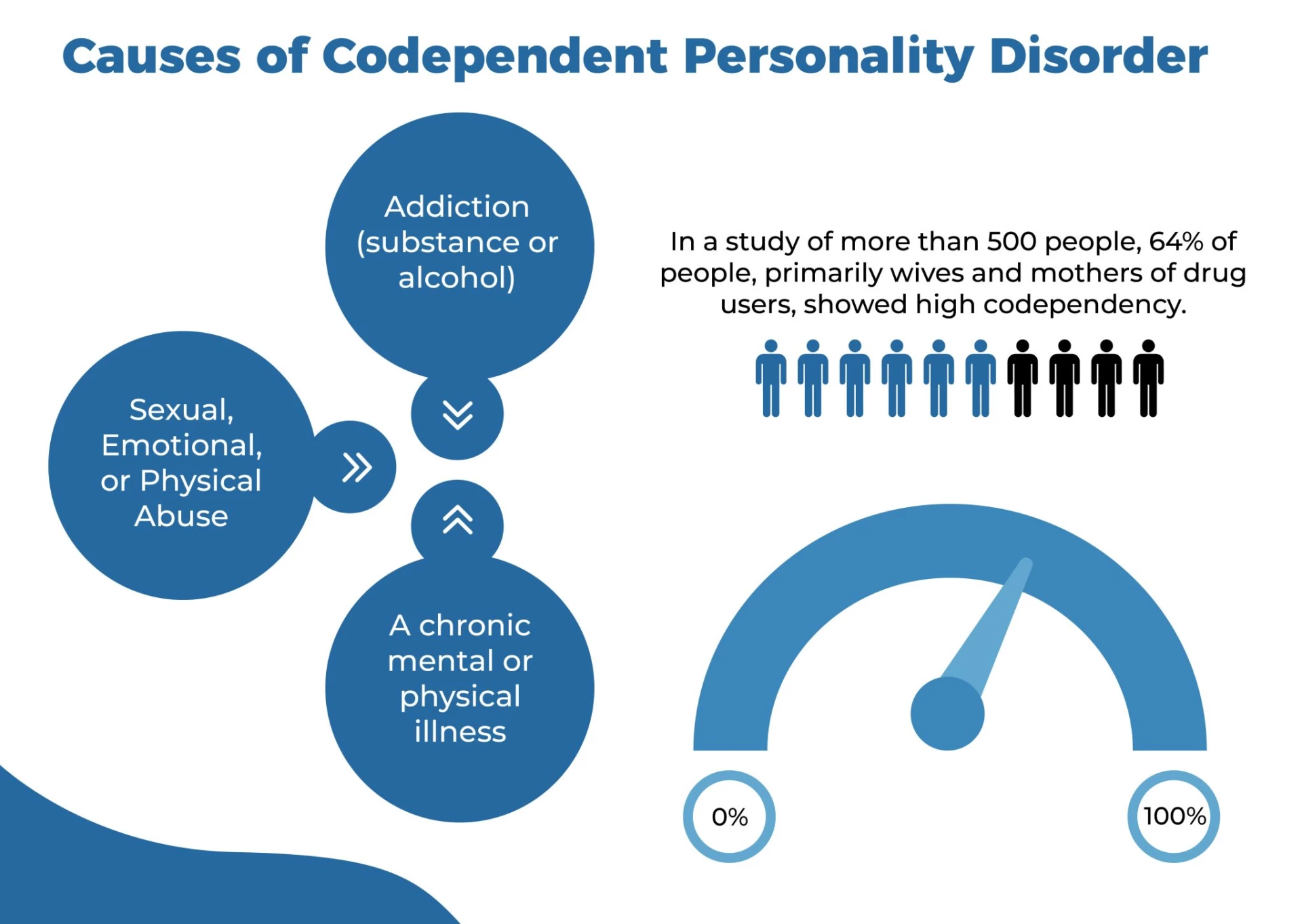
Personality disorders are a form of behavioral health issue that affects a person's capacity to operate and maintain a high standard of living.
People with personality disorders may find it challenging to sustain good relationships and have a distorted view of themselves and others. Dependent Personality Disorder can have a negative impact on a person's quality of life and relationships, and it is often associated with other mental illnesses.
Is Codependency a Mental Illness?
Is codependency a psychological condition? The Diagnostic and Statistical Manual of Mental Disorders, Fifth Edition provides a comprehensive framework for symptom identification and classification of behavioral health disorders.
Codependency should be an officially recognized mental health condition, with qualifying diagnostic criteria borrowed from other disorders such as dependent personality disorder, borderline personality disorder, histrionic psychological disorder, and even comment stress disorder, according to mental health experts as early as 1986.
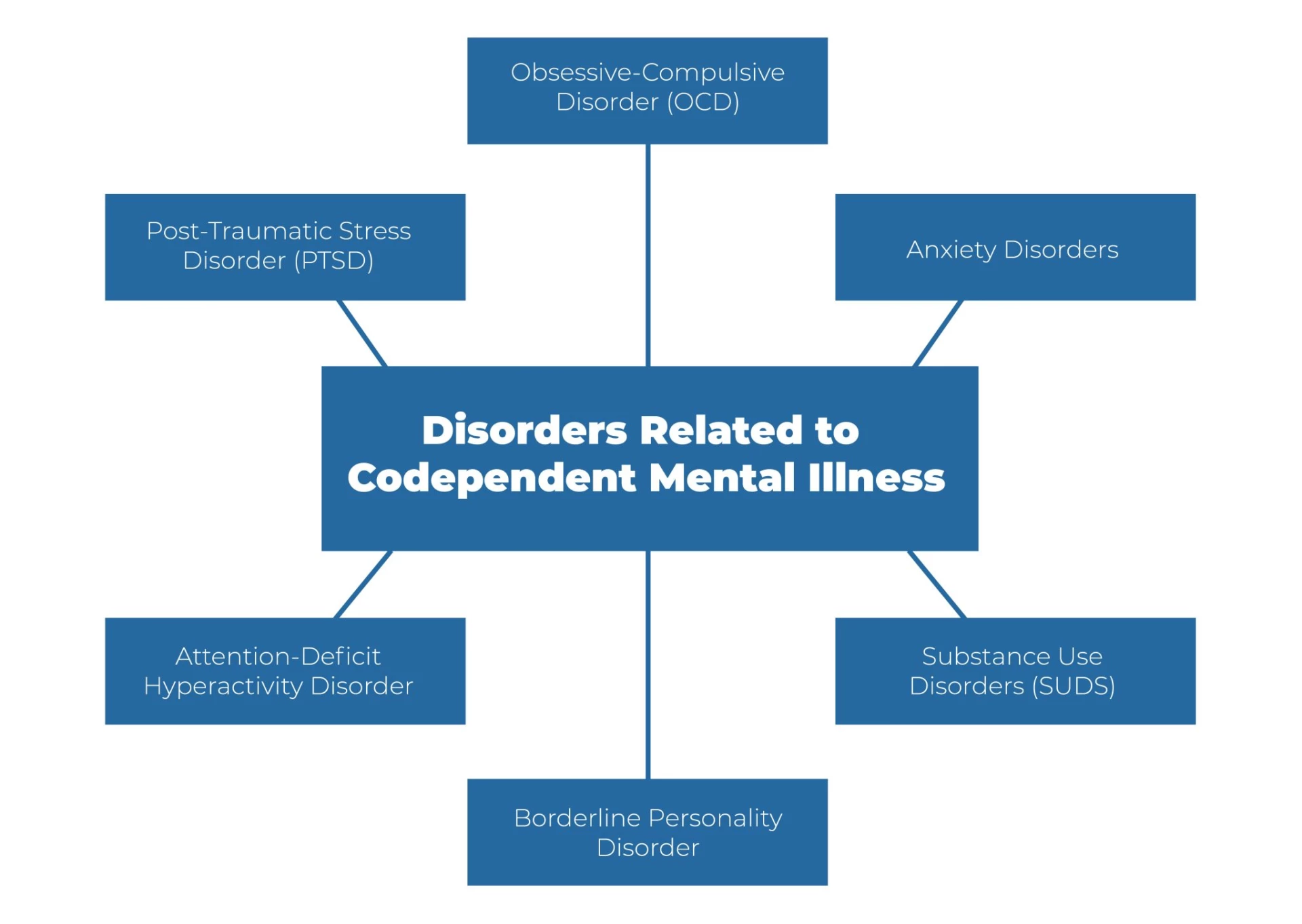
Codependency, on the other hand, has eluded attempts to make it a recognized disorder. The DSM-5, the most recent revision of diagnostic criteria, recognizes only dependent personality disorder, not codependency, as an established diagnosis.
The argument for not having a separate diagnostic for codependency arises from the belief that the problem overlaps too much with other mental health disorders to warrant its own label. Codependency symptoms, for example, are similar to those of dependent personality disorder (DPD) and borderline personality disorder (BPD).
However, newer research suggests that while persons with codependent personalities can have qualities from both DPD and BPD, other people with codependency do not have symptoms from either, implying that codependency is a distinct mental health illness.
What are the Differences between Dependent Personality Disorder and Codependency?
The signs of codependent personality disorder and codependency are the most similar. The nature of the relationship, though, distinguishes the two.
A codependent individual will show dependent tendencies toward a single person, whereas a person with dependent personality disorder will show dependent traits toward anyone. Interpersonal interactions will be difficult for someone with borderline personality disorder, whereas codependency fosters reliance on one person.
Codependency is neither a personality disorder nor a mental ailment that has been formally recognized. Rather, it's a distinct psychological construct with a lot of similarities to other personality disorders.
Emotional, psychological, and social well-being are all part of mental illness. It has an impact on the brain's cognition, perception, and behavior.
It also influences how a person deals with stress, interpersonal interactions, and making decisions. While codependency is a psychological problem in which a person feels overly reliant on loved ones in their lives. The dependency frequently escalates to the point that the one who is affected feels responsible for the dependent's feelings and actions. As the disease progresses, they'll begin to doubt their own self-worth and perception.
Is there any link between Codependency and Addiction?
In many relationships, codependency and addiction occur at the same time. When a person is struggling with a drug or alcohol addiction, loved ones can play a critical role in aiding that person in seeking help and finding the drive to complete the recovery process.
Codependent relationships, on the other hand, might have the opposite impact. When a person with a substance use disorder is in a relationship with a codependent, breaking their addiction to alcohol or drugs becomes considerably more difficult.
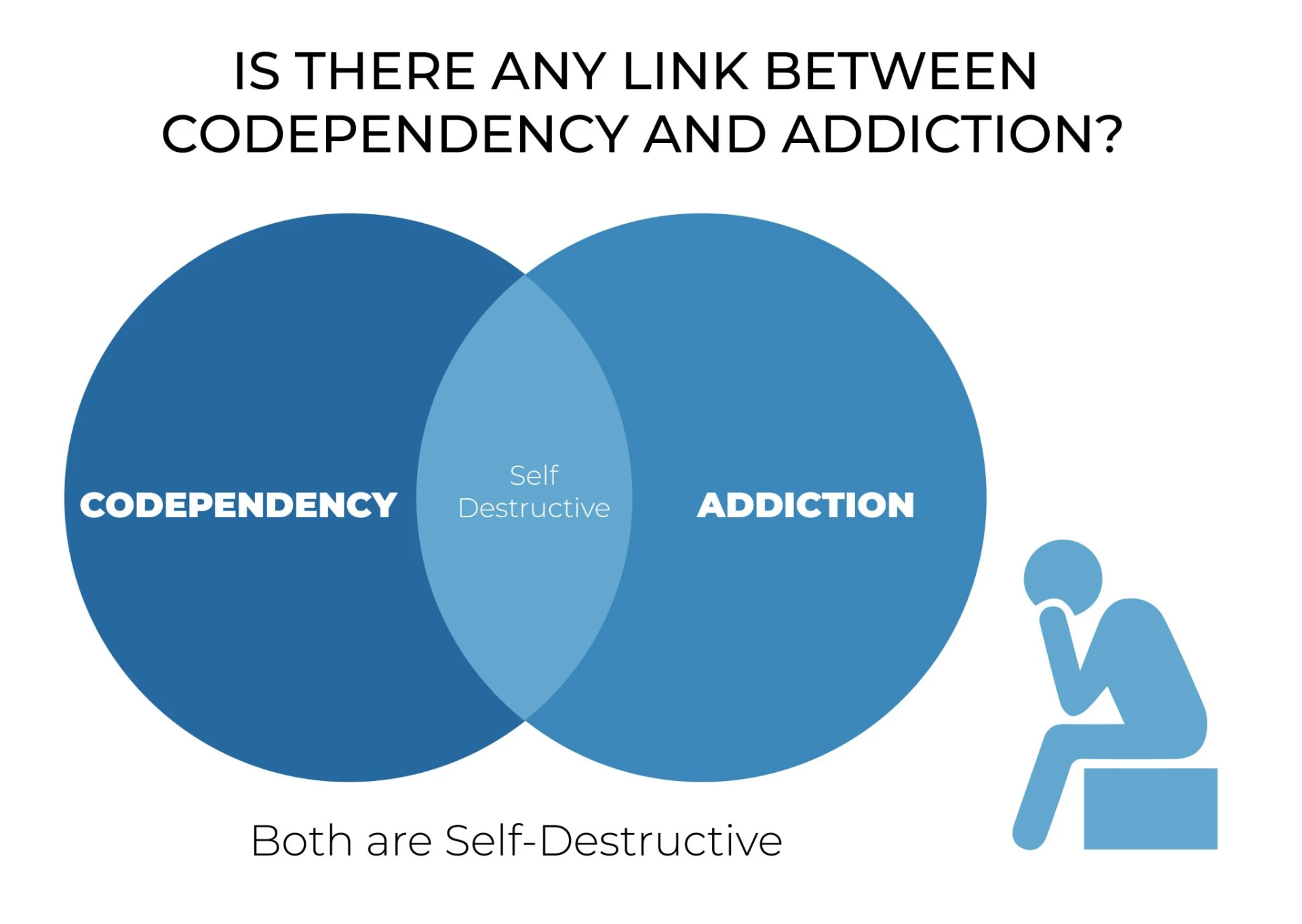
Similarly, a codependent may struggle to complete the codependent recovery process due to a desire to aid and enable the person who is addicted to drugs or alcohol. Relationships between an addict and a codependent are frequently self-destructive and will continue to be so unless adequate assistance is provided.
Conclusion
Congratulations!
You've completed this guidebook admirably, and you now have all the information you require regarding Codependency.
I hope that this article will be useful to you in your daily life and that it will provide you with a thorough grasp of codependency.
For your treatment, take all of the steps indicated in this handbook.
- What section of this guide was most informative to you?
- Which treatment do you find most effective for codependency?
- Do you find 4A’s treatment interesting?
- Are you a codependent person?
Have all of your questions been answered in the guide? If you still have queries about any area, let me know in the comments section below.
Frequently Asked Questions
What are 5 characteristics of a codependent person?
1.Making decisions in a relationship is difficult.
2.It's difficult to put your sentiments into words.
3.Communication problems in a relationship.
4.Others' approval is more important to you than your own.
5.Having low self-esteem and a lack of trust in you.
