Are you eager to launch your coaching business but feeling overwhelmed about where to start?
You're not alone!
In this article, I'll help you understand what a coaching business plan involves. I'll provide you with a coaching business plan template and also teach you how to shape it so that it mirrors your vision and goals. I'll walk you through every step to ensure you create a successful coaching business plan tailored to your niche.
Let's dive into the world of business planning, where clarity meets strategy.
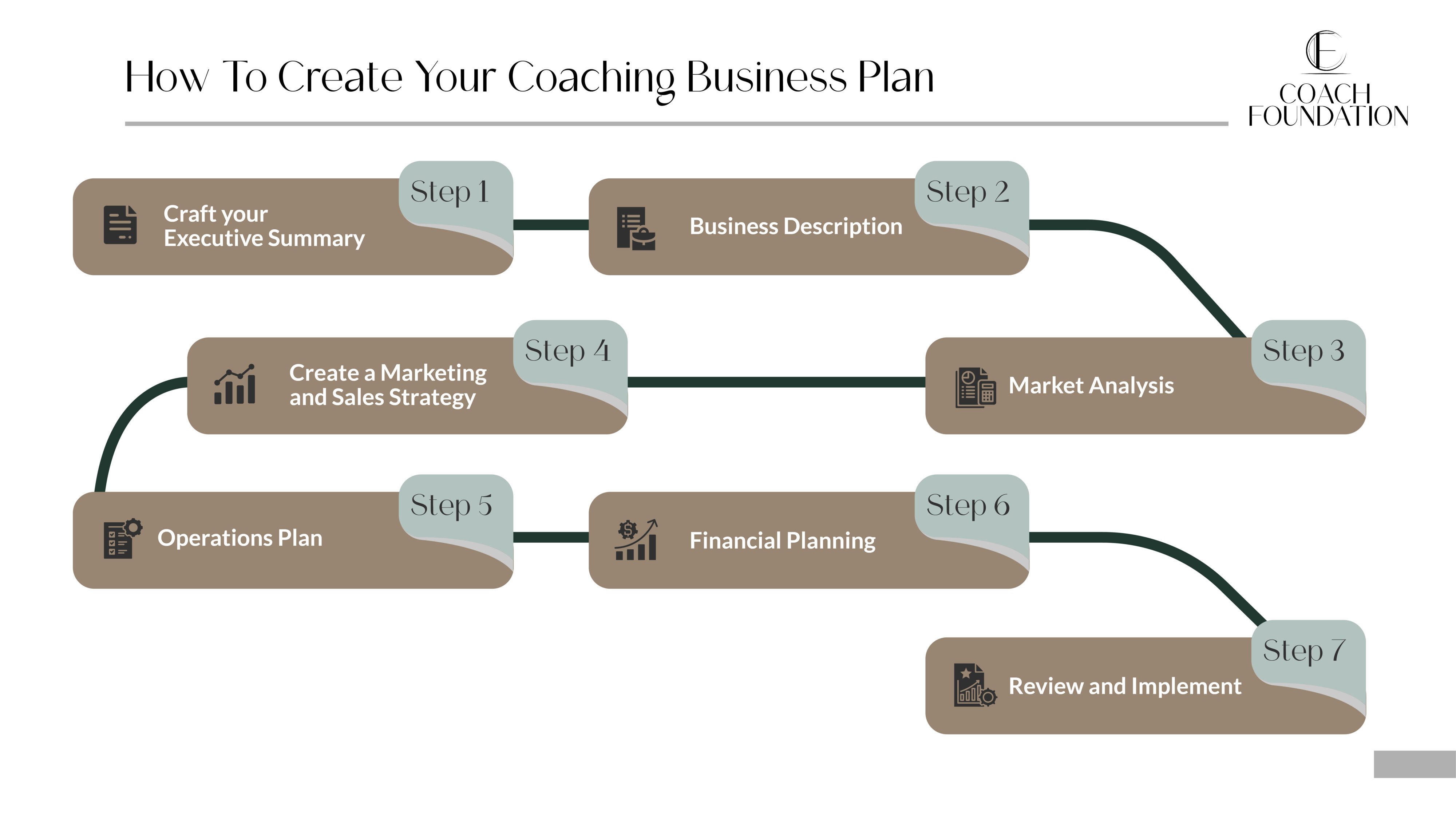
In Brief :How to Craft your coaching business plan in 7 simple Steps
Step 1: 📝 Executive Summary - Craft a compelling summary that encapsulates your business vision, mission, and core elements like the business name, owner, and location, setting the stage for what follows.
Step 2: 🗂️ Business Description - Detail your coaching services, niche, and operational mechanics. Explain how these elements work together to meet the needs of your clientele.
Step 3: 🔍 Market Analysis - Conduct a thorough analysis of your target market and competition. Use this data to tailor your services and pinpoint market opportunities.
Step 4: 📈 Create a Marketing Strategy - Develop a comprehensive marketing plan that includes digital and traditional methods to attract and retain clients, ensuring your brand stands out.
Step 5: ⚙️ Operations Plan - Outline your business’s operational structure, including the logistics of daily operations and the roles of your team members.
Step 6: 💰 Financial Planning - Forecast your business’s financial health with detailed budgeting, pricing strategies, and expected financial outcomes.
Step 7: 🚀 Review and Implement - Regularly review and refine your business plan to ensure it remains relevant and effective
Last updated: March 2026
Do You Need a Coaching Business Plan?
Image from Pixabay.com
A few years ago, I was just like you—excited yet baffled about the right steps to take in starting my coaching business. I dabbled in social media, attended conferences, tried podcasting, and explored various other avenues.
Despite my efforts, the results were far from what I needed. It felt like I was constantly moving, but not in the right direction.
Then it clicked. I realized that diving headfirst into business without a well-thought-out plan was like sailing without a compass.
So, I took a step back and started from scratch, this time with a clear strategy in mind. I laid out a business plan that not only guided my business to success but also continues to guide me today.
Starting a coaching business can be an exciting venture, but without a clear plan, it’s easy to lose direction and focus. A business plan helps you outline your business objectives and also provides a roadmap to achieve them.
Here's why a business plan is vital for a coaching business:
How To Create Your Coaching Business Plan
A well-structured business plan outlines every critical component of your operation, from your business identity and client demographics to your financial management and growth strategy.
To start your coaching business, begin with a powerful executive summary in your business plan. This section is like the front cover of a book—it needs to captivate and inform.
Here's how to craft an executive summary that sets the stage for a compelling business plan:
2. Business Description
Here, you explain what your business does, how it operates, and what it aims to achieve.
This section gives context for the rest of the business plan. It helps stakeholders understand your business at a detailed level.
Choose Your Niche
https://youtu.be/VSk9Jrb9U9g?si=8hd2dF9WUbMgt5yD
Choosing a coaching niche and specifying your services are key. This sets your business apart.
Detail your target market. Whether you focus on life, executive, or health coaching, each meets unique client needs. Focus on demographics like age, profession, or specific challenges. Your coaching addresses those challenges.
Explain how your services are tailored to meet these needs, and discuss your business’s competitive edge. List your services in this field. Include personal coaching, group workshops, and online courses.
Also, showcase what makes you unique. For example, you might have a special coaching method. Or, you could be highly skilled in a popular coaching area.
Business Structure
The structure of your coaching business can greatly impact its operations and growth. You may operate as a sole proprietorship, a partnership, or a corporation. Each type has its own implications.
A sole proprietorship is easy to start and gives you full control. But it also leaves you fully liable for debts. On the other hand, a corporation shields you from debt and can attract investors. It does this through its structure and ability to sell shares. However, corporations face more rules and taxes.
Choose the structure that fits your business goals. Consider how it affects liability, taxation, and investment.
Business Model
Your coaching business can adopt various models to deliver its services, depending on your target market and your expertise:
Value Proposition
What sets your coaching services apart is your unique value proposition.
For instance, your approach might integrate cutting-edge psychological research, or perhaps you offer a unique blend of strategies drawn from various disciplines such as mindfulness, behavioral science, and leadership training.
Maybe your services are particularly tailored to a niche market, such as startup entrepreneurs or corporate executives facing burnout.
Highlighting this uniqueness in your business plan helps potential clients and investors understand why your coaching services are not just necessary but highly desirable.
3. Market Analysis
A thorough market analysis is crucial. It helps you understand your environment. You can identify opportunities and challenges. Then, you can make strategies. These strategies use your strengths to meet market demands.
This part of your business plan will show the whole market. It will offer key insights. These insights will help you set real goals and grow in a lasting way.
Identify your Target Market
Identifying your target market involves defining the specific group of people who are most likely to benefit from your coaching services. Key aspects to consider include:
Market Need
This section details the specific needs your coaching services address.
Are your clients looking for career advancement, personal growth, better stress management, or improved leadership skills?
Understanding these needs allows you to tailor your offerings effectively.
For example, if there is a high demand for stress management techniques among corporate workers in your area, your coaching could focus on mindfulness and resilience training.
Analyze your Competition
Analyzing your competitors helps you understand the current market landscape and identify what sets your coaching apart. Consider the following:
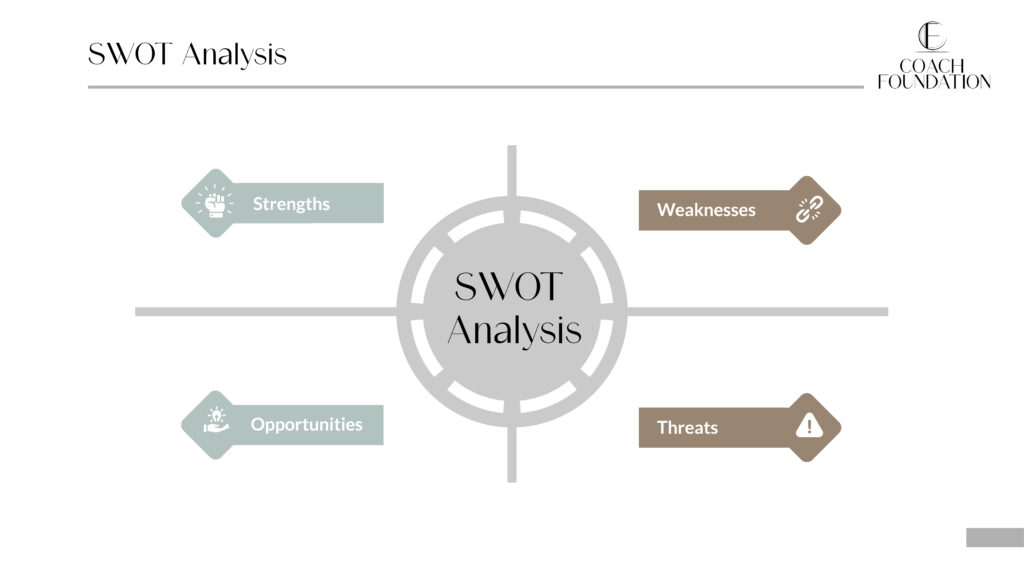
SWOT Analysis
A SWOT Analysis is a strategic method used to evaluate the Strengths, Weaknesses, Opportunities, and Threats.
Use it to analyze your coaching business:
4. Marketing and Sales Strategies
Image from Pixabay.com
An effective marketing and sales strategy is critical for the success of any coaching business. This part of your business plan outlines how you will attract and keep clients.
It details your approaches to reaching your target market and turning leads into paying customers. The right strategy boosts visibility. It also improves client engagement and loyalty.
A well-crafted marketing plan is essential. It sets clear goals and identifies the best tactics to reach them. It ensures your marketing is consistent, targeted, and effective. They help build brand recognition and trust.
Branding
Developing your coaching brand involves creating a distinctive identity that resonates with your target audience and sets you apart from competitors.
Key elements include:
Marketing Channels
To reach your potential clients effectively, utilize a mix of marketing channels tailored to where your audience spends their time:
Effective marketing can significantly boost your coaching business, attracting a steady stream of clients. It not only draws attention but also captures and retains interest
Sales Strategy
Converting potential clients into paying clients requires a clear sales process:
Set up a sales funnel. A sales funnel is a process that guides potential clients from their first interaction with your brand through various stages of engagement until they make a purchase.
It starts with awareness, often through your marketing efforts, and progresses to interest (engaging with content), decision (attending a consultation), and finally action (purchasing a coaching package).
https://www.youtube.com/watch?v=EEp4fS7LGe4
5. Operations Plan
The Operational Plan section of your business plan provides a detailed look at how your coaching business works. This section outlines the day-to-day operations that support your coaching business.
This includes preparing for client sessions, both scheduled and ad-hoc and follow-up activities for each session, client communication, and administrative tasks like scheduling, billing, and client records management.
It’s important to specify how these tasks are handled and by whom, as well as any business hours or response time commitments you make to your clients.
If your operations are mostly or entirely online, detail the platforms and technologies used to facilitate virtual coaching sessions. This model offers greater flexibility and a wider potential client base. It also ensures privacy and security for your communications.
For an offline or physical location, describe your coaching office, its location, and why it’s important to your coaching services. Include any considerations for accessibility, comfort, and professional environment.
A hybrid model involves a combination of online and offline services. Explain how you integrate these aspects smoothly.
Technology Used
Technology is crucial in running a modern coaching business efficiently. List the specific technologies and software you utilize for various business functions:
Staff and Resources
Finally, detail any staff or additional resources needed to operate your business effectively. This includes any administrative support, marketing personnel, or additional coaches.
If you handle most operations solo, discuss any outsourced services you might need, such as virtual assistants, accountants, or IT support.
6. Financial Planning
The Financial Plan is a critical section of your business plan. It is crucial for both potential investors and for you as the owner.
It shows that your coaching business is financially viable. It gives a roadmap for financial success.
This section is crucial for securing funding. It shows you understand your business's finances.
Image from Pixabay.com
Startup Costs
Outline all initial costs required to start your coaching business. This includes any licensing fees, initial marketing expenses, technology setup costs, office equipment, and any other expenditures necessary to launch your business.
Pricing Strategy
Set your prices for your coaching services based on the value you provide, the demands of your target market, and your competitors’ pricing. You can also offer different pricing tiers based on the length and depth of the coaching provided or discounts for upfront payments for a series of sessions.
Revenue Projections
Project your revenues over the next three to five years. Base these estimates on your market analysis, including expected client numbers, session pricing, and any additional revenue streams like workshops or online courses.
Break-even Analysis:
Calculate when the business expects to break even. This analysis should consider all fixed costs (like rent and salaries) and variable costs (such as session materials or payment processing fees) against expected revenue streams. The break-even point is the moment when total revenues equal total costs, indicating when the business starts to generate profit beyond recovering its initial and operational costs.
Think of it like this: if you have a lemonade stand, you need to know how many cups of lemonade you have to sell to pay for all your supplies and costs. The moment you've sold enough cups to cover all your expenses, you hit your "break-even point." That means you're not losing money anymore, and any more lemonade you sell after that starts to make you profit.
7. Review and Implement
Once you've finalized your coaching business plan, the next steps are critical: reviewing the plan carefully and implementing it effectively.
This ensures that your business is built on a solid foundation and is ready to adapt to challenges and opportunities. Here’s how to approach these important phases:
Reviewing Your Business Plan
Implementing Your Business Plan
Now that your business plan is meticulously crafted, it's time to bring it to life. This step might seem a bit overwhelming, but it's essential for growing your coaching business.
The great news is, you're not in this alone. We're here not just to support you but to actively participate in your journey.
Our role extends beyond mere guidance; we're here to help build your business. While you concentrate on what you do best—coaching and transforming lives—we'll handle the operational details. From identifying your niche to marketing execution, we've got you covered.
Conclusion
As we wrap up, I hope the insights shared here have empowered you to create a structured and effective business plan for your coaching venture.
Crafting a solid plan is crucial, not just for guiding your business but for adapting as your enterprise grows.
If you have any questions about the business planning process or wish to share your own experiences and insights, feel free to leave a comment below.
Resources for your Coaching Business Plan
As a coach, it’s crucial to have the right resources at your fingertips.
We’ve put together a curated list to support your journey to craft your custom coaching business plan.
To get your FREE custom Coaching Business Plan Template, click on the "Download Your Coaching Business Plan" Button
Other resources
Financial Planning and Management Tools
QuickBooks: An accounting software ideal for small businesses to manage accounts with ease.
Mint: Helps with personal and business financial planning and budgeting.
Microsoft Excel / Google Sheets - Spreadsheet tools that are essential for financial analysis, including creating detailed financial projections and budgets.
Software and Online Platforms
LivePlan: This is an intuitive, user-friendly business plan software that guides you through the process of creating a detailed, investor-ready business plan. It offers templates, financial forecasts, and performance tracking tools.
Bizplan: Bizplan makes the process of writing a business plan more efficient through step-by-step guidance, templates, and a modern, user-friendly interface that simplifies financial forecasting and business modeling.
Enloop: This tool automatically writes and formats your business plan as you input information. It offers features like auto-generated financial reports and a real-time performance score to improve your plan.
Tools
SMART Goals - A framework for setting objectives that are Specific, Measurable, Achievable, Relevant, and Time-bound, ensuring well-defined and attainable goals.
SWOT Analysis - A strategic planning tool used to identify and understand the Strengths, Weaknesses, Opportunities, and Threats related to business competition or project planning.
PEST Analysis - A framework for analyzing and monitoring the macro-environmental factors that may have a profound impact on an organization's performance.
Business Model Canvas - A strategic management template for developing new or documenting existing business models across nine key components.
Value Proposition Canvas - A tool that helps businesses ensure that a product or service is positioned around what the customer values and needs.
"Business Model Generation" by Alexander Osterwalder & Yves Pigneur - A book that introduces practical tools for creating, analyzing, and reinventing business models, with visual methods for brainstorming.
"The Lean Startup" by Eric Ries - A book that introduces methodologies for developing businesses and products in an efficient way by managing and directing startup activities toward the markets.
Gov.uk (for UK based businesses): Guidance on starting and running a business in the UK, including legal obligations.
Each resource was chosen based on its practical utility, ease of access, and the most current information available.
From established industry platforms to cutting-edge tools and insightful publications, our editorial team has researched, fact-checked, and curated a diverse mix of resources to cater to various learning styles and needs.
This ensures you have access to the best tools and knowledge, helping you build a solid coaching business plan.
Frequently Asked Questions (FAQs)
What Are The Steps Of A Business Plan?
A coaching business plan includes the following steps – making a list of the strengths and weaknesses of the company, moving on to a SWOT analysis, outlining a short-term and long-term strategy, creating project benchmarks, and defining the key success factors. Another additional step is how to price the business and launch a new product.
What Must An Entrepreneur Do After Creating their Coaching Business Plan?
A list of tasks that entrepreneurs should complete after setting up their coaching business plan includes: obtaining startup capital, researching trade laws, reviewing business licenses, and choosing a company name.
What Is the Purpose of Writing a Business Plan Before Entering the Market?
Creating a coaching business plan before entering the market can prove beneficial because it allows entrepreneurs to look at the big picture of the company, from the way it will be run to its goals and general purposes. It also gives entrepreneurs an opportunity to look at what they need to do in order to successfully and efficiently run their business.
What Should I Include In A Business Plan?
Every business plan needs to include the questions and answers of these three fundamental issues: what do you want your company to accomplish, why should people buy what you sell, and how will you make it happen? It is important to take this opportunity to be very thorough with your business plan.
How to Make a Business Plan?
To make a business plan, you must know what kind of business you want it to be. You will need to research your market, competition, and finances. If you don’t, then you run the risk of running out of money or building a business that is unable to make a profit.
How Do You Draft A Coaching Plan?
You can draft a coaching plan through plenty of documents and templates that can be used as a guide to help you brainstorm and organize your own thoughts. One great resource is the Coaching Business Plan Workbook and Guide by Mary Baldwin and Amy Levin-Epstein.
How To Write A Business Plan Step By Step?
The precise step-by-step guide on how to write a business starts with first outlining what your business will be and what your long-term goal is. Next, it’s important to start with developing your company’s mission statement, detailing who your customer is and what they want. This is followed by conducting market research and researching your competition.