
Be Do Have Model: Change Your Mindset, Change Your Life
Last updated: March 2026
Be Do Have model
The Definitive Guide
Have you ever wondered why some people seem to achieve anything they set their mind to? Part of it is because of dedication but a big part of it is due to having the correct attitude. And one of the best ways to get this attitude is by adhering to the Be Do Have model of thinking.
In this article, I am going to explain the Be Do Have model in detail.
The key takeaways from this article will be:
- Full comprehension of the Be Do Have model
- Steps for using the model
- How to successfully use it for coaching clients
- Importance and benefits of the Be Do Have the mentality
So, without further ado, let’s get to it!
Contents
Limitations of the model
Chapter 1:
Basics of the Be Do Have model
In this chapter, I will give you the basics yet detailed knowledge of all that you need to know about the Be Do Have model. You will also understand the major differences between having an “influence” vs behaving with “authority”. The Be Do Have model deals specifically with the former rather than the latter but you will understand the relevance of that as well.
So, buckle up!
What is the Be Do Have model and what does it mean?
In his book The 7 Habits of Highly Effective People, Steven Covey presented the Be-Do-Have concept to the general public decades ago. The concept is straightforward:
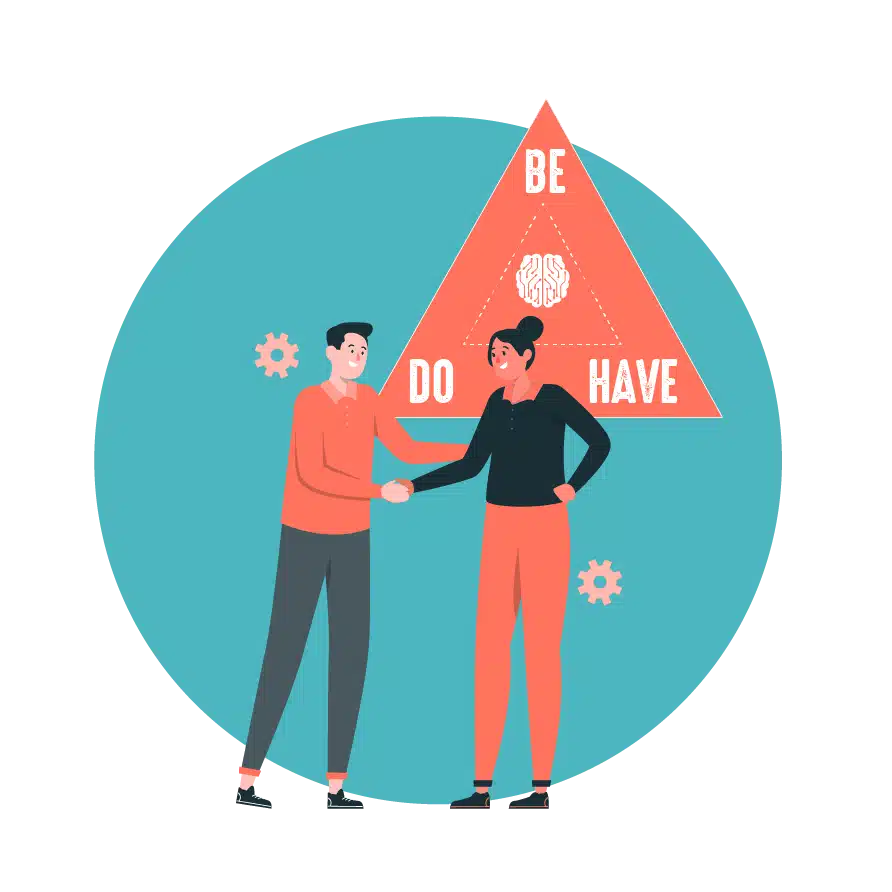
We reach our intended aim by asking the following three questions in the given precise order;
- Who do I need to be in order to accomplish this goal?
- What do I need to do in order to accomplish this goal?
- What do I need to have in order to accomplish this goal?
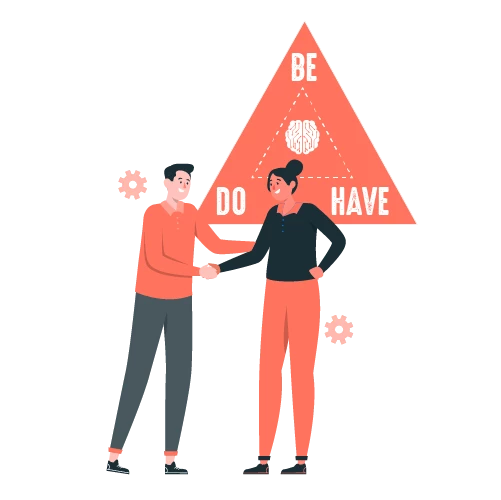
Because it influences your state of being, the Be question must be posed first. Influence is based on who you are rather than what you have or do. In short, the model urges everyone to lead by example and start to embody what you want others to do. Be-do-have is a mindset regularly recommended for people who want success in achieving their biggest goals.
Surprisingly, the Be-Do-Have paradigm isn't employed very often. Instead, the Do-Have-Be approach is used in most cultures. In other words, if we undertake (DO) such-and-such thing, – we will enhance (HAVE) what we want and so BE successful.
Other leaders use the Have-Do-Be approach, which can be summarized as follows:
When I have the time, money, and support that I require, I will be able to do the things that will enable me to be who I want to be. Sounds familiar? And this approach works for a lot of people.
“Well if the Have-Do-Be approach is working, why do I need to promote a Be-Do-Have mentality, Sai?”
Well simply put, this mentality will take one much further than any other approach. Also, we now live in an age where people relate to people who lead by example rather than being autocratic. So, if one is able to embody the Be-Do-Have approach, they will surely go further in whichever goals they undertake. I can say this from personal experience.
Let me try to illustrate the same in another way:
To try to advance in life, there are three typical methods. One of them actually does the job.
They'll be known as:
- The Victim-mentality - the one who lacks to take action because they think they don’t “have” what is needed to achieve their goals
- The Worker-mentality- the one who focuses on working a lot to achieve their goals but is never satisfied of what they have
- The Winner-mentality- this is the correct Be Do Have mentality which focuses on being extraordinary to do and have extraordinary lives
- The victim sets up their life in the HAVE DO BE hierarchy
They assert, "I'll DO the things I've always wanted to do, and then I'll BE happy and successful when I HAVE the time, money, and support. I don't yet HAVE, which is the issue. I would undoubtedly be just as successful as that person if I had what they possessed, but I don't, thus I'm not.” Before they may advance in life, the victim is constantly waiting for the outside world to alter.
- DO HAVE BE is the focus of the worker
"The more I DO, the more I'll HAVE," they claim, “I'll be happier if I have more things. The issue is that no matter how much I accomplish, there is always more to accomplish and more to accomplish. I am motivated, busy, and exhausted because what I do defines who I am. I work harder because the more I have, the more I stand to lose. Being happy never happens because we all understand that there is no correlation between having more stuff and being happier.”
- The winner lives considerably differently than the losers: BE DO HAVE
They assert, "It is not what I must HAVE before I can begin, nor is it the task I must DO, but who I must BE? What sort of individual would have access to the outcomes I desire? What would I be doing if I were that kind of person? Once one decides on what they want to become, the action needed to make it happen comes much faster and easily.
The only lifestyle that is effective is Be Do Have, which is also the rarest and most abstract of the three.
Who is it best suited for?
“So then Sai, who is this approach best suited for?”
I think that there isn’t one set answer for this but some of the broader categories that I have seen this model work wonders for are:
- Organization leaders (I mean anyone who is in some sort of leadership position in an organization and not just C-Suite people.)
- People who want to work on bettering their self esteem
- People who want to have a more positive approach towards life
- Anyone who wants to change their life to a more enriching one
In short, Be-Do-Have is for anyone and everyone. Since it is a mentality, it cannot be restricted to only certain types of individuals benefiting from it. It is a lifestyle change that we as coaches can help people implement to have a better approach towards life and level up.
Examples of Be Do Have model
I have some hypothetical situations where Be-Do-Have can be implemented. Let’s take a look!
- Mary aspires to be a best-selling novelist.
She'd have to think about what kind of individual excels in this sector first, according to this paradigm. Perhaps she comes to the conclusion that it's someone who is disciplined, focused, creative, innovative, and enthusiastic about what they do.
She'll then determine what she has to do in order to become that person. They should strengthen their discipline by writing a specified number of words per day. There are numerous exercises that can help you focus, as well as trainers that can teach you how to be more creative.
Finally, Mary can visualize the life of the individual who takes these exact behaviors and if she keeps doing the first two steps successfully, she will have what she wants.
- Matthew wants to be a fitness influencer
First off, Matthe will have to look around and understand what it means to be a fitness influencer and what other fitness influencer’s lives look like.
Matthew will then have to become fit as per societal norms. He will have to work on his physique and stick to a healthy diet. He will also have to actively reach out to audiences and establish himself as a person of authority/reliability in this field.
Once he does these two steps successfully, he will have the life he desires.
But in both these examples, there is a key focus on the steps of being and doing. Having is a by-product of the first two steps. One needs to remember that to have something, they need to be and do what aligns naturally with it. And this is only achieved by developing the correct mentality.
So, let’s look at how to develop the Be-Do-Have mentality, its uses, and why it is so important in the next chapter.
Chapter 2:
The Importance and Benefits of the Be Do Have mentality
Like I mentioned earlier, the Be-Do-Have is more of a mentality rather than just a model.
It is something that anyone can work on and master with a little bit of help and guidance. But we need to first understand why this mentality is important and then we can understand the uses of it.
Why is the Be Do Have mentality important?
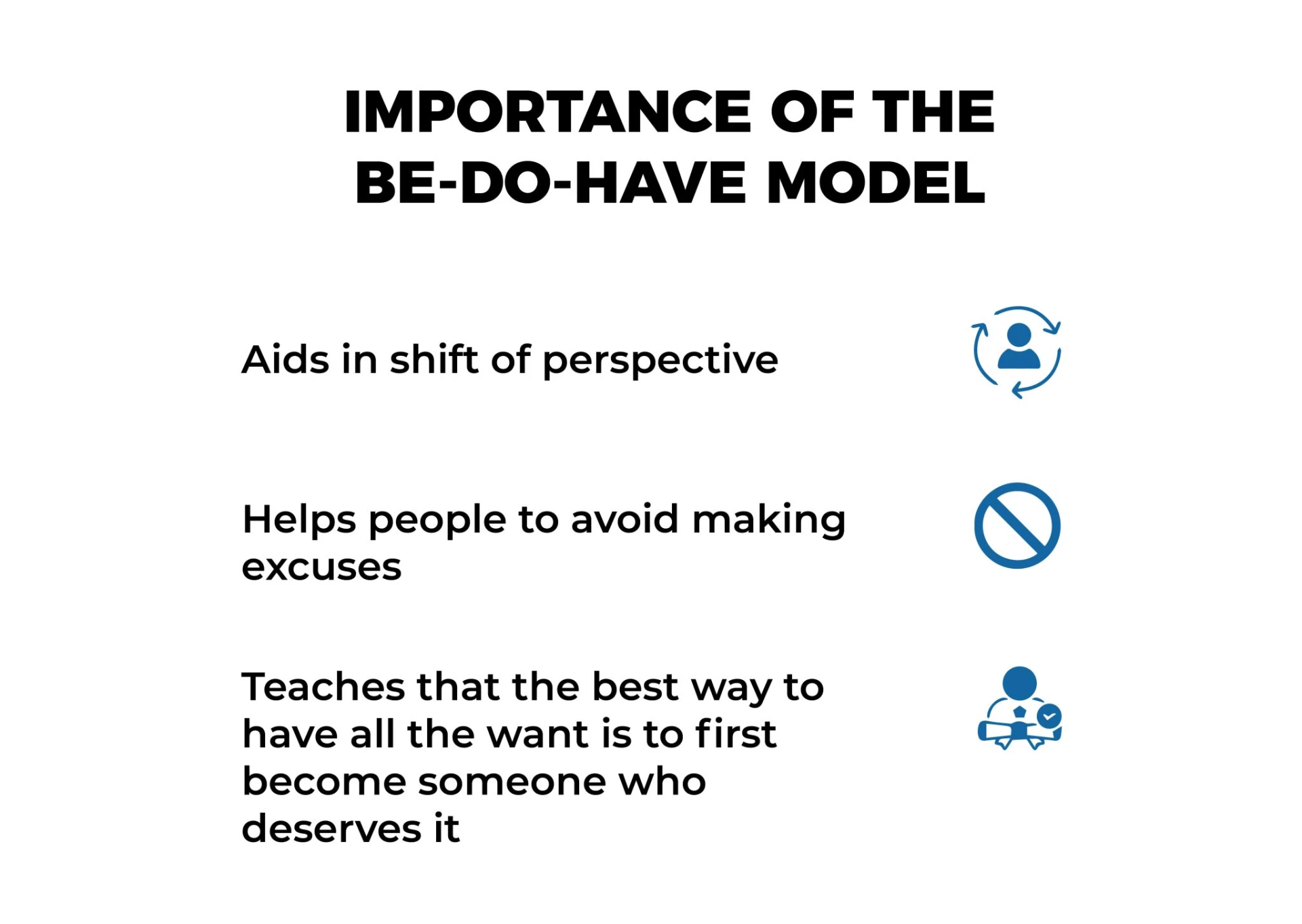
I talked extensively in the earlier chapter about what is the Be-Do-Have mentality but why is it so important and life-changing?
Because the normal individual perceives the three main factors in the wrong order, the Be-Do-Have approach is frequently taught.
Many people feel that the more they accomplish and own, the happier they will be. The issue is that this person's self-esteem is frequently determined by how much work they put in. This is a surefire way to become a workaholic who burns out and becomes exhausted. Furthermore, as many successful leaders can attest, possessing more goods does not automatically make you pleased or happy.
Another damaging perspective is that after I get this, I'll do this, and then I'll be happy. This is used by people who create excuses because they don't have the ideal circumstances to start living the life of their desires right now. Ironically, they'd probably discover a way past these excuses if they focused on being what they want to be first.
In short, the Be-Do-Have mentality really shifts one’s perspective from that of someone who cribs and complains to rather someone who is able to analyze and take concrete steps to become what they want to be. The Be-Do-Have mentality empowers one to look at their own flaws and strengths and utilize them in order to achieve their dreams.
Why is it useful?
Simply put, Be-Do-Have is the most efficient approach to live the life of your desires
For example, you're unlikely to succeed in your profession if you start doing all the acts of a successful life coach, but don't have the personality attributes of one.
If someone gives you a booming life coaching practice, but you haven't embraced what it takes to be or do well as a life coach, you'll find it difficult to attract new customers and will most likely lose those who have been handed to you.
It becomes easier to do as you ‘become’. Once you ‘become’, you have essentially taken all the necessary steps you need in order to have your dream. Plus, it also makes you capable of handling your dream as you want it.
What are the common uses of the Be Do Have model?
Let’s look at some of the most common uses of the Be-Do-Have model that I have come across professionally.
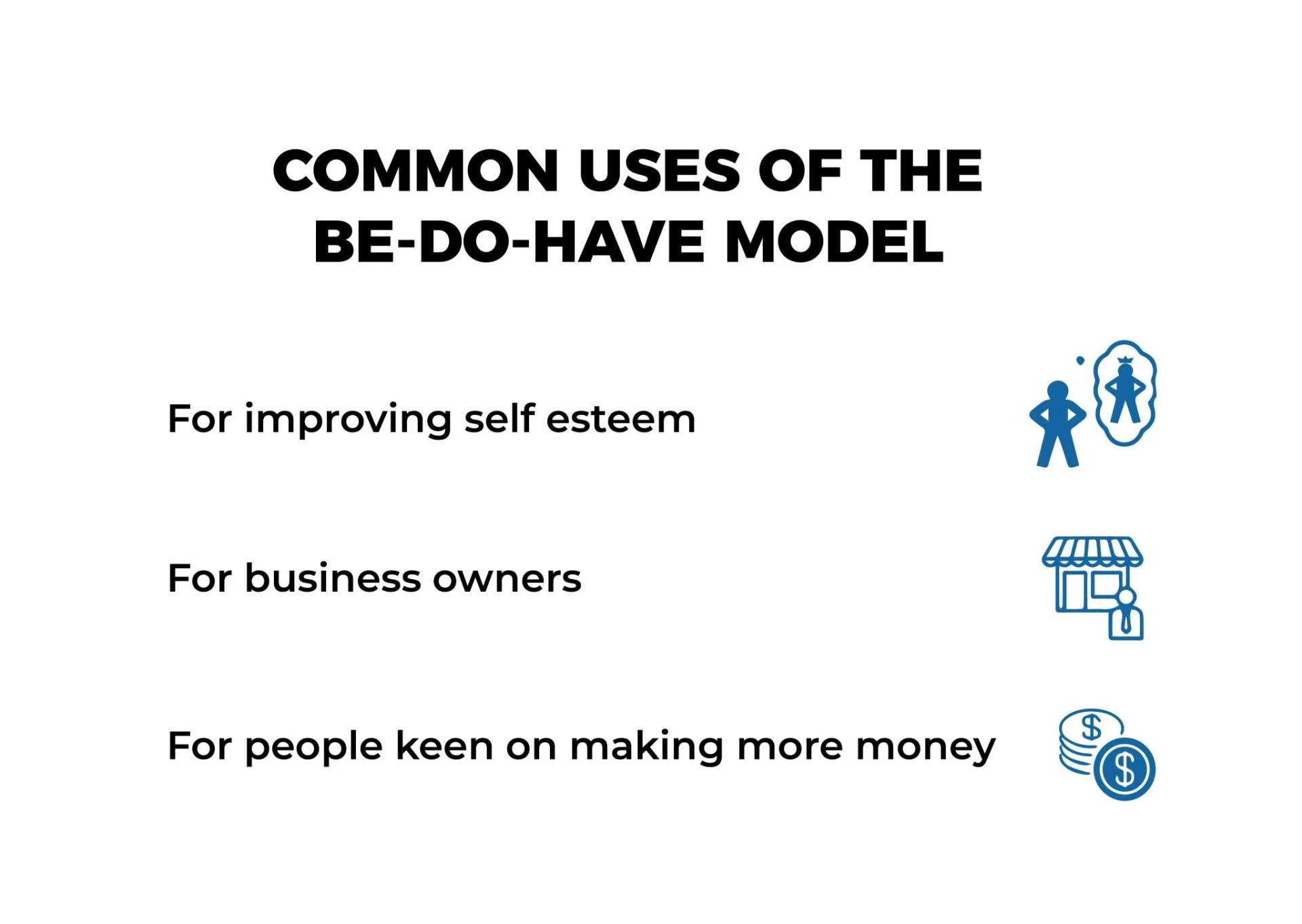
- For improving self-esteem
The Be-Do-Have mindset can boost your self-esteem significantly.
I'll be happy when I have X" or "I'll be happy when I'm doing Y" is a common viewpoint. The typical focus on outcomes and what we want to achieve, rather than who we want to be in our life, is outdated. However, there are a few problems in this logic that can limit your ability to be happy or fulfilled.
For starters, obtaining the materials we require can take a long time. Furthermore, the excitement of receiving things is sometimes replaced by a yearning for something even better.
The "I'll be pleased when I'm doing" perspective is more in your control, but depending on what you want to do, it could take a long time. Even then, it will be tough to create a life in which you do that one thing all of the time.
So, if you adopt any of these mindsets, you'll be in for a long wait for what will almost certainly be temporary enjoyment.
But what if you choose to be happy because of who you are rather than what you do or have?
That's more useful since you can choose to act differently right now and begin embodying your heroes. Right now, you can practice being nice, generous, hardworking, or any other quality you like.
The Be-Do-Have mindset can drastically improve your capacity to live a life that is in line with your values. You can achieve an empowered state and a true sense of self-esteem today by doing so.
- For business owners
Any leadership function requires the Be-Do-Have concept. To begin, you must begin to really embody the attributes of a strong leader, or no one will follow you.
There are numerous business circumstances in which someone is promoted to a leadership position despite having inadequate leadership abilities. This individual has followers and completes the task at hand, but they struggle to get their followers' compliance. He's a corporate leader who can't lead, and he'll eventually fail in his position.
But what about the person who, while not in a leadership position, has the traits of a leader? The man with a lot of energy and enthusiasm who talks the talk, cares about his coworkers, and gives assistance? The goofy guy who can instill a sense of belonging in his team?
People will be more inclined to follow him than their current leaders. His superiors will have no choice but to promote him sooner or later.
- For people keen on making more money
You'll note that every good book on making money will place a strong emphasis on mindset.
This is due to the fact that your self-image will determine:
How motivated you are to multiply your wealth; how much money you'll save vs. spend and invest; how much passion you show when building connections; how you'll overcome life's challenges; how likely you are to attain your full potential; and more.
You could be given a booming company that earns a lot of money, but if you don't learn how to be a smart business leader, you'll lose everything. Without the correct self-image, you could win millions of dollars and lose it all. Why do you believe that so many lottery winners become bankrupt?
So, instead of hoping for more money, stop wishing for it. Rather, you want to develop the characteristics of a wealthy person. You'll eventually obtain the same life outcomes as them if you have those attributes and start acting like them. It is all about having the correct mentality and Be-Do-Have helps you with that. Just like everyone talks these days, you only manifest what you embody or ‘like attracts like’. So, Be-Do-Have focuses on helping one have the correct mindset to achieve what they want.
Now that we have understood the Be-Do-Have in depth including its importance and benefits, let’s take a look at what are the exact steps of the model in Chapter 3.
Chapter 3:
Using steps of the Be Do Have model for coaching
The Be-Do-Have model is quite simple and straightforward as we have seen so far. But sometimes the simplest things can seem confusing.
So, I am going to break down the steps of the Be-Do-Have model with some examples to understand how coaches can help their clients navigate through their goals using the Be-Do-Have mentality.
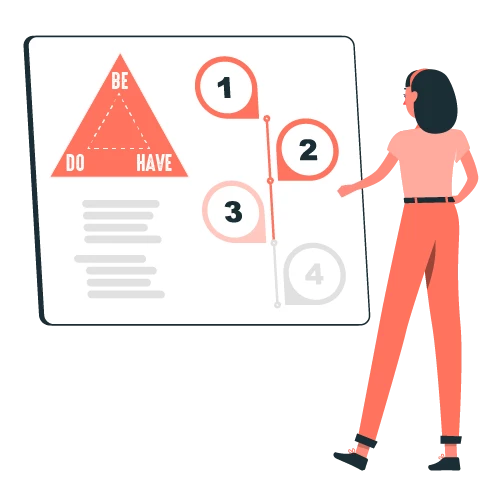
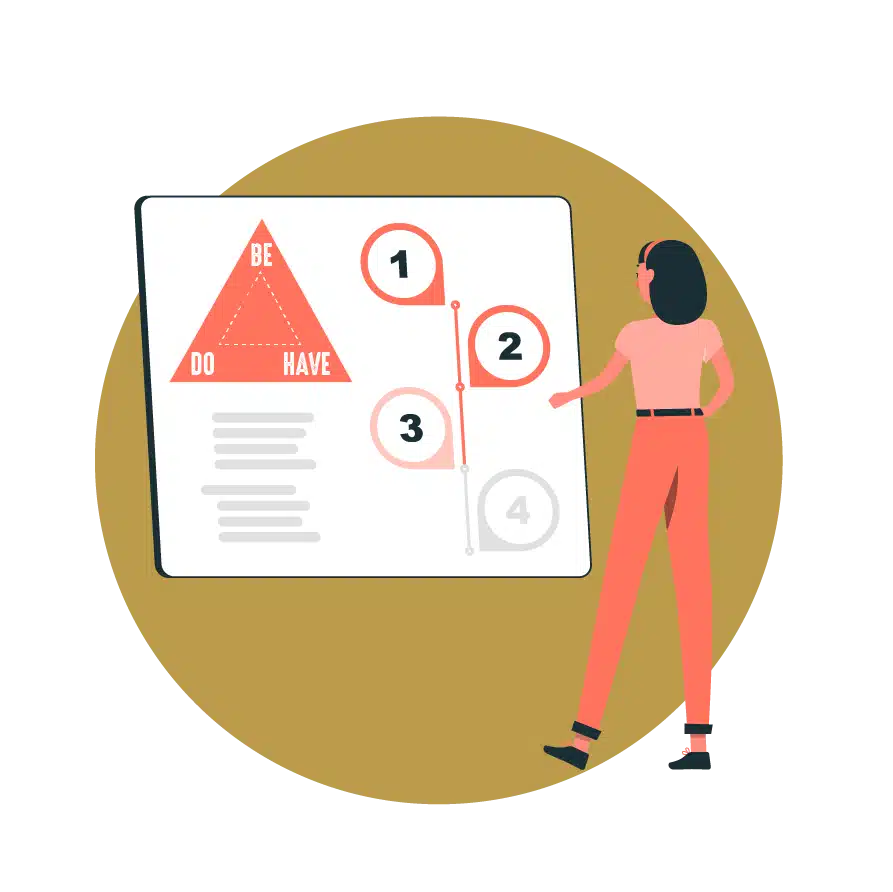
What are the steps for BE-do-have?
The first thing to realize is that there are three parts to a goal or outcome to consider.
- What must be accomplished is the HAVE.
Decide What You Are Committed To: When we decide what we want to achieve and add a lot of precise details, we may set a powerful intention and start to perceive many ways of being.
- The DO, or what needs to be done in order for it to happen
Create The Person You Want To Be: Prior to acting, we must choose the person who will carry it out. What are some potential states of being that are consistent with the goals you have set for yourself?
- The BE, or who a person must really BE (how they need to behave)
Visualize Yourself Taking Action: Once the new way of being has been developed, we are forcefully called into action, propelling us into the future and toward realizing our objectives.
Working with a client's BE or WHO is just as important as supporting and holding them accountable for their activities, the "DO," so they can "HAVE" the outcome they want.
It's a concept that's really beneficial when advising people on professional or business challenges, but it's also applicable to highly emotional personal decision-making.
It doesn't have to be difficult. Things as simple as remembering to recharge a phone or establishing a time of day to conduct phone sales calls are examples of BEs. It could be as simple as refusing to purchase unhealthy food or being adamant about the types of initiatives or demands that are acceptable.
The issue is that most people focus on the HAVE, or the result, rather than the BE, which is the primary motivator for attaining the objective.
So, here are some examples:
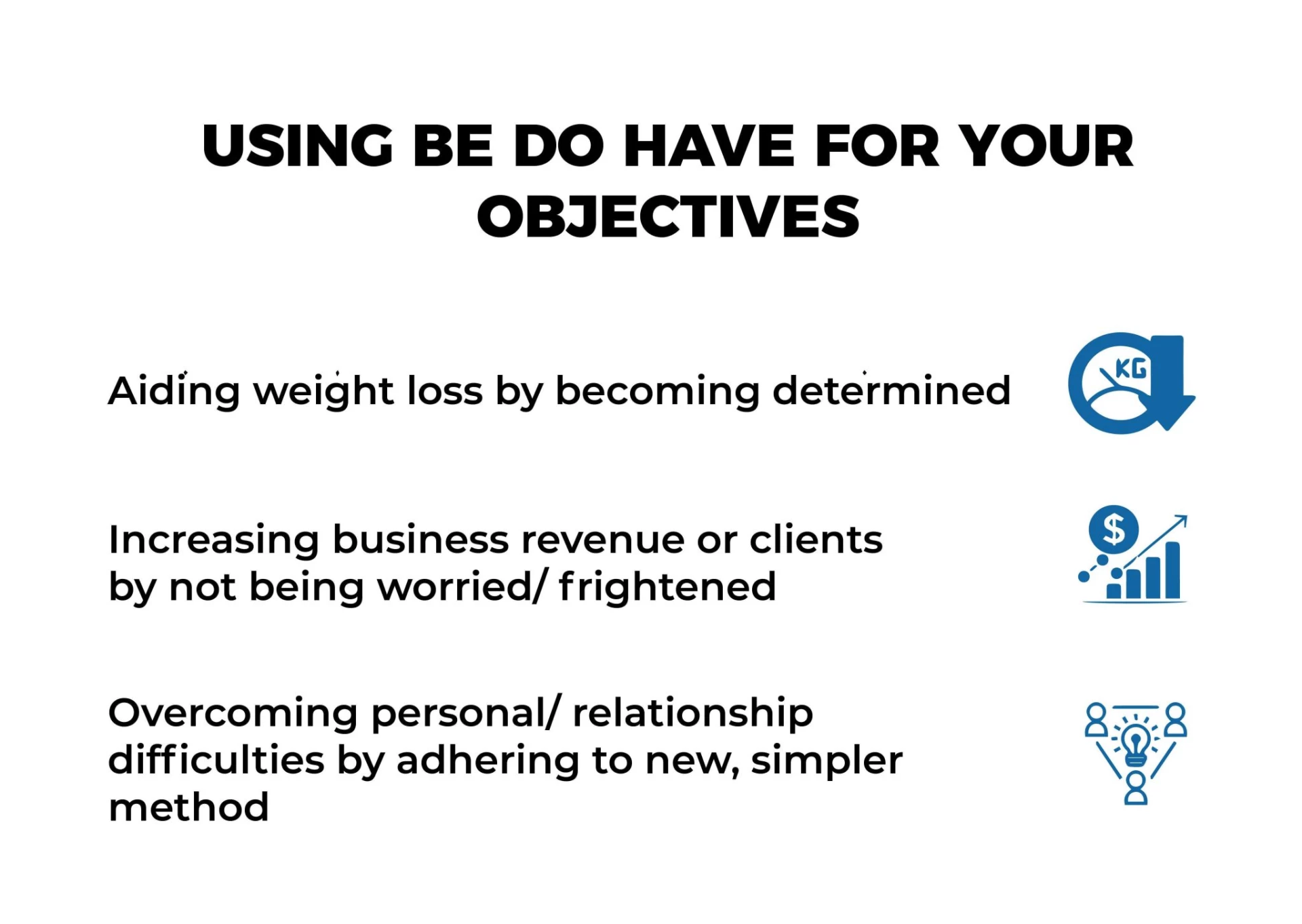
All the Be Do Have steps have to eventually be used to determine objectives which one wants to achieve using the said mentality. There are some objectives for which the Be Do Have model has always worked wonders. I have given such examples here.
- Getting to your weight-loss goal
The fitness or weight loss objectives that so many of our clients fail to reach are excellent examples of this.
To improve one's chances of success, they must first become the type of person who is prepared to try new ways of dealing with stress rather than relying on comfort food and procrastinating on exercise. OR BE a person who is willing to give up things that could hinder their weight-loss efforts.
To put it another way, if the customer wants to lose weight, he or she must BE someone who can devise methods to DO what it takes - such as saying NO to the second piece of cake and YES to extra exercise! As a result, they have the physique they desire!
- Increasing revenue or increasing client sign-ups
A client or employee of a small firm may set a goal of gaining ten new clients or sales.
They may need to put in some practice time in order to become someone who is not frightened to market their service or product.
This could entail overcoming a fear of the DO by attending networking events, ringing up contacts, or being involved on social media.
- Relationship and personal difficulties
A busy mother may need to stop being overwhelmed by her family and friends' demands and start prioritizing her own needs. This could be about learning to say no to unreasonable demands on one's time.
A small business owner is stressed out. She recognizes that she needs to do less, but she is hesitant to relinquish any of her responsibilities. You can teach them to become someone who is willing to learn how to delegate or outsource, even if it means making mistakes.
You can see that in each of these instances, it is the BE or the WHO who can take the necessary action to reach the HAVE (the goal). As it could be a significant step outside of a previously held comfort zone, the BE frequently requires practice and encouragement. So, you as a coach will have to not only encourage your clients to take small steps for those “Be”s but also keep them accountable throughout their journey.
I hope this chapter was helpful in understanding the steps of the Be-Do-Have model and how to use them for coaching. In the next chapter, I will specifically focus on some limitations of the Be-Do-Have model.
Chapter 4:
Limitations of the model
As with every great idea or model, even the Be-Do-Have model can have its own limitations.
Although the limitations aren’t as apparent, it is necessary for coaches to understand them so that they can be fully informed before using it in sessions.
Let me condense the limitations.
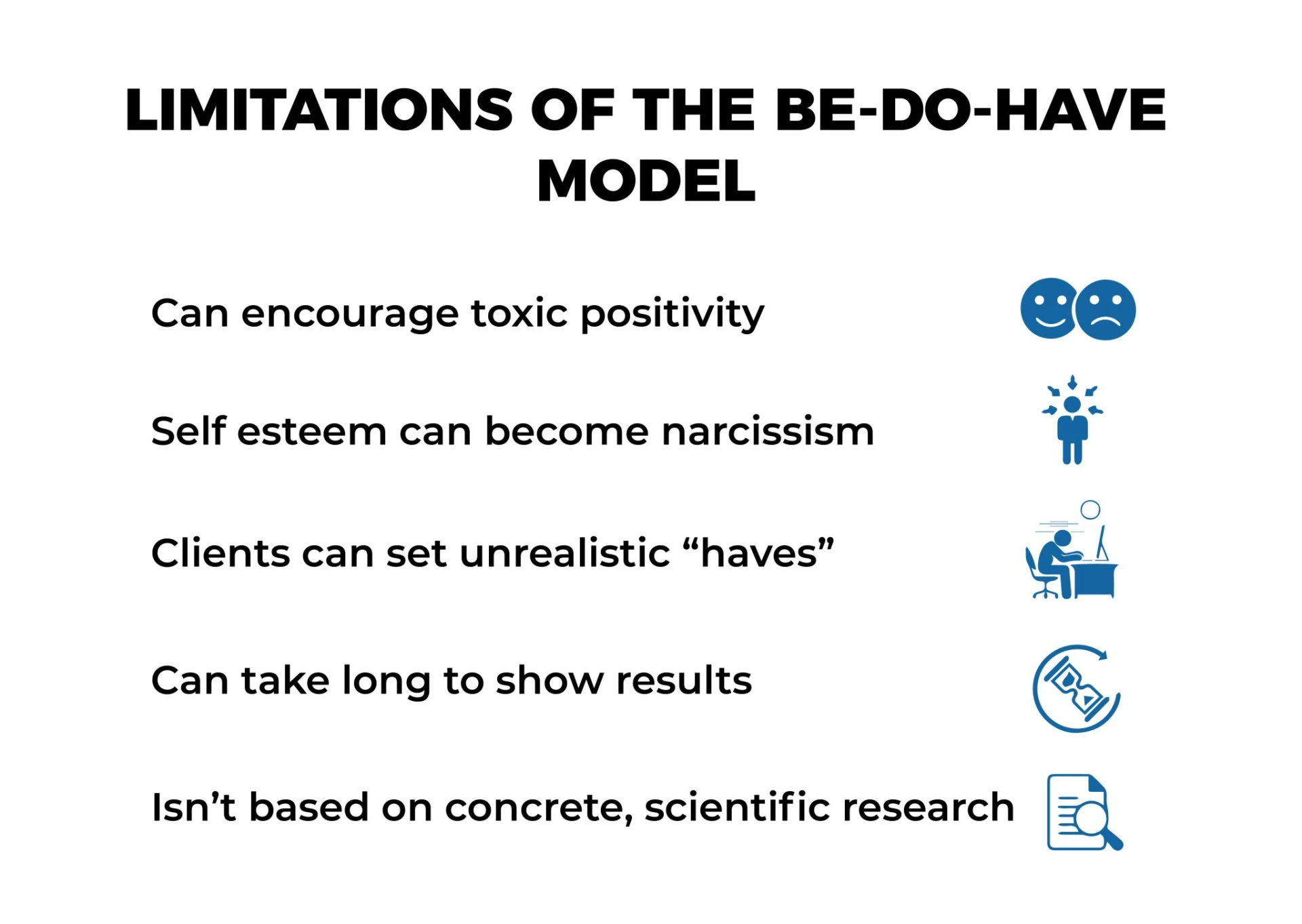
- People can misconstrue the Be-Do-Have model and instill in themselves “toxic positivity”
This is a common limitation of any mindset model that encourages positive thinking and action. Clients may start thinking that life always has to be positive and in turn, start losing their ability to understand and deal with negative situations in life.
As a coach, it would be your duty to keep a level of realism in the sessions and the outcomes that the client expects out of the Be-Do-Have model. Also, it would be crucial to keep the client in check with their shortcomings.
- Self-esteem can turn into narcissism very quickly
While the Be-Do-Have model encourages self-esteem, there is a very thin line between self-esteem and narcissism. When people start becoming overly confident of themselves, they might start exhibiting narcissistic tendencies which will give them the opposite effect than what is desirable out of the Be-Do-Have model.
- Clients can have unrealistic expectations of their “have”
The Be-Do-Have model needs to be grounded in reality like I already mentioned. Sometimes, clients may have unrealistic expectations out of their life, image, and goals. Again, you as a coach will have to keep clients from “daydreaming” too high about their dreams.
- Be-Do-Have is a mentality so it may take longer than expected to show results
The Be-Do-Have is a mentality and it will totally be subjective how fast or slow one can adapt to this new mentality. This just means that coaches will have to explain to clients that results will depend on how much effort the client takes to adapt to this new mentality. So, remind clients they will get how much they put in. Also, some people naturally have more of a positive thinking mentality as compared to others. So, they might adapt to this mentality faster than some who have a more realistic/pessimistic approach toward life.
- Be-Do-Have is not based on thorough scientific research
The Be-Do-Have is based on observation or human tendencies. There hasn’t been much concrete research done on it. Also, since it is a subjective theory, it is difficult to come to balanced, unbiased conclusions. So, take it with a pinch of salt.
These are the most important limitations to be considered while using the Be-Do-Have in sessions. Be cognizant of them and the Be-Do-Have will be your best friend in sessions!
Conclusion
Congratulations for getting through this article!
We as coaches always need to keep learning new things and to enhance our knowledge as a coach. And the fact that you took the time to learn something new today is commendable!
Please let me know in the comments if you found the article useful and maybe situations where you think you can use this model in your coaching sessions. If you didn’t find it useful, let me know what was lacking and what you would’ve liked to learn more about. I will make sure to add it next time! And till then, stay tuned for the next exciting topic!
