

Attachment Theory: The Definitive Guide
Last updated: March 2026
Attachment Theory
The Definitive Guide
This is the definitive guide to all that you need to know about attachment theory, how different types of attachment are formed, and how they impact adult lives.
If you want to:
- Learn about what Attachment Theory is
- Learn about the history behind how the Attachment Theory came to be

- Find out all you need to know about the different types of attachment styles
- Identify your attachment style
- Learn more about how your attachment style can impact your relationships
- Evolve your attachment style to be more secure
Then this guide is for you.
Let’s get started!
Contents




Chapter 1:
The Fundamentals of Attachment Theory
There is no denying that the way we have been brought up since our childhood has a big impact on who we become as adults.
As we progress with the guide, I will explain how these bonds are formed between parents and their children, what these bonds mean to the kids, and how they end up defining who the children grow up to be as adults.


What is Attachment?
Before getting into the basics of attachment theory, it is important to understand what we mean when we use the term attachment.
Attachment is a bond created between two people over time. It can be defined as the level of closeness and security one feels when they are with another person. If you are with someone you are attached to, you will feel a lot safer than if you are spending time with someone you are not attached to.
The first sense of attachment we as human beings feel is when we are infants. We feel a sense of closeness and security with our parents because they feed us, clothe us, provide us with shelter, and take care of us while we learn more about our surroundings.
What is Attachment Theory?
Attachment theory is a theory developed by John Bowlby and refined by Mary Ainsworth. The theory is focused and studied as a part of developmental psychology and it discusses the emotional bonds one builds as a part of their childhood.
According to John Bowlby’s attachment theory, it is our human nature that compels us to form close emotional bonds with those around us. The first bond we develop is with our caregiver right after birth, especially if our caregiver (typically our mother) is appropriately responsive.
He further states that the reasons why we tend to form attachments is to protect ourselves from harm and negative emotions and to manage our emotions when something negative happens to us in our lives.
His theory also states that this sense of attachment that we feel with our mothers as children has a big role to play in our emotional and cognitive development.
The Origin of Attachment Theory
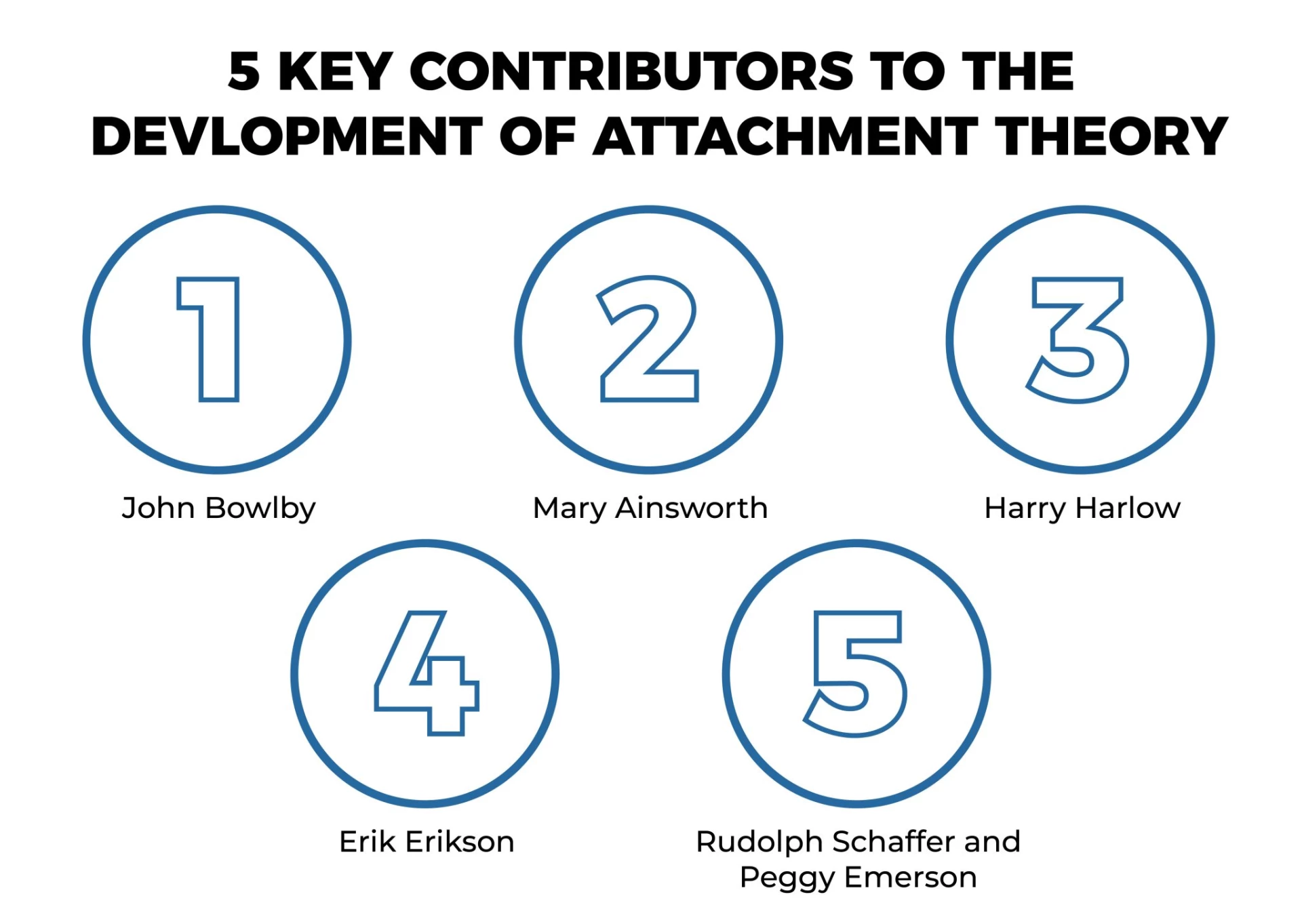
While Bowlby is largely credited with the development of the attachment theory, it was actually a number of psychologists that worked overtime to develop this theory. John Bowlby was the one that got the ball rolling initially when he started working with children. The theory was expanded upon and refined by Mary Ainsworth in the 1970s, making it what it is today.
John Bowlby spent time after the World War conducting research on attachment behaviors he observed in infants. He postulated that right from birth, infants would look for their primary caregiver and attachment figure and would feel intense distress if they were separated from them.
He noted that the infants in his study would look for their attachment figure to feel loved, secure, and safe in their environment. Only when the children felt protected by their primary caregiver would they interact with their surroundings, engage in play time, and be more social.
If the caregiver was not present close to the children, they would feel extremely sad and distressed and their response would be to either look for their caregiver or cry till they felt soothed. The time it would take for the child to calm down would vary based on the time the caregiver spent away from them.
This study proved valuable in developing what we know as the attachment theory today because John Bowlby was the one who identified that attachment played a big role in the cognitive, emotional, and social development of a child at an early age.
Mary Ainsworth was working on her research in child psychology separately a few years down the line from John Bowlby. Her popular study, Strange Situation (1969), added to John Bowlby’s assessment of child behavior and attachment. It indicated the levels and types of attachment that children experienced in their infancy with their caregivers.
The Strange Situation Classification (Ainsworth and Wittig, 1969)
The Strange Situation study is what formed the Attachment Theory that we know of today. The study was conducted between mothers and their infants ranging from 9 months to 18 months in age. It tested for various parameters when the children and their caregivers were put in different situations and recorded the responses of the infants after they were separated from their mothers.
The study checked for certain behaviors in the children upon the reunion with their mothers after being separated. Ainsworth’s main goal was to see if the children sought contact upon proximity with their mothers, if they maintained contact after, if they avoided interaction to ‘punish’ the mother or if they were indifferent in general.
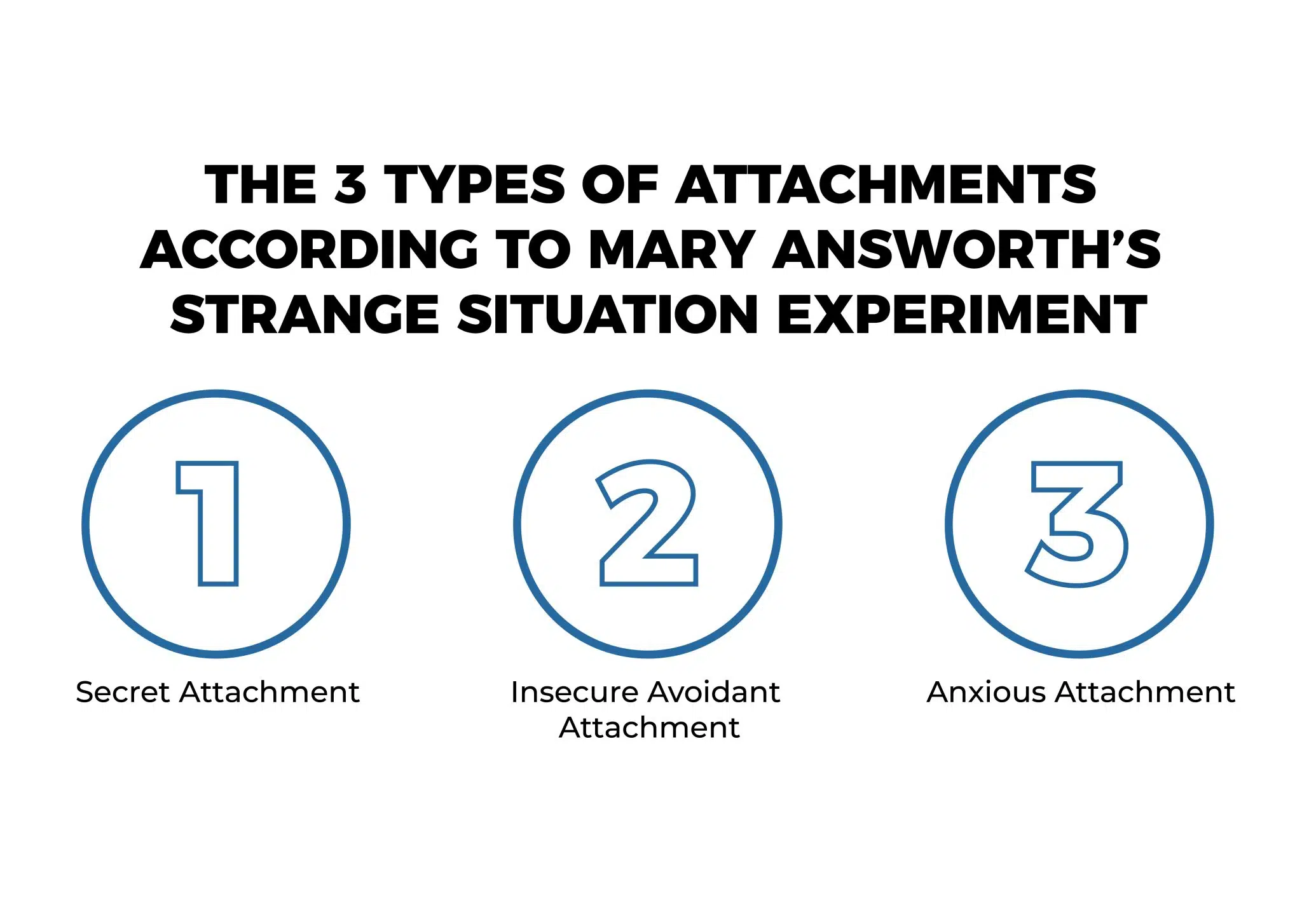
These results were used to design three distinct attachment styles, based on the way the children interacted with their mothers upon their separation and reunion. Mary Ainsworth developed three types of attachment that she observed in the children:
- Secure Attachment: This was the most common attachment style observed in the infants in her study. The children felt confident and secure in their caregivers being present even though they were temporarily away. They were social and explored their environment freely.
- Insecure Avoidant Attachment: Insecure avoidant children showed little to no signs of distress when separated from their mothers. They did not rely on their mothers for comfort and they continued the exploration of their environments regardless of how their caregivers responded.
- Insecure Ambivalent or Anxious Attachment: Here the children showed intense distress when they were separated from their mothers. The children in turn did not explore their environments and showcased ‘punishing’ behaviors upon the reunion.
We will discuss these attachment styles and how they affect adult relationships in the later chapters. It is important to know about the scientific thought and research that went into developing what we know as the Attachment Theory today because it gives us more insight on how the theory was formed and how it evolved over time.
These studies formed the root of the Attachment Theory and more psychologists contributed over time to develop the types of attachment, stages of attachment, and the adult attachment theory we will discuss later on in this guide.
Other Key Contributors to the Development of the Attachment Theory
There is still ongoing research on understanding how adult relationships are impacted by our attachments formed as children, so it is still a topic of discourse and study in the field. When it came to developing the theory itself, there was a lot of contributing research done by other psychologists and researchers that made the attachment theory what it is today.
We are now going to look at some of the most recognized research conducted over time and how they contributed to the theory.
The Harlow Experiments (1950s)
The Harlow Experiments were designed to test the relationship between parents and their children in monkeys by Harry Harlow. He conducted two experiments that stated that the level of attachment we form is based on the emotions we feel when we interact with our caregivers. It’s an emotional response, not a physiological one.
In his first experiment, Harry Harlow separated the infant monkeys from their mothers a few hours after birth and used inanimate surrogate replacements to provide milk and act as mothers.
There were two types of surrogates - one was made with terry cloth and the other was made with wire mesh. The infant monkeys preferred to go get their milk from the terry cloth mother because it was more cuddly and thereby, more comforting, as compared to the wire mesh mother.
From this experiment, he concluded that basic physiological needs (hunger) weren’t the only thing these infants were looking for to fulfill with their mothers.
For his second experiment, Harry modified the setup and gave the infants either mother for them to interact with. The infants had either the terry cloth mother or the wire mesh mother, not both. Monkeys of both groups thrived physically but there were noticeable behavioral differences between the two.
When he introduced loud sounds and objects to the infants, the monkeys with the terry cloth mothers reached out to the surrogates for emotional support as a response, whereas the monkeys with the wire mesh mothers would scream, react a lot more aggressively, and throw things on the floor.
This experiment was a clear indicator that the emotional attachment formed between the monkey and their surrogates had an impact on how they processed situations that would cause them distress and regulate their emotions.
Erik Erikson
Erik Erikson took a more psychosocial approach to child development that was aligned with Sigmund Freud’s theory. He concluded that the way children develop is based on their social interactions at large and not just their emotional attachments to children. It’s based on the development of their id and ego.
He recorded a number of developmental stages throughout an individual’s life and categorized them by the emotional development they would face when it comes to building relationships.
- Infancy was when the children would learn the concept of trust and mistrust.
- Early childhood was when they would start to understand the concept of independence and feel shame or doubt.
- The child’s preschool years would define how they would assert their independence in a social setting. They would either accept it or feel guilty if they did anything that was considered inappropriate.
- Adolescence is the stage where they would begin to form their identity or develop confusion about their role in society.
- Young adulthood is when children would either choose to share their emotions and feelings and move on to build lasting and secure relationships, or they would be fearful of the commitment and feel isolated and lonely.
- Middle adulthood is when one would either establish themselves in their career and feel like a productive member of society or not fulfill the acceptable requirements and feel like they were unproductive and stagnant.
- Late adulthood is when one would retire from their role as contributing member of society. If individual feels like they have accomplished they would feel satisfied with their lives or they would feel despair at not having achieved enough.
This theory is not directly related to what Harry Harlow, John Bowlby, and Mary Ainsworth were researching but it does showcase how an individual’s infancy and early childhood can affect the way they approach the later stages in their lives.
Rudolph Schaffer and Peggy Emerson (1964)
Rudolf Schaffer and Peggy Emerson conducted a longitudinal study to test the theory of attachment. They wanted to check if the attachment was formed in different stages from birth so they studied 60 babies over a period of 18 months from their birth.
There were three parameters to this study:
- How the children would respond to strangers
- How they would react when they were separated from their primary caregiver
- How they would check for the appropriate response to a new situation
They observed the following responses in children over time:
- From 0-6 weeks, the infants were very asocial to any stimuli and had little to no response.
- From 6 weeks to 7 months of age, the children wanted to be close to any caregiver, and from 3 months onward they would respond favorably to the ones they were familiar with.
- From 7 to 9 months is when the children selected a primary caregiver and developed an attachment to a single person. This is when they started to display separation anxiety from being away from their caregiver and fear of strangers.
- From 10 months onward, the babies developed multiple attachments to familiar people around them as they formed a sense of independence. The level of attachment could vary based on the response they would get to their cues from other individuals.
Based on these experiments and studies, we have understood the responses that children have based on their interactions with their caregivers.
In the next chapter in the guide, we will discuss what the main stages of attachment are in children, and how they are formed.
Chapter 2:
The Different Stages of Attachment in Early Childhood
The first two years of the child’s life are what shape the way they interact with society and form relationships with those around them.
In this chapter, we will discuss the stages of attachment that are formed in children and the four types of attachment discussed in the attachment theory.

How are Attachments Formed in Children?
Children form attachments based on how their primary caregivers interact with their offspring. They develop what is known as an internal working model that guides them throughout their lives in terms of forming attachments, developing relationships, building their sense of self, and more.
Different ages in a child’s life are responsible for different stages and levels of attachment. Let’s look into what the stages are.
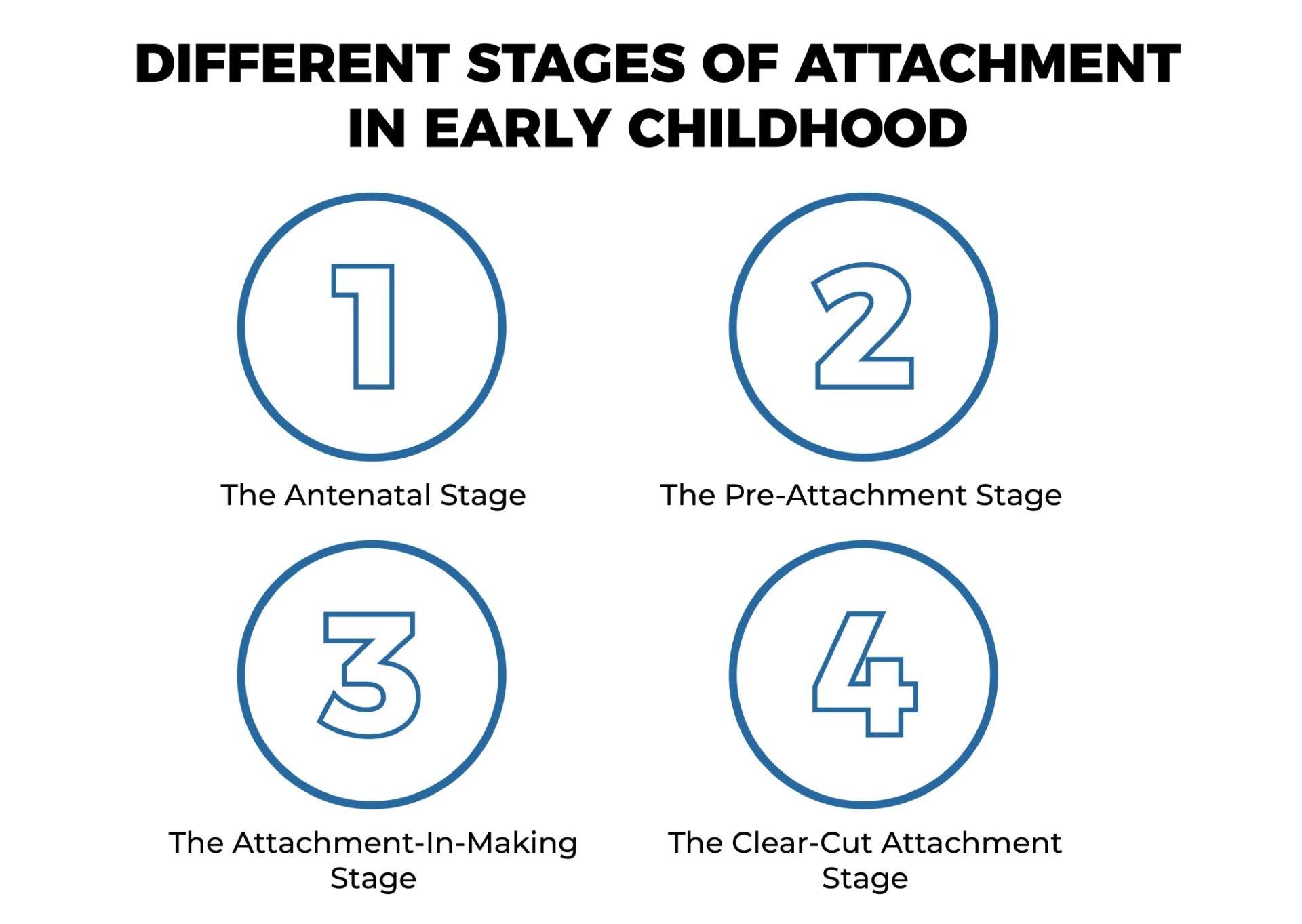
- The Antenatal Stage: This is the developmental stage of the baby as a fetus in the mother’s womb. There have been studies that showcase that the fetus can understand when the caregiver or parent is talking or interacting with them and they give responses to these interactions. Developing a relationship with one’s baby in the pregnancy stage itself can have a positive impact on the child and they can act as a predictive measure of how the mother will interact with the child once they are born.
- The Pre-Attachment Stage: The pre-attachment stage starts from when the child is born until they are six weeks old. The infant is too young to form any form of attachment in this case but it has been observed that they do want to be physically close to a caregiver. They do not have a preference as to who it is that is taking care of them, but they want to feel a sense of bonding and intimacy with an adult.
- The Attachment-In-Making Stage: This stage is when the child begins to make preferences in terms of who they are building their attachment with. They are only capable of forming a singular attachment with the primary caregiver. It starts from 6 weeks and goes on till they are 6 to 8 months old. The infant learns how to differentiate between the primary caregiver and the rest.
- The Clear-Cut Attachment Stage: This stage is when the toddler begins to form preferences in terms of their attachments. They become capable of developing multiple attachments of varying levels, and they display the most favorable ones with their caregiver. When the infant is separated from the primary caregiver, the child can have separation anxiety and react negatively by crying or throwing tantrums trying to get the caregiver’s attention. This stage starts after the attachment-in-making stage and goes on till the child is anywhere between 18 months to 2 years old.
Now that we know what the stages of attachment are in children and when they are formed, we can move forward with the next chapter where we will discuss the types of attachments formed in children.
Chapter 3:
The Types of Attachment Formed in Children
The attachment theory has been developing over time and there have been some additions to the original theory. Currently, the attachment theory can be divided into four main attachment styles. The first three were developed by Bowlby and Ainsworth, and the fourth type of attachment was added to the theory later.
Let’s take a deeper look into what these attachment styles are.

Three Styles of Attachment Defined by Ainsworth and Bowlby
Based on the research conducted by Bowlby and Ainsworth (as mentioned in Chapter 1), they segregated the types of attachment formed in children into three main categories, which are:
- Secure attachment style
- Insecure avoidant attachment style
- Insecure ambivalent or anxious attachment style
Later, a fourth attachment style was added to this list, which is the fearful avoidant attachment style.
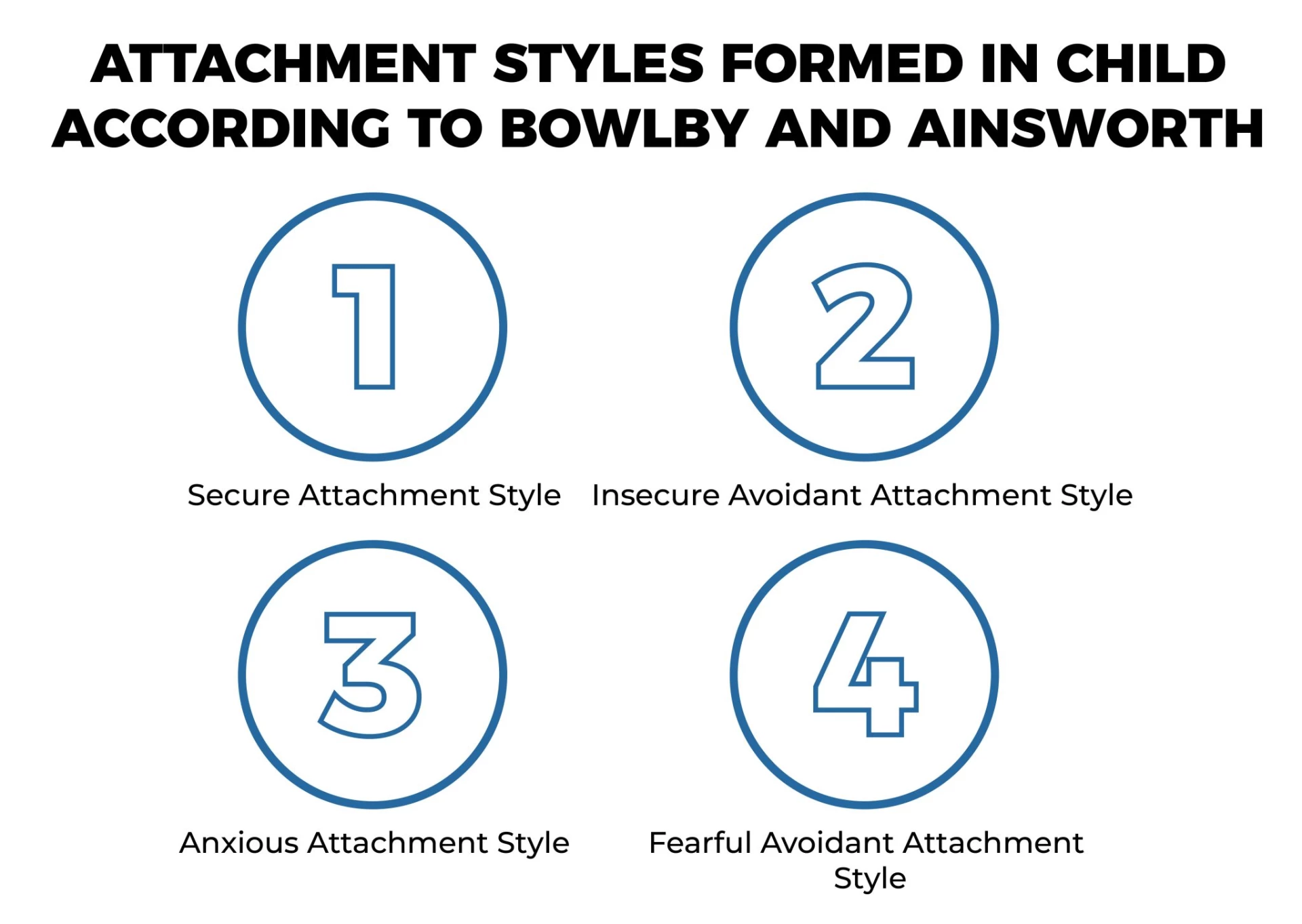
We discuss these four attachment styles in more detail in the sections below.
Secure Attachment Style
Secure attachment is shown in children who become upset upon separation from their caregivers. They begin to cry and seek the comfort of their primary caregiver upon their return. Their mood stabilizes once they are comforted and they are happy once more to be in the presence of their caregiver.
Once the children have grown old enough to have preferences in terms of who is tending to them, they prefer the company of their parents as compared to strangers.
The secure attachment style is based on the primary caregiver’s nurture and care. The level of care and attention the mother gives to her child while she is with her child is also one of the factors that determine the type of attachment style the child develops.
Some of the other characteristics that help the child develop a secure attachment style include the following:
- The level of sensitivity the mother has to the child
- How responsive she is to the child’s needs when she is around them
- How accepting she is of the child
Insecure Avoidant Attachment Style
Insecure-avoidant attachment is shown in children who do not have a significantly close relationship with their caregiver. Their response when they are separated from their mother is to not show a lot of distress. They are fairly neutral when they are separated and reunited with the mother.
They do not show much preference or closeness to their primary caregiver. They are fairly independent in completing their tasks and do not look towards their mother for assistance.
Some of the factors that could be the reason why children form an insecure avoidant attachment style while growing up include the following:
- Lack of consistent attention from their primary caregiver results in the child not feeling secure enough to rely on the mother
- The mother may not be as responsive to the child’s demands, which results in the child feeling ignored and uncared for
- The mother may not be present in times of the child’s needs which makes the child feel like they should not showcase outward displays of distress or any emotion especially if it is negative
Insecure Ambivalent or Anxious Attachment Style
The anxious attachment style develops when the primary caregiver does not provide consistent care. It is randomized in nature, which makes the child fear abandonment.
This emotion translates into severe distress when the child is separated from the mother. The child can also act out and throw tantrums to punish the mother for leaving. The child ends up becoming extremely demanding and can even act clingy with the primary caregiver to get some form of a reaction from them.
There is a lack of security that the child experiences due to the sporadic attention they get from the mother. This lack of security is what makes them fearful and sometimes even angry.
Some of the other reasons why the child could possibly develop an anxious attachment or insecure ambivalent attachment style include the following:
- Lack of support from the mother when the child is with her, results in the child feeling insecure about themselves
- Lack of response or reaction to the child’s demands, can result in the child throwing tantrums to get attention
- The mother does not give the child the comfort they need every time they are in distress, which creates a sense of paranoia about whether or not the caregiver will be there for them when they need them again
Addition of the Fourth Attachment Style
Fearful Avoidant Attachment Style
Bartholomew and Horowitz, in 1991, proposed a fourth attachment style that was observed in children. The fearful-avoidant attachment style is a type of insecure attachment where the child displays both fear of abandonment as well as avoidance upon attention when provided.
Usually, the fearful avoidant attachment style develops in children when the primary caregiver is abusive or frightening towards the child. It develops a deep-rooted sense of inconsistency that is also scary to the child.
Some of the other factors that could result in the child developing a fearful avoidant attachment include the following:
- Abusive behavior from the parent or primary caregiver towards the child
- Inconsistency in parenting develops a fear of abandonment in the child
- A combination of frightening behavior and inconsistency makes the child afraid of the caregiver as well as realize the need for the caregiver to provide them with essential needs for survival
- Disorganized displays of affection from the mother towards the child leads to a disorganized response from the child towards the mother
Chapter 4:
How Attachment Styles Translate into Adulthood
Now that we have a better understanding of how these attachment styles are formed in children, we can delve into how these attachment styles are shown when they grow up to be adults.
Your parents are the ones who are responsible for the first and primary approach you have towards society at large.

So how do these attachment styles reflect on individuals as adults and how does it translate into behavior? Let’s find out.
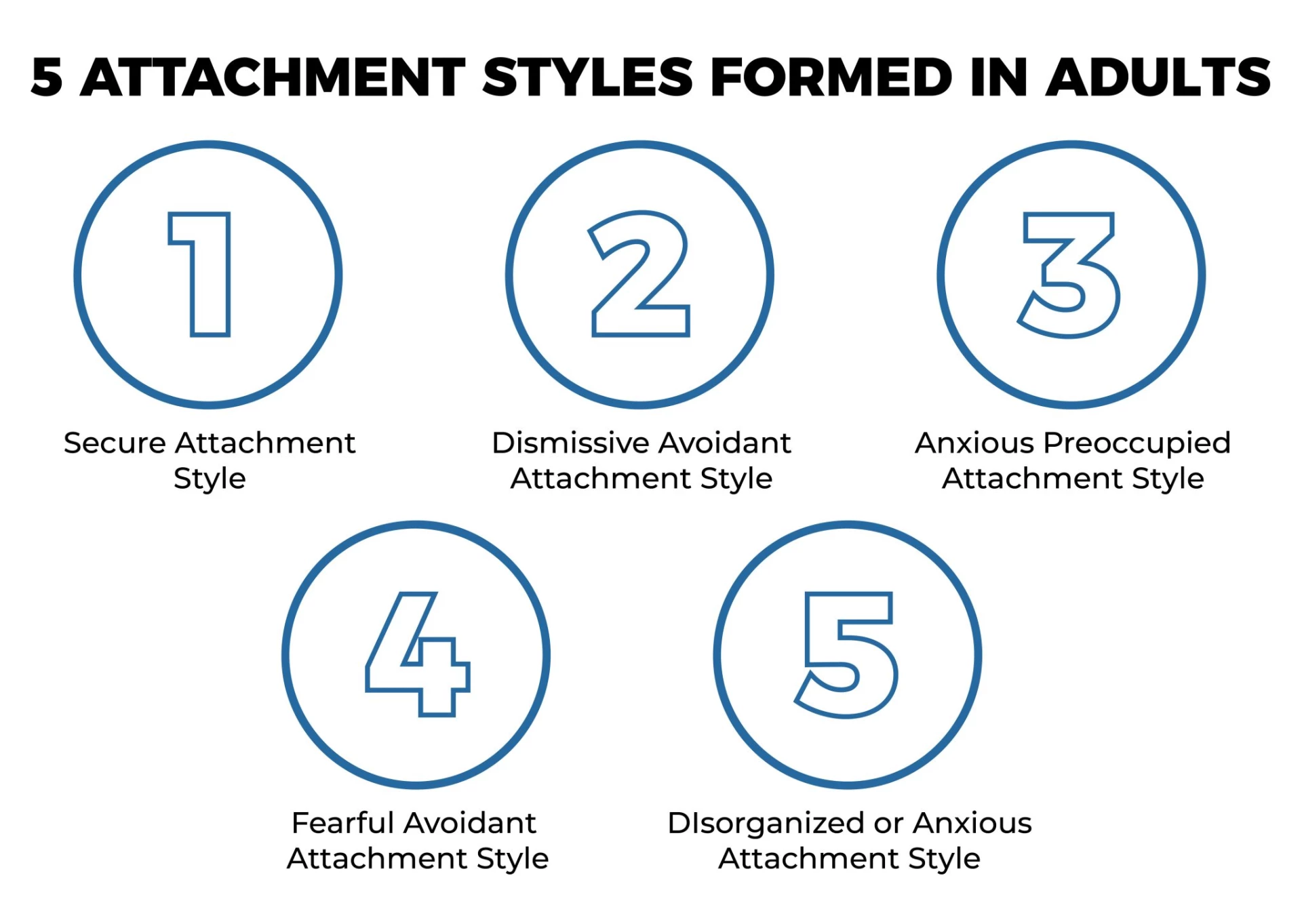
Secure Attachment Style in Adults
Children who have developed a secure attachment style become secure adults. This translates into the following behaviors:
- Adults believe they are worthy of love.
- They form loving and stable relationships with those around them.
- They are often trustworthy.
- They respond to situations in a stable manner.
- Secure adults are comfortable when they are on their own.
- They do not shy away from intimacy.
When it comes to developing romantic relationships, secure individuals show the following traits:
- They are capable of loving their partners and accepting the love from them in a healthy manner.
- They can form intimate relationships in a short amount of time because they are not afraid of commitment or intimacy.
- They have a healthy understanding of personal space and boundaries
- They are trusting of their partners.
- They can maintain their sense of identity in their romantic relationships and do not become codependent on their partners.
Dismissive Avoidant Attachment Style in Adults
Children who develop insecure-avoidant attachment are often distant adults. Some of the behaviors that showcase the insecure-avoidant attachment style in adults include the following:
- Adults have a sense of self-worth but it is more to the point of being protective of oneself.
- They are not trusting of others around them.
- These adults often have trouble with intimacy.
- They believe that they are their own caretakers and do not become very attached to others around them.
When it comes to developing and maintaining romantic relationships as adults, those with an insecure avoidant attachment style showcase the following traits:
- Adults don’t believe in sharing any distressing or stressful events in their lives with their partners, and instead prefer to deal with them alone.
- They believe that the partner is being ‘too much’ or clingy when they are asked for some form of emotional dependency or accountability.
- They keep their partners at an arm’s length and do not share intimate details about their lives with them.
- They avoid, sulk, or behave passive-aggressively when they have an issue with their partner.
- They are more focused on their own needs above anyone else’s.
Anxious Preoccupied Style in Adults
Children who did not get consistent care in their infancy and early childhood are the ones who become anxious preoccupied adults. The lack of regularity affects the trust the children have in their caregivers, and it translates very poorly in their adult relationships.
Adults who have an anxious-preoccupied style showcase the following traits in their romantic relationships:
- The adult is too critical of minute details in the relationships
- They are paranoid that their partner is not faithful to them
- They believe that they are never going to get the love they deserve and find faults with everything
- They are overly cautious and always look for negative signs in the relationship
- They overanalyze situations, conversations, and everything about the relationship
- They have a tendency to get unreasonable
- They can get quite jealous in the relationship
- They spend a lot of energy on their partner’s social media, texts, and digital interactions with them or others
- They have a tendency to over-communicate
- They need to be reassured all the time and need to know where their partner is and what they are doing at all times
Fearful Avoidant Style in Adults
Children who have developed an anxious attachment style when they are young often become anxious and fearful adults. Some of the behaviors this attachment style translates to include the following:
- Adults do not have a healthy set of boundaries with those around them
- They are often afraid of abandonment
- They do not feel worthy of love
- They tend to withdraw in situations where they are asked to be emotionally vulnerable
A fearful-avoidant style is a form of insecure attachment style, it just manifests differently in relationships. Adults who have the fearful avoidant attachment style often display the following behaviors:
- They get emotionally attached to their partners very easily
- They do not reciprocate the level of emotional intimacy that their partner displays, despite being attached
- They do not trust their partners and are afraid that their partners will betray them
- They are always worried that their relationship will end and get irritated every time there is a disagreement
- As soon as things start to get serious with their romantic partner, they tend to panic and sabotage their relationship
Disorganized or Anxious Attachment Style in Adults
Adults who have an anxious attachment style showcase their insecurity very strongly. These behaviors can be observed in adults in the following ways:
- They do not trust those who do care for them because they do not believe they are worthy of love
- They have a low sense of self-worth and do not trust others around them
- They are often withdrawn and do not believe that they have close interpersonal relationships
- These adults still look for outward validation to determine their sense of self-worth
- These adults are often considered to be ‘needy’ or ‘clingy’
The anxious attachment style is shown quite distinctly in adult relationships. Those who are insecure and ambivalent can often show the following traits in a romantic relationship:
- They will believe that they are incapable of being on their own
- They become too emotionally invested in their partner and their needs
- They put the partner’s needs before theirs and when the partner does not reciprocate, they resent them for it
- They do not have a healthy sense of boundaries
- They have extremely strong emotional needs and they expect their partner to meet them
- They usually have a low sense of satisfaction about what is going on in their lives
- They change their life goals, views, and ideologies based on their partner
- They often ‘merge’ with their partner, they adopt their partner’s personality traits over time
- They fall in love too intensely and too easily
Now that you have gone through how different attachment styles translate into adulthood, you might recognize some patterns and behaviors that you identify with.
What do you think your attachment style is as an adult?
We will discuss this in the next chapter.
Chapter 5:
How do you identify your Attachment Style as an adult?
You might have found a relationship between how you were raised as a child by your parents and how you deal with your relationships now, as an adult.
You might have insecurities in your relationships, which might into the relationship you have with your siblings, friends, and even co-workers. It can depend on how emotionally involved you are with the other person.

So how can you tell which attachment style you have developed as an adult?
Why You Should Care About What Attachment Style You Have
The first response we have when we realize that there are a few positive changes we need to make to become better people and better partners in a relationship is to question it.
“Why should I change myself?”
“Shouldn’t they love me for who I am, flaws and all?”
“I’m not insecure, I’m just more emotionally caring than the other person. I shouldn’t be the one to improve myself, my partner should try to understand me better!”
Don’t worry, it is natural to question things that make you uncomfortable. It’s a survival instinct. We are molded from our environments, both nature, and nurture. They play a very important role in making us who we are today.
But, as you might have noticed, there are a lot of negative traits when you have an insecure attachment style. You might not care at all about the other person, or you might get too involved and lose sight of who you are in a relationship.
Both extremes are unhealthy for your mental well-being. So if you want to improve yourself, you should definitely try to work on becoming a more receptive and supportive partner, instead of a reactive or distant one.
The first step in this journey is to identify the attachment style that best describes you.
How do you do that?
If you are in therapy already, you can speak to your psychologist to help and guide you through identifying your attachment style. If not, then there are a lot of online questionnaires that you can fill out to find out what attachment style you have as an adult.
You can find some of these questionnaires, surveys, and quizzes down below:
- Discover Your Attachment Style
Take the free, 5-minute attachment style quiz to explore how childhood conditioning manifests in your adult relationships.
(This is the most widely recognized quiz there is.) - What's your attachment style? Take this quiz to find out
- Attachment Styles: Take the Quiz to Discover Your Attachment Style
Chapter 6:
Can you Change your Attachment Style?
You completed the quiz and found out that you have an insecure attachment style. Now what?
It will require some work, but you can evolve your attachment style, unlearn from your childhood experience, and become a secure person in your relationships.
We’ll discuss some of the ways your attachment style can evolve (naturally or by working on it consciously) over time in the section below.

Ways in Which Your Attachment Style can Evolve
Spend some time reflecting on your past romantic relationships and start to look for signs where you might have behaved unfairly towards your partner, and how it could have been a response created because of your attachment style.
Throughout our lives, we spend time introspecting, learning and growing from our past behaviors so that we can become better people than we were the day before.
We have listed some of the most effective ways in which you can improve your relationships by working on your attachment style in this section.
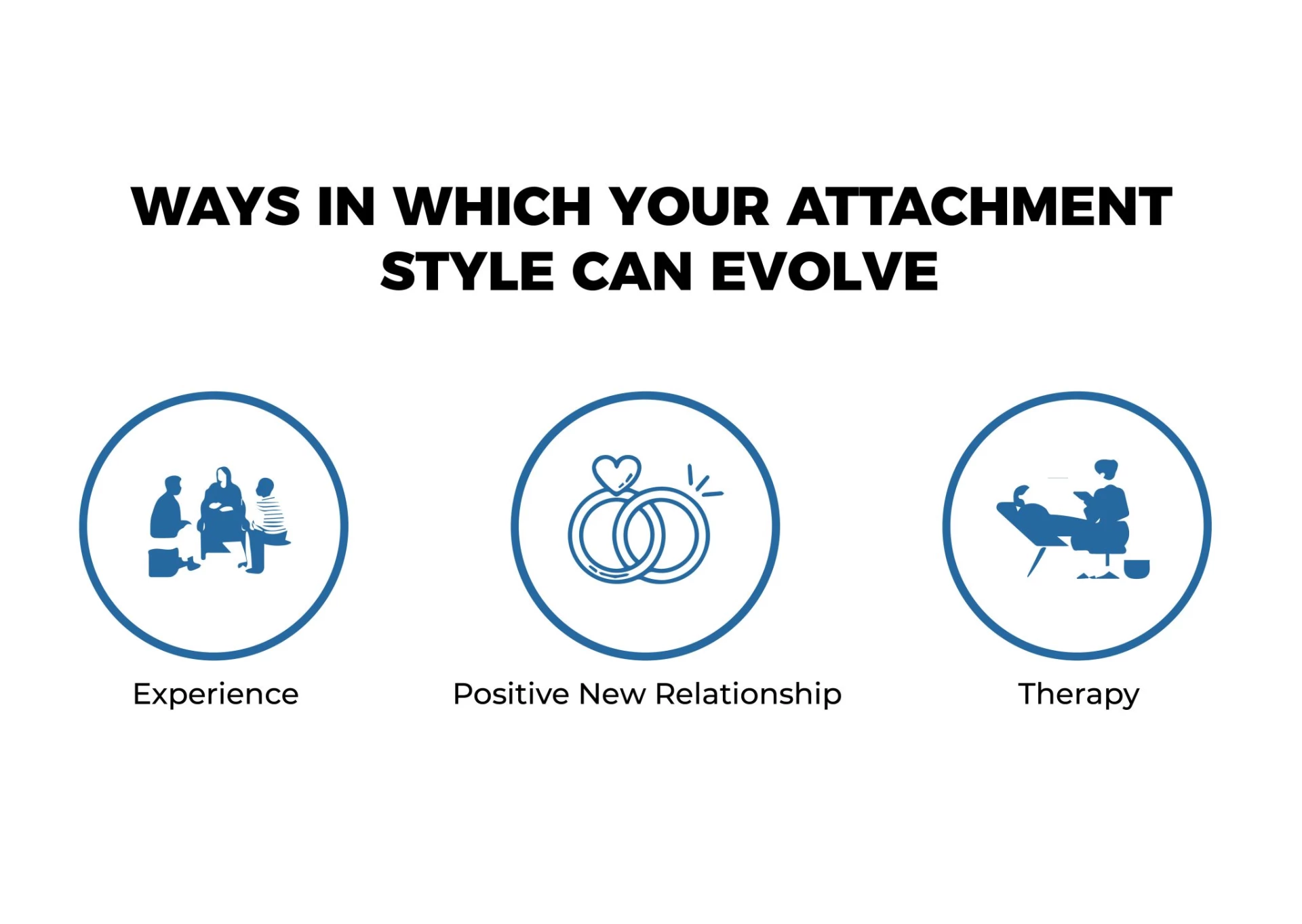
Experience
Your own personal experiences can help you change your attachment style. Now, this does not have to necessarily be a positive thing. Bad relationships can cause trauma and an insecure attachment style might be the aftermath of it.
But, as mentioned above, you have the power to reflect and introspect your past behaviors consciously, and learn from them. They can prove to be valuable lessons on how you should and should not react to certain situations. You can use these as building blocks, and the next time you are put in an uncomfortable situation with your romantic partner, you can look back on these circumstances and change the way you respond to them.
Remember that a response doesn’t always have to be a reaction.
Having Positive Experiences in Your New Relationship
A largely underrated method of improving the relationship you have with yourself and your partner is having a healthy partner in your new relationship. Your partner can guide you into becoming a more secure person in the relationship.
You learn a lot from each relationship you are in, and they help shape who you are as a person. Maintaining a healthy relationship can definitely be a learned experience if your partner is willing and helpful at addressing your insecurities. They can help you identify the root of your insecurities and work with you to help you improve how you are as a person in your relationship.
Therapy
Therapy is probably the healthiest and most responsible way of evolving your attachment style. Your therapist can work to help you overcome your insecurities in a safe space. They are licensed to help you become better individuals as a whole and help you with tools to enable growth in your personality.
You can go to different types of therapy that can help you evolve your attachment style.
Some people benefit from going to a life coach to change their entire mindset about how they handle situations.
There are also relationship coaches that offer more specialized services to help you with your dating life.
Your general psychologist already knows a lot about your case, and if your relationships are something you want to analyze and improve upon, they can help you with the same.
Cognitive Behavioral Therapy (CBT) is a proven method to alter the way you approach situations by rewiring your responses to various stimuli. You can apply it to your dating life and see if it helps you become a more secure individual in the relationship.
Like most theories, the attachment theory is not perfect. It comes with its own share of criticisms, which are discussed in detail in the next chapter.
Chapter 7:
Criticisms of the Attachment Style Theory
Despite the revolutionary new approach to understanding relationship dynamics, Bowlby’s attachment theory comes with its own set of criticisms.
There are some loopholes in his theory, which we will now discuss a little more in-depth.

Nature and Nurture
As you can see, the focal point of the entire Attachment Theory and its subsequent theories is that your identity is wholly dependent on the nurture (or lack thereof) you receive. This statement does not take into account the other environmental factors that could shape your approach towards relationships.
For example, if you grew up in an area that got flooded in your childhood and resulted in you losing your home, the way you would respond to heavy rainfall will be drastically different than if you had not. This has nothing to do with your mother or father loving the rains, or you being around rainfall in your childhood.
Similarly, there are other external environmental circumstances that are not in your caregivers’ control (nature) that can also shape the way you approach relationships. It’s not just nurturing.
The Type of Studies Conducted
The studies conducted were on infants, and they were put under extremely stressful situations, and their reactions were all recorded only in those times of stress. The study did not further elaborate on how the child would respond in a non-laboratory setting, and without being under high levels of duress.
So the results cannot be wholly unbiased or conclusive of the child’s natural behavior or response. Since the situations were fabricated, and the environment was new for the child, it is normal for the infant to have an extreme reaction.
Suppose the study was conducted at their homes, where the infant recognizes the environment they are in. How would they respond then?
What about Peer Influence?
The Attachment Theory by Bowlby glasses over the influence of peers altogether in a child’s development. If we were to translate childhood behavior into adulthood, peers need to be acknowledged as an influence as well.
For example, a child or teenager who spends their time with their peers who smoke is a lot more likely to take up smoking as a habit as compared to a child who spends their time with a non-smoking group of people. It doesn’t matter if the parents do not smoke, peer influence can also play an important role in shaping one’s identity and beliefs.
The lack of involvement of other peers that the children will be subjected to as an influence on their identity is another popular criticism of the Attachment Theory.
Involvement of Other Members of the Family
In Bowlby’s experiments and all the following research, the primary caregiver is always assumed to be the mother, and there are two things wrong with this assumption.
First, the mother is not necessarily always the primary caregiver. There are many instances when the child is raised by the father, older sibling, grandparents, aunts, or uncles. Always assuming that the mother is the one responsible for developing attachment is a bias.
The second is that the studies do not include the involvement of other members of the family. Even if the mother is the primary caregiver, if the child is raised in a household with other siblings or grandparents in the house, they are bound to have an influence on how the child forms and views relationships and attachments.
These two important points are not considered in Bowlby’s Attachment Theory.
Conclusion
Congratulations on finishing the definitive guide on Attachment Theory.
If you enjoyed reading this guide and found it helpful, do mention it to us in the comments section below.
If you have any additional notes or queries related to this guide, please feel free to reach out!
Did you have any questions you’d like answered?
Was there something that wasn’t discussed in enough detail that you would like us to elaborate on?
Is there any feedback you would like to give?
Don’t hesitate! We’re here to help.
