

Assertiveness Coaching: The Definitive Guide
Last updated: March 2026
Assertiveness Coaching
The Definitive Guide
This definitive guide is all about Assertiveness Coaching. The article's main objective is to help those who desire to boost their self-confidence by utilizing assertiveness coaching.
This post will provide you with a detailed explanation of Assertiveness Coaching and demonstrate how to use it to cope with everyday situations.
Read this guide if you:
- Want to demonstrate your confidence by being assertive
- Desire to feel more valued by others
- Want to attain a leadership position
- Want to develop a solid reputation
I’m sure you'll love this guide.
Let’s begin!
Contents



Chapter 1:
Fundamentals of Assertiveness Coaching
This chapter serves as the article's introduction. The term "Assertiveness Coaching" will be defined in this chapter before other significant points are listed.
The core meaning and reason for selecting assertiveness coaching will also be discussed in this chapter.

What is Assertiveness Coaching?
“A crucial trait that can help you better manage yourself, other people, and situations is called assertiveness and coaching of such traits is called Assertiveness Coaching.”
You can use assertiveness to influence someone to accept, agree with, or modify their behavior. Making "I" statements and presenting your thoughts and feelings in a style that is self-assured but not confrontational are the main goals of assertiveness training. You could initially find assertiveness training difficult if you have trouble believing that your wants or thoughts are important.
There are five components of Assertiveness Coaching which may include: clear, concise, confident, courageous, and controlled. The message is delivered succinctly, clearly, bravely, confidently, and in a cool, collected manner. It respects both one's own needs and other people's needs.
Being assertive entails standing up for your own rights and expressing your ideas, emotions, and convictions in clear, appropriate ways. It’s crucial to remember that we should constantly respect the opinions, feelings, and beliefs of others by being forceful. Being able to communicate sentiments, wishes, wants, and desires in an appropriate manner is a crucial interpersonal and personal ability.
Assertiveness may help you communicate in a direct, honest, and reasonable manner with others in all your encounters, whether at work or at home, with clients or coworkers, without infringing on their or your own rights.
Assertive individuals are better able to act in their own best interests, defend their rights without feeling overly anxious, communicate their feelings honestly, and do so without rejecting the rights of others.
Considering your own and other people's rights, wishes, wants, needs, and desires is a key component of being assertive. For both sides to act responsibly, assertiveness entails urging others to be open and honest about their opinions, desires, and feelings.
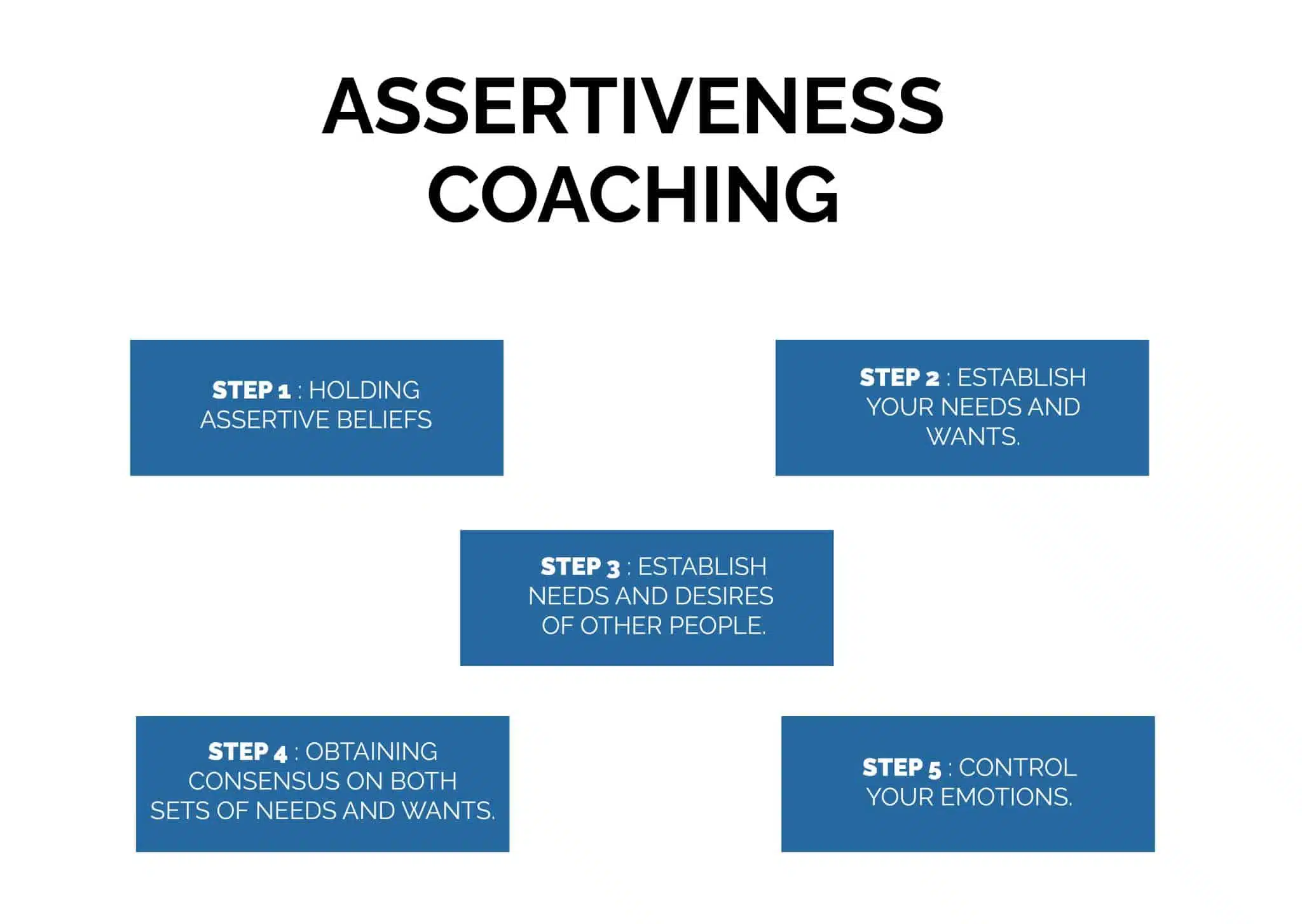
Here are five actions you can take right away to improve your assertiveness:
Step 1: Holding assertive beliefs.
Step 2: Establish Your Needs and Wants.
Step 3: Establish the needs and desires of other people.
Step 4: Obtaining Consensus on Both Sets of Needs and Wants.
Step 5: Control Your Emotions.
Core Meaning of Assertiveness Coaching
In true sense, being assertive is a good method to communicate. It is the capacity to stand up for ourselves honestly and respectfully. An individual uses assertiveness as a critical thinking strategy when they speak up to defend their opinions or in response to false information. People who are assertive can speak up, assess material, and identify areas where it is missing in content, specifics, or proof. Being assertive fosters original thought and excellent communication.
Reasons for Selecting Assertiveness Coaching
The reason for selecting assertiveness coaching is the idea that everyone has the right to respectfully express their needs, wants, and feelings to others. We may experience depression, anxiety, or anger as well as a deterioration in our feeling of self-worth when we don't feel free to express ourselves.
As a result of our potential for resentment when other people fail to understand why we are not being aggressive enough to communicate with them, our relationships with them are also likely to deteriorate.
Assertive behavior is situation and time specific, and there are no specific regulations about what it is. To put it another way, a person's behavior that is appropriately assertive for them in one setting may be excessively passive or aggressive for them in another.
Finally, the principle that assertiveness is a learned trait. Even while some people may appear to be more aggressive by nature than others, anyone may develop assertiveness.
Although these concepts may seem basic and obvious, acting assertively can occasionally be challenging for virtually anybody and is frequently difficult for some people.
For this reason, assertiveness coaching emphasizes learning assertive actions and putting them into practice with the assistance of a qualified therapist, in addition to discussing the value of assertiveness.
Now I will take you to thenext chapterwhich will discuss ways to become more assertive in detail.
Chapter 2:
Exploring Ways to Become More Assertive
This chapter will go through all the key guidelines for success in assertiveness coaching.
This chapter will enlist some ideas for improving assertiveness. It will also discuss some of the tips and communication techniques to gain assertiveness.
Ideas for Improving Assertiveness
An essential communication skill is being aggressive. You can explain yourself clearly and defend your viewpoint by being assertive.
Additionally, it can assist you in doing so while honoring the rights and convictions of others. You may increase your self-esteem and get the respect of others by being forceful. This can aid with stress reduction.
If you frequently take on a lot of duties because you find it difficult to say no, it might be especially helpful to you in reducing stress. Some people have an inherent tendency to be forceful. But if you're not, you can develop assertiveness.
Different communication styles are developed by individuals based on their personal experiences. You might not even be aware of your personal style since it has become so established.
Over time, people frequently maintain the same communication style. However, you can learn how to communicate in a more healthy and efficient manner if you want to alter your style of communication.
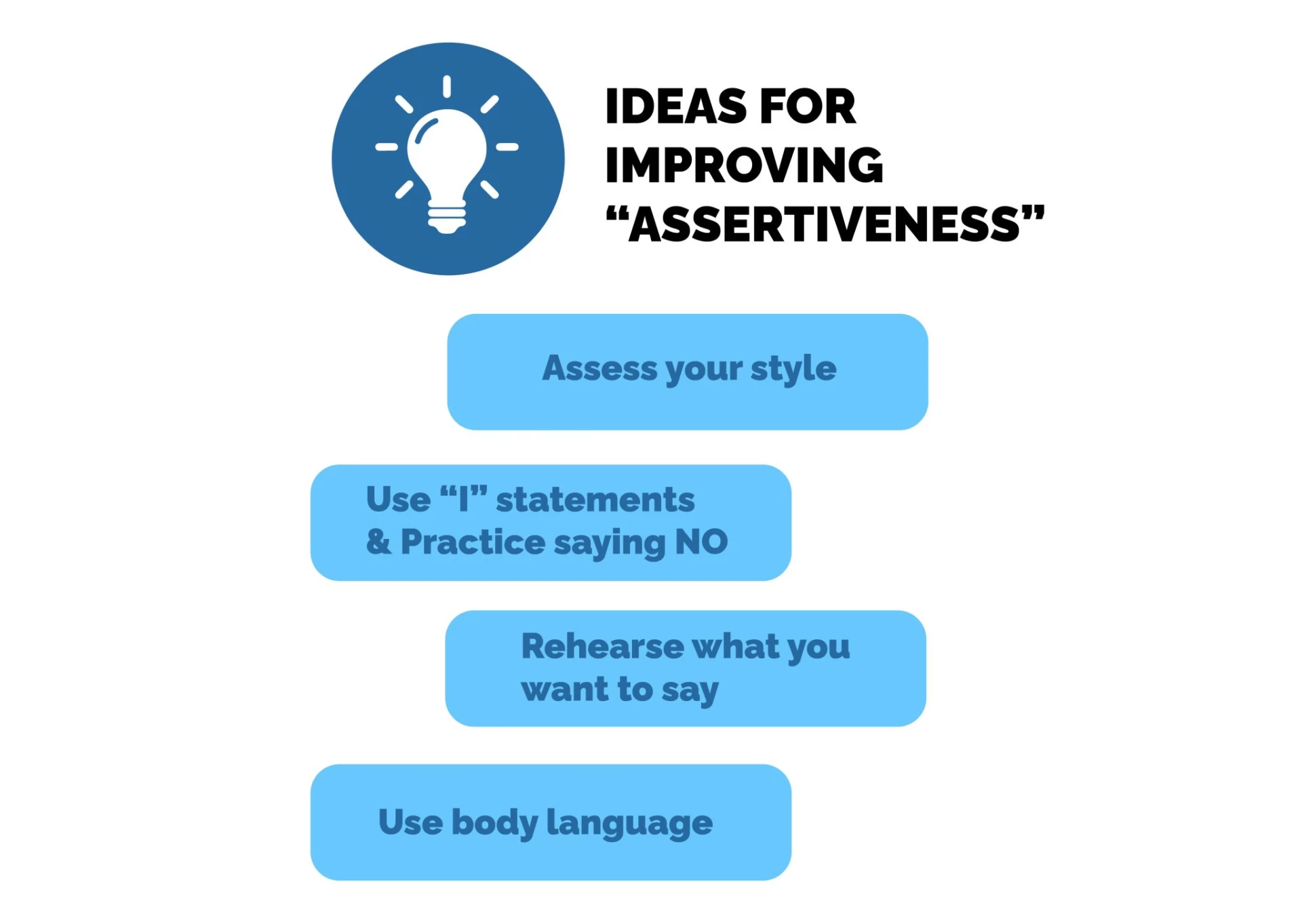
Here are some ideas for improving your assertiveness:
1. Assess your Style
Do you express your ideas out loud or keep quiet? Do you accept new tasks even when your schedule is already full? Do you accuse or judge others hastily? Do others appear to avoid or be afraid to talk to you?
Before you start adjusting, recognize your own personal style. That is what defines you.
2. Use "I" statements
By using I statements; you can communicate your thoughts and feelings to people without coming across as accusatory.
Say "I disagree," as opposed to "You're wrong," as an example. Say "I would like you to help with this" rather than "You need to do this" when making a request. Keep your requests concise, precise, and specific.
3. Practice Saying No
Try saying "No, I can't do it now" if you have trouble saying no to requests.
Keep in mind that saying "no" is a complete phrase, therefore you are not required to give an explanation. Don't think twice; just say it.
4. Rehearse What You Want to Say
If expressing your thoughts or desires is difficult, prepare for common scenarios that you may experience.
Declare your thoughts aloud. To rehearse from a script, it can be beneficial to write it out in advance. Think about acting out a scenario with a colleague or coworker and soliciting specific comments.
5. Use Body Language
Not only verbal communication is possible. Even if you don't feel confident, project confidence. Lean slightly forward while maintaining a straight stance. Maintain constant eye contact.
Maintain a happy or neutral expression on your face. Avoid crossing your legs or arms. Affront the guy. In front of a glass or with a friend or coworker, practice using assertive body language. Your facial expressions and body language are equally as significant as what you say.
Keep in mind that developing assertiveness requires time and effort. The process of being more aggressive probably won't happen immediately if you've spent years keeping your mouth shut.
You might need to acquire some anger control skills if your anger causes you to become overly violent.
Consider professional assertiveness training if, despite your best efforts, you aren't improving your level of assertiveness.
And if problems like rage, tension, worry, or fear are getting in the way, think about speaking with a mental health expert. It will be worthwhile in the end. You can start communicating your demands and your feelings more clearly by learning to be more forceful. You might even discover that as a result, you acquire more of the things you want.
Tips to Gain Assertiveness
Being assertive is a skill that can be acquired and learnt. It is a method of communication that is essential to healthy partnerships. It can aid in your transition from a passive to an active and frequently heard state of mind.
If you are not typically direct, learning to be more assertive usually requires going outside of your normal routine, but doing so can boost your self-esteem and confidence.
Here are our top tips for developing assertiveness so that you may speak up, engage in conversation, and solve problems more frequently:
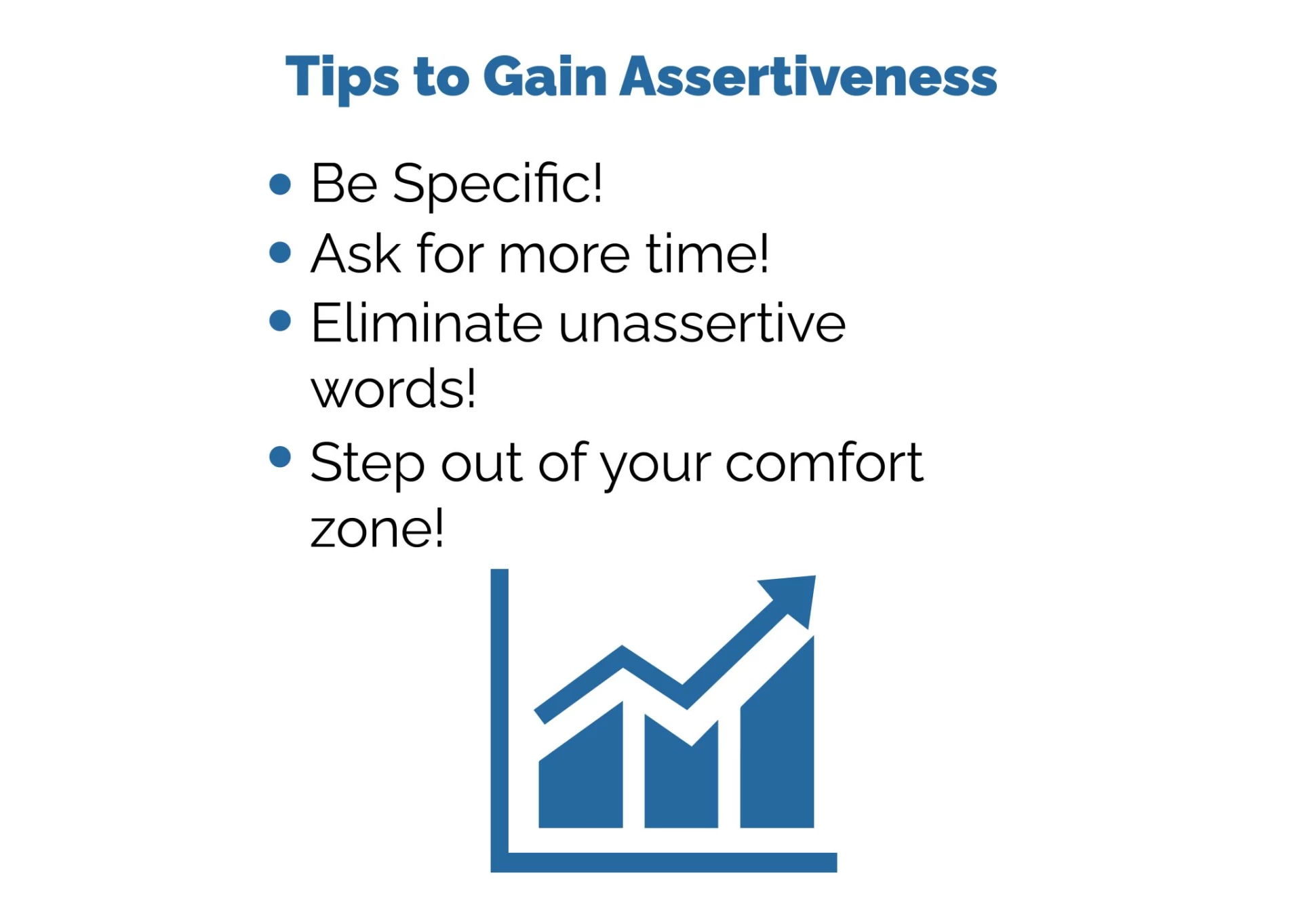
1. Be Specific
Simply said, making broad generalizations in communication is factually inaccurate. Consider your words carefully, and present truthful data. Make careful to be clear, succinct, and direct when expressing your opinion or concern.
2. Ask for More Time
Ask for extra time if you find it difficult to decline. For instance, "I'll have to look into it," "Let me see if I can reasonably fit that into my schedule," or a straightforward "Let me think about that and I’ll get back to you." These kinds of sentences will help you to develop assertiveness.
Asking for additional time is not wrong; in fact, it shows the other person you value their request.
3. Eliminate Unassertive Words
Unassured speech does nothing to boost your confidence. Starting by getting rid of the words - is a simple technique to practice being more aggressive. Try to include more assertive words in your speech. Build communication with strong words which makes you more assertive.
4. Step Out of your Comfort Zone
Make requests and get over any worries you may have about getting rejected. There truly is no harm in asking because most individuals like to assist others.
You won't receive what you don't ask for, therefore if you want to create more possibilities for yourself, you must push yourself outside your comfort zone. You will practice becoming a new, assertive form of yourself if you push yourself into situations when you feel less confident.
Assertive Communication Techniques
You can utilize a variety of straightforward but efficient communication techniques to develop your assertiveness. Here are a few techniques you can make use of:
- The "I" Statement.
- Empathy.
- Escalation.
- Request more time.
- Modify the verbs.
- Be a stale old record.
- Scripting.
By recognizing your desires and wants, communicating them positively, and developing the ability to say "no" if necessary, you can gradually develop your assertiveness.
Assertive communication strategies can also be used to help you express your thoughts and emotions clearly and forcefully.
When attempting to increase assertiveness, there are several specific tactics that can be helpful.
One, known as the ‘broken-record method’, is helpful when someone else didn't admit or accept your message.
Imagine, for instance, that a salesperson is trying to persuade you to purchase something you do not want. “Thank you, but I'm not interested in purchasing anything today,” you respond. If the pusher persists, you merely reiterate the same thing while maintaining your composure. The person will eventually be compelled to accept your denial.
Another tactic frequently referred to as ‘fogging’ is a way to refuse requests or disagree with someone while still demonstrating your respect and acknowledgement of their viewpoint. You start by explaining the other person's feelings before elaborating on your inability to or decision not to agree with their request.
For instance, you might be cold, and your husband might ask you to lower the thermostat. You can respond by saying: “I apologize but, even with a sweater on, I'm still shivering. I don't want to lower the temperature any further. Perhaps you should wear less clothing or take a stroll.” The key is to assert your opinion freely.
Now, I will take you to the next chapter which will discuss the difference between aggression and assertiveness.
Chapter 3:
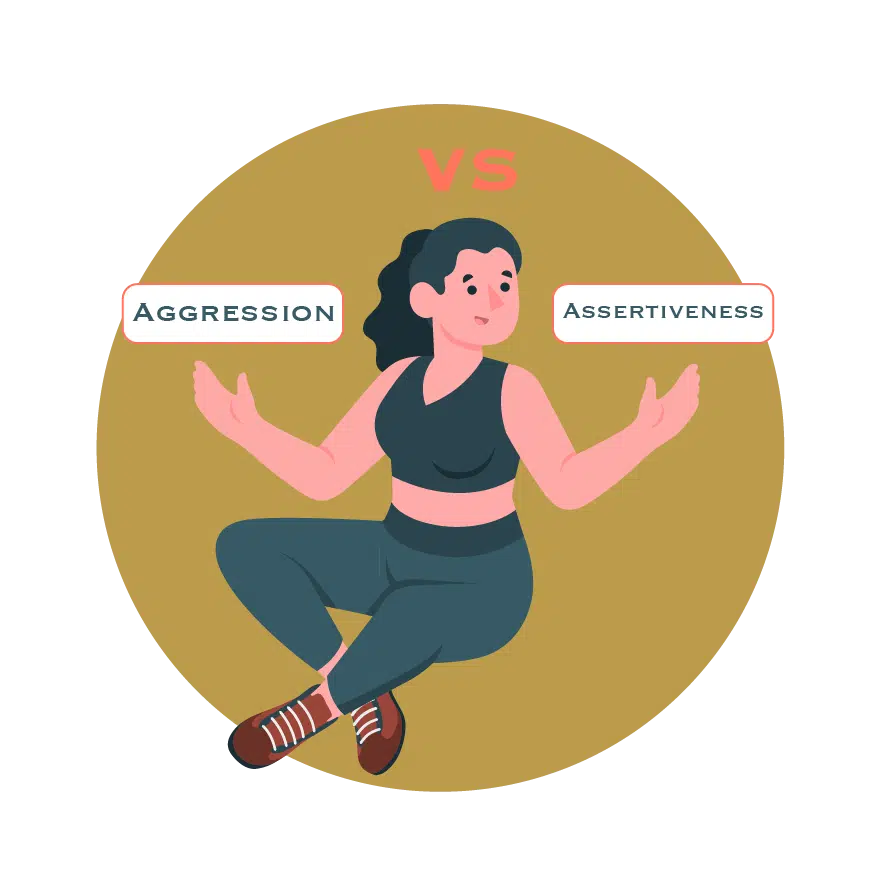
Aggression vs Assertiveness
Aggression and assertiveness are two terms which are often mistaken to be synonyms. There is a magnitude of distinction between the two though.
In this chapter, I will discuss the difference between aggression and assertiveness in depth.
Relationship Between Assertiveness and Aggression
You must understand the difference between assertiveness and aggression if you want to learn how to be assertive. Let's imagine you have a friend who frequently interrupts you in meetings.
Here are some possible responses that you can give to your friend:
The first possible response is with aggression. Speaking louder than your colleague or yelling, "Quit talking!" would be an aggressive response to their interruption. Because it infringes on the rights of the other person, this response is aggressive rather than assertive. The meeting does allow your colleague to speak and blocks communication. The problem remains unresolved.
You may respond in an assertive way to your friend. A confident retort would be something like, "Forgive me. When I'm finished speaking, I'll give the floor to you. Thanks." You have quickly communicated to your colleague what is and is not acceptable. By doing this, you'll be able to speak your mind and your colleague will do the same when the time is right. This type of response is assertive.
Simply, the antidote to aggressive behavior is assertiveness. Effective communication is prioritized while maintaining respect for both your own and others' boundaries.
Assertiveness training is sometimes confused with aggression, leading some people to fear that it would make them pushy or inconsiderate of others. It’s possible to think of assertiveness as falling somewhere in between aggression and passivity. A middle ground of sorts.
When you prioritize the needs and wishes of another person over your own when engaging in interpersonal interactions, you are acting passively. Aggressive behavior, on the other hand, happens when you impose your needs on others.
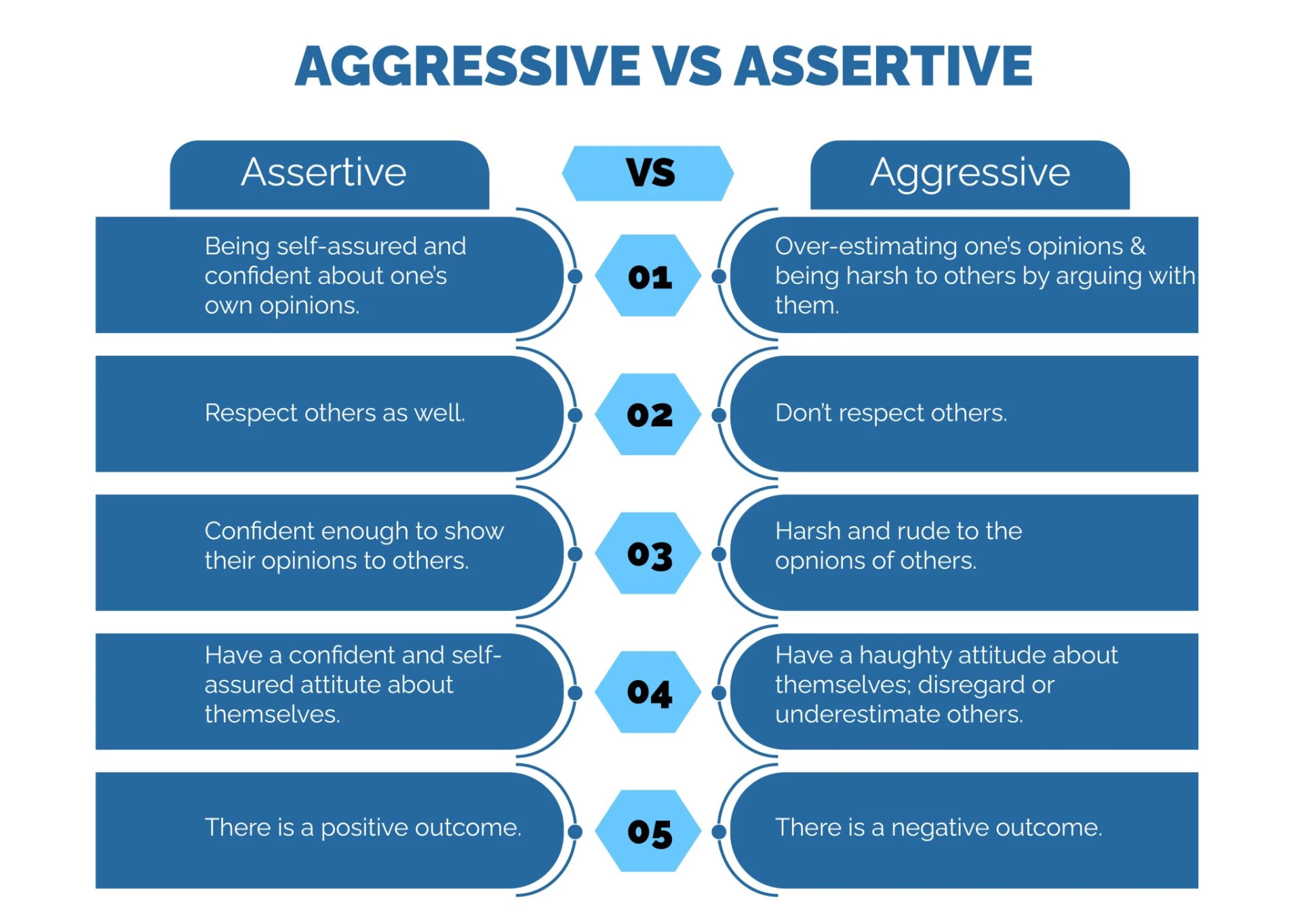
Being aggressive is overestimating one's opinions and being cruel to others by engaging in conflict but being assertive is being self-assured and confident about one's own opinions.
Aggressive behavior typically entails scaring, threatening, or (to a lesser extent) ignoring others, whereas assertive behavior is all about sticking up for yourself. People who are assertive defend their own interests, including their wants, values, and views. And they do it in a civil, nonaggressive, courteous manner.
Aggression and assertiveness are different behaviors, notwithstanding any perceived similarities. Being loyal to your desires and needs is the cornerstone of assertiveness.
It is based on the principles of justice and equality. In contrast, aggression is motivated by a desire to succeed or be right. Aggression does not consider other people, fairness, or equality in favor of acting in one's own self-interest. It is self-centered and self-serving, and other people might see it as bullying.
Differences between Assertiveness and Aggression
It might be challenging to recognize genuine assertive behavior. This is because there is a tight line between assertiveness and aggression, and individuals frequently mix the two up.
Because of this, it helps to identify the two behaviors so that we can tell them apart clearly:
1. Balance Forms the Basis of Assertiveness
It necessitates being open and honest about your needs and wants while also considering the rights, needs, and wants of others. When you are assertive, you are confident in yourself and use this to your advantage to make your argument clearly, fairly, and empathetically.
2. The Goal of Aggressive Behavior is Victory
Without considering the rights, wants, feelings, or interests of others, you act in your own best interest. When you are hostile, you employ selfish power. You might come off as being demanding or even abusive. You frequently take without asking for what you desire.
Therefore, an aggressive boss is one who leaves a mountain of work on your desk the afternoon before you go on vacation and insists that it be finished immediately. Although the work must be done, they neglect your wants and feelings by forcing it onto you at the wrong time.
However, when you tell your supervisor that the task won't be finished until you get back from vacation, you strike the perfect balance between passivity not being aggressive enough and aggression being hostile, angry, or rude. While understanding your boss's obligation to complete the job, you stand up for your own rights
Strategies to Control Aggressive Behavior
Being assertive is a positive strategy for handling challenging people, attaining your objectives, and resolving conflicts. Aggressive behavior is different from assertive behavior in that assertive behavior involves a positive and courteous attitude.
Speaking without thinking, calling people names, and not paying attention to other people's needs are all examples of aggressive behavior. Destress from a tense circumstance, communicate clearly, and comprehend others perspectives to settle your concerns assertively rather than violently.
Here are some strategies for controlling aggressive behavior:
1. Smile and Take a Big Breath
In addition to preventing rash and aggressive behavior, taking a moment to breathe and smile causes your brain to release endorphins.
Your brain has been conditioned to associate happy emotions with these muscle movements, so when you smile, endorphins are released. Serotonin and endorphins work together to maintain a calm mood. Stress-relieving behaviors like breathing and smiling help reduce cortisol levels in the body.
2. Spend Some Time in Meditation
It's not necessary to sit on the floor with your legs crossed to meditate. You can accomplish it by taking a stroll or looking for a peaceful location to be by yourself. You may even schedule your meditation or follow a guided meditation using applications on your smartphone.
You can always get away from a stressful scenario for a short while, whether you're in an office setting or a social one. You can create a constructive plan of action where you can be forceful by taking a few minutes to clear your head and meditate. Aggressive and immature behavior might result from acting hastily and without thought.
3. Keep in Mind that Your Viewpoint Matters
You have every right to feel however you do. Additionally, you possess the ability to communicate your opinion respectfully and confidently. Even though it may seem foolish, giving yourself a pep talk can help you gain confidence and articulate what you need to say clearly and confidently.
Without having had a chance to calm down, you are more likely to act aggressively if you try to confront someone. Bullying is an example of aggressive behavior since it prevents people from cooperating to find a solution.
4. Recognize that you have no power on the thoughts or Sentiments of Other People
Only your actions and emotions are under your control. Being assertive entails concentrating on your approach to problems.
While changing someone's behavior may be your aim, you cannot compel someone to act in accordance with your wishes. The only thing you can do is express your needs and feelings. Aggressive behavior entails trying to enforce your will and persuade someone to conform to your desires. Being assertive entails managing your emotions and behavior while maintaining composure.
Now I will take you to the next chapter which will discuss the benefits and drawbacks of Assertiveness Coaching.
Chapter 4:
Benefits and Drawbacks of Assertiveness Coaching
Everything has benefits and drawbacks at the same time. This chapter will discuss the benefits and drawbacks of Assertiveness Coaching.
It is important to know about the benefits along with drawbacks to know about something in depth. That is why this chapter is clinically important.
Benefits of Being Assertive
By being assertive, you can communicate your demands and wants more forcefully while still being fair and sympathetic. Additionally, it might boost your self-confidence and even your mental wellness.
Other advantages of assertiveness include those that can help you at work and in other spheres of your life.
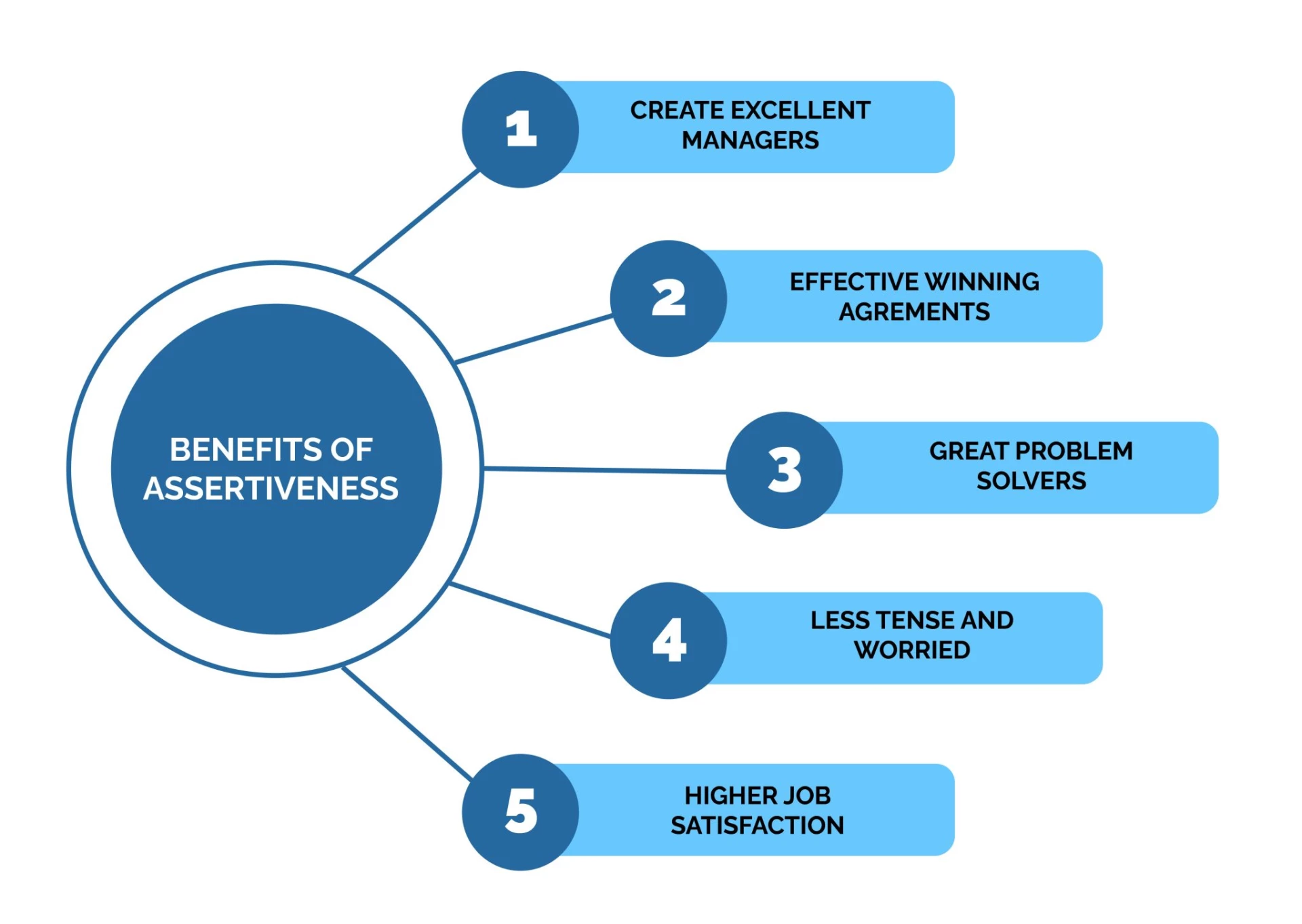
These are some benefits of assertiveness:
1. Creates Excellent Managers
Being assertive makes you an excellent manager. By treating people fairly and with respect, they accomplish their goals and receive the same treatment in return. As a result, they are frequently regarded as likeable leaders who are a pleasure to work for.
2. Negotiate "Win-Win" Agreements that are Effective
Assertive people can understand the merits of their opponent's stance and can rapidly come to an understanding with them.
3. Superior Problem-solvers and Achievers
They have the confidence to take whatever steps are necessary to identify the best answer to the issues they run across.
4. Less Tense and Worried
People with assertive behavior are less tense and less worried. When things don't go as expected or planned, they are confident and don't feel frightened or mistreated.
5. Higher level of Job Satisfaction
Assertive people have higher opportunities to get high-paying jobs. They feel comfortable setting boundaries and saying "yes" to the request and "no" to the assignment. They are the best suitable choice for any kind of job.
Risks of Being Assertive
Some national and organizational cultures value passivity over assertiveness and may consider such behavior to be impolite or even disrespectful.
According to research, men are more likely to be rewarded for being forceful than women, which may have an impact on how assertive behavior is regarded. But this doesn't suggest that you should just accept the way things are. Instead, shun naivety and be brave.
You run the risk of going too far as well. Even if other people have wonderful ideas, you could start to cease listening to them if you become overly assertive. This will only serve to annoy your coworkers and sour relations.
Training in assertiveness carries very little danger. If those close to the participant have trouble embracing the alterations in their relative or friend, this could have an impact on personal ties.
However, this risk is no bigger than that connected with any other change in one's life. Overcompensating by being overly forceful at the beginning of training is another potential concern. Participants can typically learn to adjust and enhance their replies with the right feedback.
When learning to speak up and adopt new behaviors, people who are extremely shy, self-conscious, or who experienced harsh treatment as children may also feel anxious.
Although the anxiety could be unpleasant, it should subside as the person grows accustomed to the approaches and gets support from other program participants.
Normal Results of Assertiveness
The typical outcomes of assertiveness training are an improved sense of well-being and higher levels of positive self-esteem. Many participants claim to feel more confident in themselves and more equipped to handle the stresses of daily life.
Additionally, those who have taken assertiveness training have a stronger knowledge of their own boundaries and can set reasonable limits with others. People are less likely to experience victimization from others when they can set reasonable boundaries (such as by expressing "no").
The result of assertiveness training is a healthy feeling of self-determination and respect for others. Each person benefits from this equilibrium by being able to communicate more effectively and make wise decisions for themselves.
Abnormal Results of Assertiveness
Unusual outcomes may include exceedingly strict restrictions as if the person is trying to make up for something. This response can be re-learned with the right instruction, role-playing, and feedback.
In contrast, shy people could suffer increased anxiety when employing the approaches at first. The person's worry about how other people will respond to their aggressive remarks is typically what causes nervousness or anxiety. Usually, the anxiety will subside with time.
Why assertiveness is not always encouraged?
Most of us don't naturally possess the trait of assertiveness. It frequently results in the uneasy sensation that we're upsetting the balance or the status quo. We all tend to strive to "fit in," whether it's with our families, our coworkers, or our friends.
Nevertheless, if we want to be taken seriously and heard at work, assertiveness is a crucial trait to develop. The issue is that few of us find being forceful simple and instead choose to keep our mouths shut. The reason behind this is perhaps because:
1. No One Teaches Assertiveness in Schools
When we are young, we are frequently called "bossy" and praised for remaining silent and deferring speaking until directed.
Additionally, we aren't frequently given the chance to assume a leadership position; instead, we must cooperate as a team. We need some assertiveness to make sure we're heard within the team and can speak out when we feel things are moving in the wrong way, even if teamwork is equally crucial in the job. We learn early on not to do this.
Children are instructed not to question their teachers or other adults in positions of power. This may assist teachers in maintaining control over children and teenagers, but it does not provide them with the skills necessary to defend their rights and beliefs at work.
This discourages us from challenging our managers or pursuing promotions and other rewards we believe we are entitled to.
2. In the Workplace, Assertive Behavior Is Often Not Encouraged
No matter how you phrase it, employees must obey instructions. Even in the most progressive firms, most incentive structures discourage aggressiveness. They promote fidelity and, to a considerable extent, submission.
As a result, employees are naturally discouraged from taking the risk associated with being forceful because, in essence, someone has the authority to stop paying them.
The promotion of free speech at work is improving in certain locations, but the natural hierarchy will still hinder those lower down the ladder from speaking their minds.
3. The Difficulties of Collaborating with Others
Unfortunately, assertiveness can sometimes be misrepresented or mistaken for arrogance and hostility. This might be the case because it is unexpected and catches people off guard.
It is often simpler to maintain a pretentious "peaceful" working relationship with a tough employer or coworker than to question or challenge them.
From there, it replicates the behaviors with additional coworkers and feeds off itself, fostering a climate of amenable obedience.
Assertiveness issues will persist in the workforce until adjustments are made to the educational system and the structural makeup of contemporary corporate labor. People will need to put in some effort to maximize their effectiveness within these systems.
Now I will take you to the next chapterwhich will discuss assertiveness in terms of counseling.
Chapter 5:
Assertiveness in Counseling
This is one of the simplified and fruitful chapter of the guide.
This chapter will describe assertiveness in terms of counseling.
This chapter will also discuss therapies that teach skills to become more assertive.

What do you mean by assertiveness in counselling?
The act of being assertive is the open and truthful expression of one's thoughts, feelings, wants, and rights in a way that respects the privacy of others. In counseling, it entails a client asserting their own rights, recognizing the rights of others, and attempting to reach a win-win outcome.
Being forceful is crucial both when you are experiencing pleasant and negative emotions. For instance, turning down requests for your time or assets when you can't do so without feeling resentful or annoyed is doing the friend who is asking a favor.
It keeps you from harboring those unfavorable thoughts of bitterness and helps you from having a hidden goal that can later harm your relationship. People will believe that your "yes" is sincere and free of any hidden obligations if they have faith in your ability to say "no" when you ought to.
Although it's not always simple, learning to be assertive is a talent that can be acquired. Understanding who you are and where your boundaries are before you can become more aggressive. Assertiveness Counseling works by assisting you in identifying your comfort zone and learning how to convey that message firmly but diplomatically.
The term ‘boundaries’ is frequently used in assertiveness counseling, A boundary literally delineates the boundaries of a space and serves as a dividing line. When we speak about personal boundaries, we are referring to a "boundary" or "limit" that we set regarding how we will tolerate being treated by others. It serves as our unique separating line.
As a result, a lot of the topics that are discussed and investigated in counseling can frequently be linked to personal boundaries and how we treat ourselves and others. Due to the range of experiences we have had, our personal limits may be related to our past, our upbringing, and how we view ourselves.
Being aggressive is quite challenging if you are unsure of your boundaries.
- What are you attempting to explain?
- What exactly will you accept and what won't you?
- What is it about the situation or scenario that is making you react?
First and foremost, assertiveness counseling may help you address the topic of your personal limits and assist you in learning not only what those boundaries are and how they function, but also what those boundaries have meant to you throughout your life. Lack of assertiveness is frequently accompanied by poor boundary management.
Assertiveness Therapy
Therapy in assertiveness has significant potential and numerous advantages. For instance, research indicates that fostering children's assertiveness may lessen their risk of experiencing bullying at school.
Therapy in assertiveness has been linked to decreased burnout and enhanced work dedication in the workplace. Possessing this quality is a sign of an excellent, or even exceptional leader when combined with self-assurance and respect for others.
Therapy in assertiveness has been shown to be helpful for establishing and maintaining relationships in all spheres of life and enhancing psychological well-being, with favorable effects on the following:
- Depression
- Anxiety
- Self-esteem
- Contentment in relationships
- Substantial mental illness such as schizophrenia
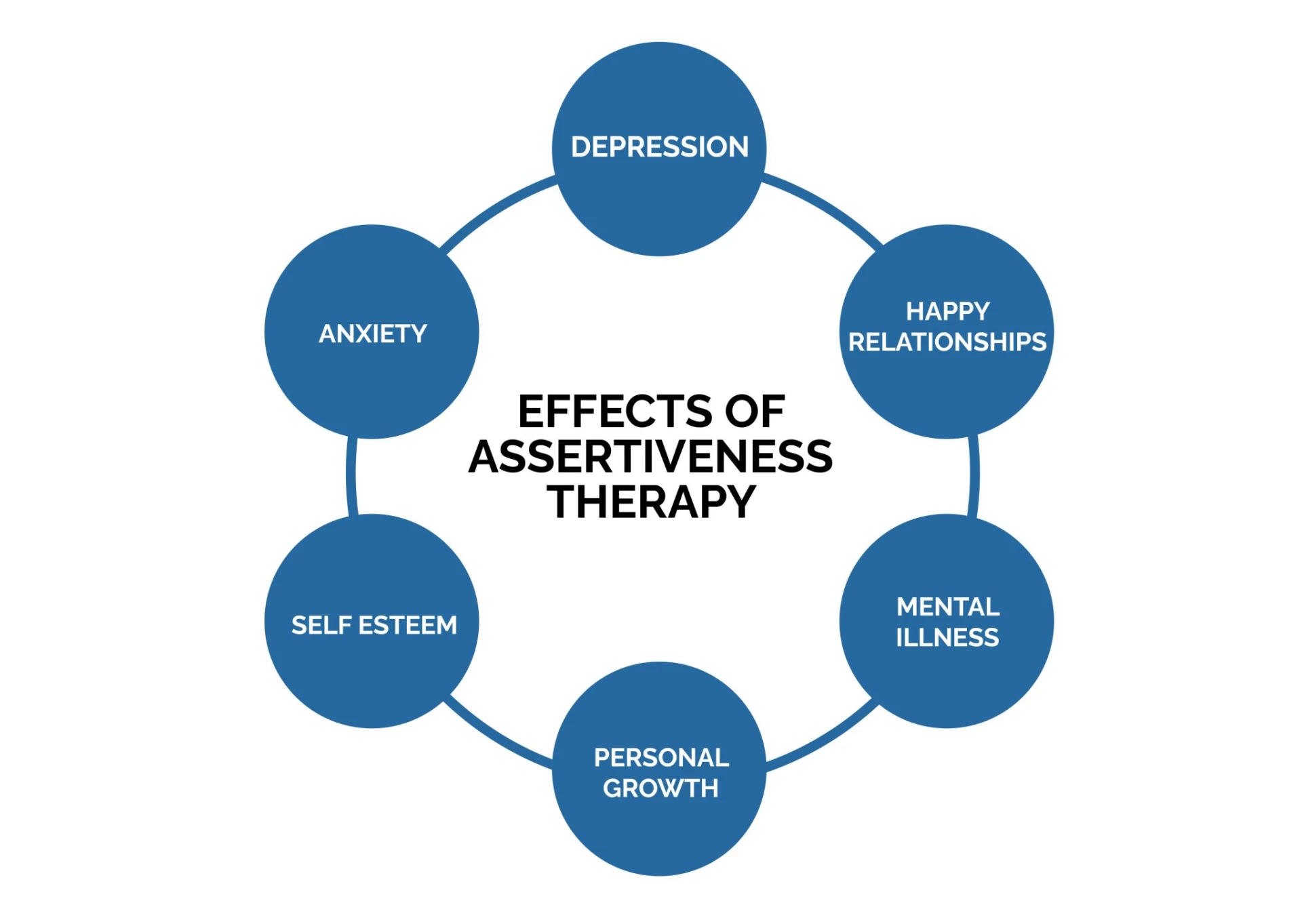
Although Assertiveness Therapy can take many different forms, it is frequently included in other, more comprehensive treatments. Regardless of labels, the following elements are typically present.
- Knowing the Context: Culture and surroundings have a big impact on how assertiveness is perceived e.g., at work vs. at home. A key component of assertiveness training continues to be finding a balance between your requirements and your level of assertiveness.
- Considering how Aggressive You Are: It is crucial that training promotes awareness of your assertiveness. Your difficulty could lie in interpreting your actions—whether passive, assertive, or aggressive. Being more aware of yourself will help to tackle this.
- Fostering Relationships: Being assertive shouldn't make relationships worse. In order to overcome obstacles and obtain the resources you require; assertiveness training must educate you on how to build trust.
- Being Honest to Yourself: When you are genuine, it can be simpler to be assertive. You can be more at ease and confident if you are true to who you are, your values, and your strengths.
Quit saying "Yes" when you really mean "No." Be clear about your requirements and wants so that you get the results you want. counseling to help you be more aggressive at work and at home.
Many of us find it difficult to be aggressive and express what we mean, both at work and in our personal life. You can explain clearly what you want and what you are not willing to accept with the help of coaching to improve your assertiveness. You can also establish and set boundaries for both you and other people.
Set your limits and take the first step in increasing your self-assurance, feeling more in charge, and agreeing to just the things you want to accomplish.
You may frequently encounter uncomfortable or difficult talks in your professional and work interactions where you feel the need to "push" your viewpoint or prove a point. Establishing your boundaries and speaking up for yourself will make it more likely that you will not only be heard but also you will succeed in your aim for the conversation or at the very least, meet the other person halfway.
Assertiveness Therapy may be right for you if you frequently hold things inside and suffer in silence rather than speaking up for yourself.
It will help you to stand up for yourself if you usually submit and defer to others while holding yourself back, if you have lost confidence as a result of damaging relationships in your personal or professional life, or if you simply need to learn how to persuade people to do as you wish without turning into a bully or losing control of your temper.
Let’s head to thenext chapter.
Chapter 6:
Challenges of Assertiveness Coaching
This is the second last chapter of the guide.
This chapter will discuss some of the challenges faced in assertiveness coaching along with some potential solutions to deal with such challenges.

What are some challenges in applying Assertiveness Coaching?
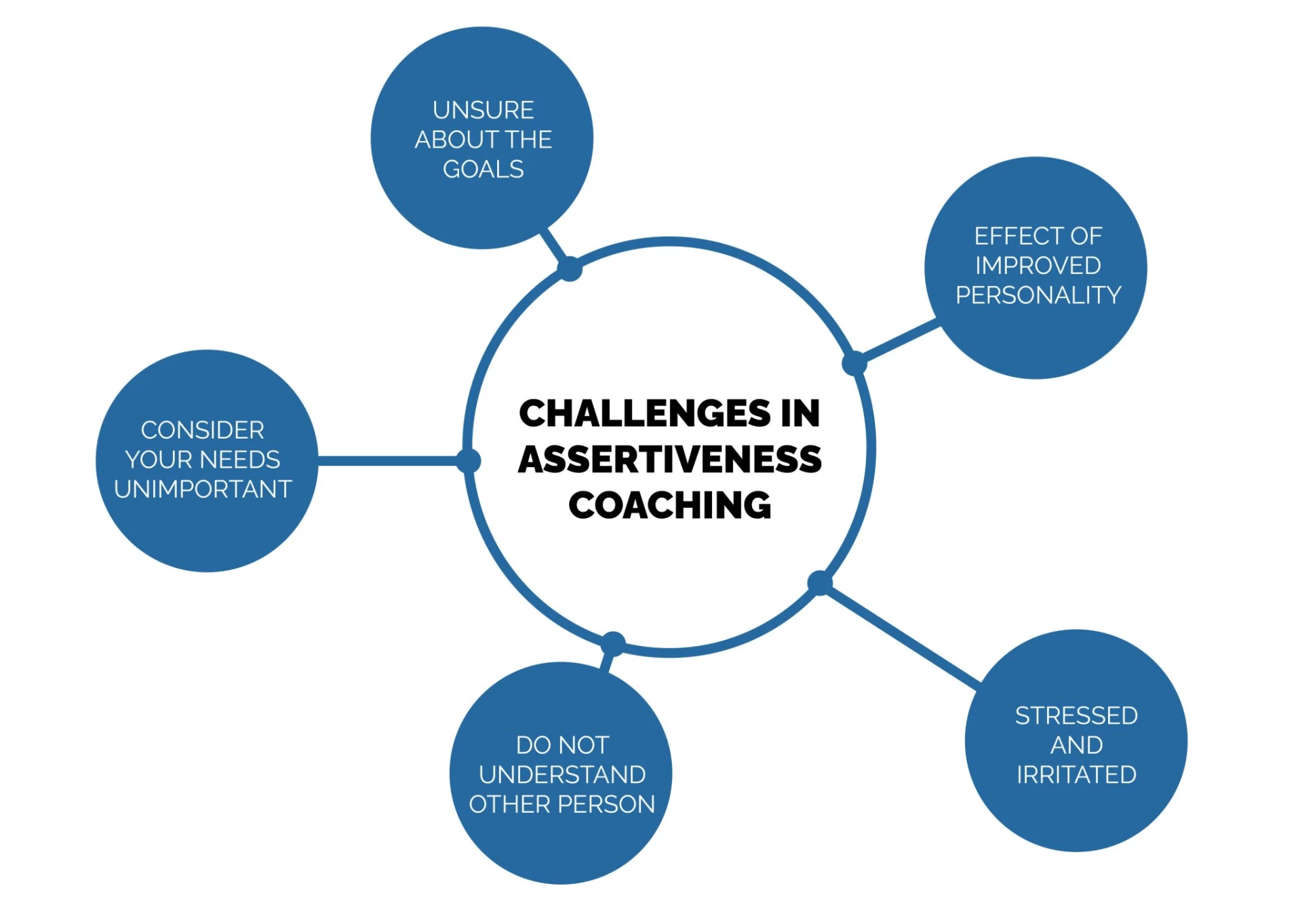
Assertiveness Coaching has many challenges that come with applying it in real life. If your previous attempts at being assertive have failed, you need to think about how your personality is influencing the situation.
Here are some difficulties with being assertive if you are facing any of these issues:
1. Consider the Effects of an Improved Personality
There is a thought before every deed. If you don't think you have what it takes to manage obstacles, think about developing your personality.
Your life will become easier and more fulfilling as a result. Imagine how it would assist if you spoke out to assert your rights, told a difficult individual that their actions are harmful to both her and others, or refused others when you felt accepting them would be constricting. Consider the effects of your actions. It must satisfy you without causing harm to others.
2. You are Unsure of your Goals:
It's important to convey your needs, wants, and feelings if you wish to be assertive . But occasionally, you may not even be aware of those. Possibly you're focusing on others too much.
Perhaps you operate largely automatically and hardly ever glance inward. Concentrating on what makes you defensive and furious because behind these emotions frequently lie more sensitive issues and unmet needs.
3. You believe your Needs are Unimportant
If you don't think your needs are important, it can be difficult to ask for what you want. Discuss this with a therapist if you're really having trouble believing that your demands are important.
4. You neglect to consider the other person's humanity
You could not be perceiving the other person's humanity if you're afraid to ask for what you want. Instead, you can be overly preoccupied with their position or duty such as your boss, parent, or older sibling. Keep in mind that this individual is a human being, just like you, who is likewise striving to be happy and meet their needs.
Everyone wants to be respected and taken into account. Keep in mind that everyone's needs count.
5. You're stressed out or irritated
It's challenging to reason clearly and sensibly when you're attempting to be aggressive with someone and you start to feel anxious.
We do, after all, activate our fight, flight, or freeze reaction when we are provoked. I advise you to practice meditation. This will help you to keep a check on your emotions from overwhelming you.
How to Face Challenges Regarding Assertiveness
All this advice that I have listed will help you overcome assertiveness issues and become more at ease for standing out for yourself:
1. Evaluate your Manner of Communication
Examining your communication style is the first step toward increasing your assertiveness. Do you communicate in a passive or aggressive manner? If you have a passive manner, you might put other people's demands ahead of your own. But over time, this manner of speaking might cause negative animosity.
On the other side, an aggressive approach infringes on other people's rights. Being assertive is totally different from this. There is only a transparent statement of your requirements or desires; there is no bullying or intimidation. You can identify areas that need work by knowing where you lie on the continuum between passive and aggressive communication.
2. Prepare your Reply in Advance
Do you frequently say yes to requests without giving them much thought? If you frequently do this. When given a request or an invitation, you aren't all that interested.
Here are a few examples to get you started:
- I'll get back to you on that, please.
- I must look at my calendar.
- "I have a conflict in my timetable."
- "I have plans; therefore, I won't be able to."
Make sure to get back to the person if you decide to say you need to check a few things first.
3. Avoid Letting Guilt stand in your Path
Keep in mind that declining a request does not imply that you are rejecting the person if you find yourself feeling guilty when you try to express yourself.
4. Talk to yourself Kindly
When you're in the heat of the moment, practicing assertiveness is difficult. Talk to yourself positively to boost your mood. It may sound corny but get yourself pumped up with positive affirmations like "I can do this" or "My time is important" before engaging in a situation where you know you'll have to lay your foot on the floor.
5. Take Deep Breaths
Take a moment to take deep breaths if setting boundaries causes your heart to race. This is especially important if you feel aggressiveness beginning to take hold. Breathing will help you ground yourself, calm your body and mind, and help you refocus on your goals.
6. Assume an Authoritative Posture:
Taking an authoritative body attitude that makes you feel more powerful and confident before entering a stressful circumstance or having a difficult talk. Roll your shoulders back, and stand tall. Maintain neutral facial expressions and constant eye contact.
7. Practice with a Person you Trust
Consider acting out alternative conversational tenors with a reliable buddy if you have a significant issue you're attempting to resolve. Write it down, then speak your desired words out loud.
Always remember to solicit input regarding your communication clarity and the potential perspective of the other person. Pay attention to how your body language and voice tone affects their reactions.
Are you able to converse without getting withdrawn or hostile? After that, evaluate yourself. Adapt your strategy considering their suggestions.
Now, I will take you to thefinal chapterof the guide where I will discuss a few applications of Assertiveness Coaching along with courses related to it.
Chapter 7:
Applications and Courses Related to Assertiveness Coaching
This is the last chapter of the guide. This chapter will discuss Assertiveness Coaching with respect to practical applications and effective courses.
It will also enlist some of the prominent courses to adopt for assertiveness coaching.
Applications of Assertiveness Coaching
Assertiveness coaching has been proven to be an effective method for preventing alcohol use problems in numerous studies. With some empirical evidence, psychological skills in general, such as assertiveness and social skills, have been proposed as interventions for several diseases.
1. Helps in Treating Alcohol Use Disorder
People with substance use disorders take to alcohol or other drugs to ease the tension and anxiety brought on by difficult interpersonal circumstances.
Thus, programs for assertiveness training have been created for patients with substance use disorders who are anxious and display interpersonal skill impairments. According to several researchers, treating alcohol and cocaine misuse disorders with assertiveness training increases treatment results.
Lack of assertiveness among substance users has been linked to a few psychological characteristics in addition to the severity of the use disorder. A favorable correlation between substance use and social anxiety has been found in studies of individuals who are alcohol and drug-dependent.
Since methamphetamine users generally have high anxiety levels, it is likely that they also feel anxious in social situations where assertiveness is required.
2. Self-esteem
Being assertive is often good for a person’s self-esteem. The idea is that raising self-esteem helps people feel more in control and empowered, which reduces their need for alcohol in tense social situations.
What situations call for you to be assertive?
Here are some instances of commonplace circumstances when assertiveness can be used:
- Accepting Praise from Others
It is normal to feel happy when someone we care about compliments us, but we should always keep in mind that these are only other people's opinions, and they may change at any time.
To respond to compliments assertively, bear these things in mind:
- Look out for indications of praise addiction. While compliments are good, they shouldn't be a way for you to seek validation.
- Express gratitude. Don’t ignore the praise or shy away from it. Make sure to acknowledge the person who compliments you.
- Find out about what other people liked so you may do more of it by using the techniques of positive affirmation and positive inquiry.
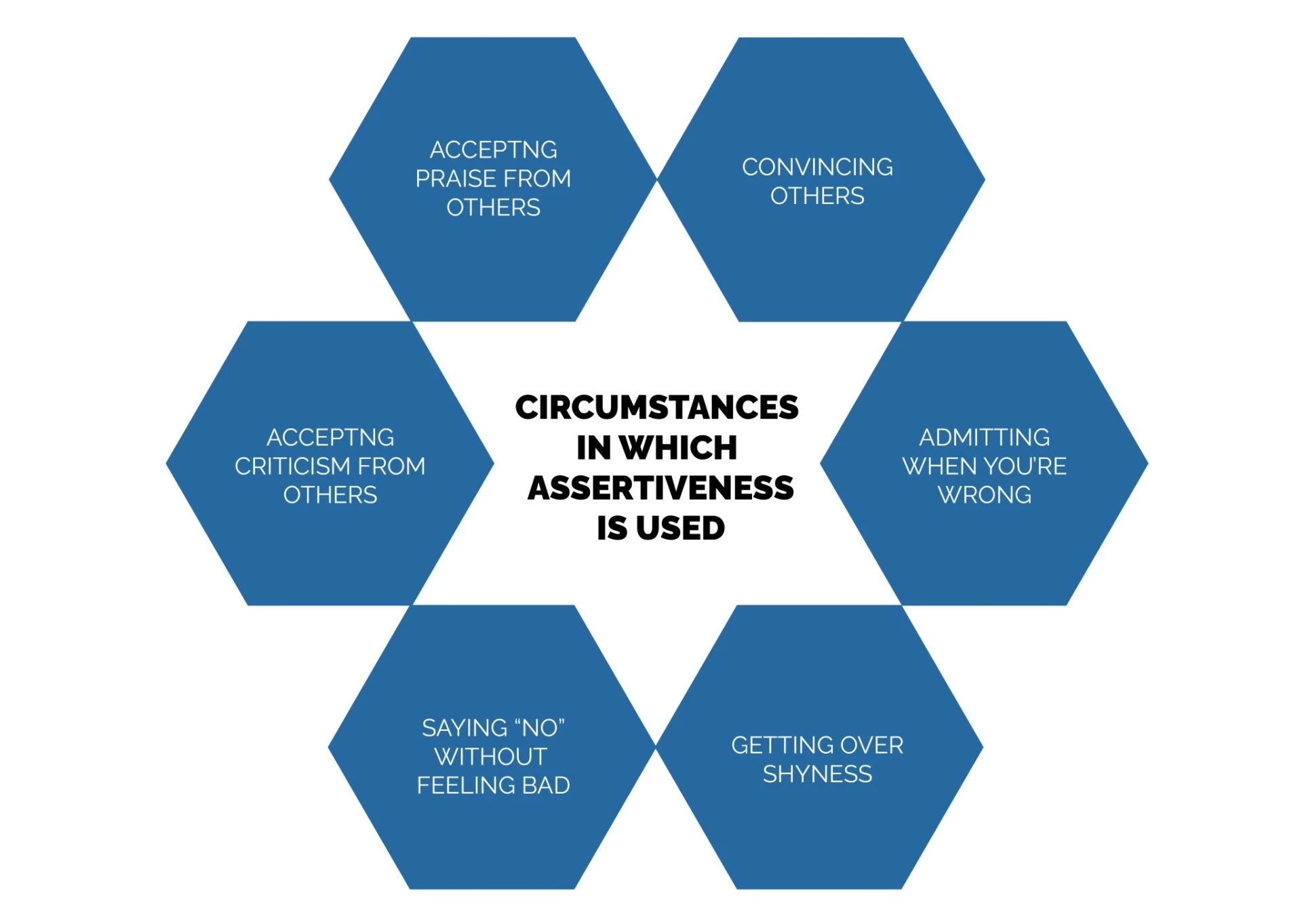
- Accepting Criticism from Others
When criticism is delivered insensitively, such as "I've only got one criticism to offer," or crudely, such as "That was crap!" or when it originates from someone whose adoration we yearn for, it can be hurtful. It is tempting to either respond negatively to someone who has brutally criticized us or look for someone else to blame. If we don't do one of them, we can end up feeling guilty and condemning ourselves.
- Recognize that this is just another person's opinion to respond to criticism assertively. People can't be made to like you.
- get a bigger picture. Consider how things will appear after a month.
- visit "the gallery." Off-stage, you can think objectively about what was spoken in this setting.
- Try to overcome your pride and take criticism as an opportunity to grow. Utilizing the methods of negative inquiry and assertion can help you achieve this.
- Saying "No" without Feeling Bad
We've all been in circumstances where we wanted to say "No," but we ended up saying "Yes," such as when the employer used a willing employee, the mother-in-law invited herself to stay, or a friend insisted on buying you more drinks.
Going along with their request may make you feel like you are being nice, but chances are they won't see it that way and will just try to impose on you again. You've made yourself vulnerable for them to take advantage of.
Learn how to say ‘no’ when you don’t want to go along with something. There’s no need to feel guilty over it.
- Getting over Shyness
When we assertively convey pleasant emotions, we need to combine sincerity and simplicity. "I thought you handled that circumstance well. You appear good tonight. I love you.
We need to combine simplicity and confidence when we express our negative emotions in an authoritative manner. Observe these statements -
“I do not agree with you.”
“ I’m upset with the repairs done to my automobile.”
“ I'm angry that you didn't even call me.”
Because these statements do not begin with "I'm sorry but..." or "Hope you don't mind my stating, but...," they have more effect. If the voice is strong and emotionless, the impact is considerably greater.
- Admitting when you're wrong
Many passive people are reluctant to "own up" to their faults because they are afraid of the repercussions. The unassailable person may have irrational thoughts like, "I must be perfect at all times," "I'll reveal my mistakes, I'll lose my chance of promotion," "They won't like me anymore," or "I'll look bad in their eyes. “
To confidently own up to a mistake, remind yourself that you have a right to make mistakes. Keep this in mind-
- As immediately as plainly as you can, own up.
- If the error has caused anyone any issues, apologize; even if not, apologize out of courtesy.
- Just once apologize and move forward.
- To fix the issue, enlist the aid of others.
- The task of making things right is shared.
Assertiveness Training Courses
Many assertiveness training courses are held online and are accessible if you want to take it a step further. Some well-liked online choices are listed below.
1. Mastery: Achieving Happiness and Success – LinkedIn
Since its launch in 2015, this online course has been taken by more than 401,000 students. Life Mastery: Achieving Happiness and Success, taught by business expert and author Chris Croft, teaches you how to maintain composure and set boundaries in challenging circumstances.
2. Double Your Communication, Assertiveness, and Confidence - Skillshare
This course, Double Your Communication, Assertiveness, and Confidence developed by businessman and transformational coach Alain Wolf, shows you how to resolve disputes amicably, articulate yourself, and speak with assurance.
3. Master Class in Assertive Communication – Udemy
This course, Master Class in Assertive Communication, taught by leadership coach Kara Ronin, has approximately 9,000 students registered and has received 4.5 out of 5 stars on Udemy.
It teaches you how to be more assertive by teaching you how to express your needs clearly, stand out more in crowds, and conquer your worries.
4. Speaking with Confidence
Speaking with assurance is a good starting point for developing your assertiveness at work. The people around you will start to view you as a reputable and trustworthy figure in your field of expertise if you can communicate your ideas clearly.
However, perhaps you find it difficult to speak confidently in front of others. Look no further than EdApp's Speaking with Confidence, which will provide you with advice on how to have more effective and natural discussions with others and help you get rid of any verbal gimmicks that keep you from speaking with confidence.
This course will also teach you how to initiate and steer a skillful conversation with coworkers, superiors, or anybody else you interact with frequently.
This free e-learning tool is fantastic since it includes several interactive components, like gamification, audio narration, and quick video clips, to make learning more enjoyable and engaging.
By using your laptop or even a mobile device, you may enroll in and complete your course whenever and wherever you want, at your own pace.
5. Voicing Yourself Heard
Getting your Voice Heard is a course that delivers on its namesake. Perhaps, you’ll agree that getting your voice heard isn't always as simple as it appears, even if we all have the freedom to express ourselves and freely talk about issues that concern and interest us.
Therefore EdApp, in collaboration with The Spark, has created a brief training course titled "Getting your Voice Heard" in which you and your team will learn basic methods for altering your voice and putting yourself and your ideas forward.
Additionally, it will discuss different types of responses and how to maintain a pleasant interaction with others by striking a balance between assertiveness and empathy.
Four modules make up this assertiveness training program, which is presented in a microlearning manner for more learning effect. Anyone who wants to improve their assertiveness and become someone who is heard, respected, and valued at work can use it for free.
6. The Secrets of Confidence and Communication
You'll learn a novel approach to resolving communication issues in this Skill path course, ensuring that your assertiveness won't lead to awkward social situations.
To prevent misunderstandings and make sure that your communications and negotiations are as clear and honest as possible, you'll also develop a greater grasp of the three ‘Vs’ of communication - visual, vocal, and verbal.
Even though this course, The Secrets of Confidence and Communication merely covers the fundamentals of assertiveness, this training isn't quite free. Unfortunately, access to its 90-minute class will cost you $45.00 USD for a one time purchase.
7. Assertiveness and Self-Confidence
A course on assertiveness, Assertiveness and Self-Confidence developed by Mandatory Training Group is intended to assist anyone who wishes to increase their level of self-confidence and express themselves in a confident yet suitable manner.
Assertiveness and self-confidence are both defined at the outset of this course in terms of their general and individual meanings. It also lists several typical communication barriers that might prevent you from acting assertively, followed by advice on how to get past them.
The training concludes with a useful handbook on how to handle challenging behaviors that conflict with your assertiveness. After finishing, students must take and pass an online course exam to gauge their progress.
Those who receive a passing grade of at least 80% will receive a free certificate for continuing professional development (CPD).
8. Effective Communication
The EdApp course on Effective Communication acknowledges the value of developing communication abilities while speaking to an audience, whether in person or digitally.
The subjects covered in this public speaking training course include improving communication skills, speaking in front of an audience effectively, and communicating virtually while keeping a personal connection.
By taking this public speaking training course, you and your staff will become stronger communicators who inspire audience members to act, whether in a live or virtual situation. EdApp is a platform for individualized learning that offers social learning tools that let users express their thoughts on each lesson slide. You can utilize this to get feedback and hone your communication abilities.
9. Building Your Confidence and Working Ethically
This course on "Building Your Confidence and Working Ethically" is available for free on the learning platform Alison. The fundamentals of using body language to communicate are covered in this assertiveness training course.
Additionally, it offers a greater comprehension of self-assurance and assertiveness techniques. The course concludes with a discussion on workplace ethics, and your students will be able to assess their understanding of the material by taking a final exam.
For a student to successfully complete the course, they must receive at least 80%. Even though the course is free, official certifications can only be bought.
Conclusion
Congratulations !
You did a fantastic job finishing this guide, and you now possess all the knowledge you need about assertiveness coaching. I sincerely hope that this article will be helpful to you in developing assertive behavior that will work for you.
You must adhere to all the guidelines outlined in the chapters if you want to act assertively.
Now let me ask you:
Which part of this manual did you find to be the most informative?
Have you made a distinction between assertiveness and aggression?
Has the guide addressed every query you had?
In the comments section below, please let me know if you have any other questions.
Frequently Asked Questions
What is Assertiveness Coaching?
What are the key components of assertiveness?
How do I figure out Assertiveness Coaching?
What are the four rules of assertiveness?
1.Start off in a simple manner by expressing your needs clearly.
2.Boost your self-assurance.
3.Make necessary changes to your strategy and communicate effectively.
4.Establish your boundaries.
