

Active Listening: The Definitive Guide
Active Listening
The Definitive Guide
This is a one-stop guide for you to know all about Active Listening — an indispensable skill to hone your coaching practice — and use it to your advantage.

So if you would like to:
- Become skilled at Active Listening
- Find out about the many benefits of Active Listening
- Know your clients better and understand the real meaning behind their words
- Enroll in the best courses on Active Listening
This guide will come in handy.
Let’s get started.
Contents






Chapter 1:
The Basics
I will be covering the fundamentals of Active Listening first, which will help you understand the concept more deeply.
I’ll also help you answer certain questions which you might have on what exactly comprises effective listening.
In addition to learning its definition, you will also find out what sets this social skill apart from the act of just ‘listening’.
Let’s dive right in.

What Is Active Listening?
A lot of times, people just hear what is being said and don’t necessarily listen.
However, in order to have successful conversations, it is important that you listen to the person you are having a conversation with.
Active Listening means paying full attention to what your conversation partner is saying.
When coaching, Active Listening will also make your clients feel valued and they might open up to you more.
You will become more aware of the influence and power of listening attentively as we move ahead.
Last updated: March 2026
What sets Active Listening apart?
As simple as it sounds, listening is a very important skill.
This is especially true if you are a coach. Obtaining, understanding, and retaining information is part of listening, which is what makes it stand out as an effective way of communication.
We often think we are listening, but we often end up not inferring the message of the speaker. When that happens, there is room for misunderstanding and conflict.
Effective listening can therefore increase your productivity as a coach because it allows you to grasp the information you need to work towards your clients’ growth.
So in this sense, there is a whole process to listening, which I am going to introduce you to in the coming chapters.
Chapter 2:
Active Listening — Then and Now
Coaches often tell me that their clients are always looking for transformational change.
As a coach, your job is to help them make it happen. And Active Listening is a big part of that process.

Before moving towards how to make sure you’re actively listening, let’s take a look at when the practice was first introduced and the initial overarching idea behind it.
The Origin of Active Listening.
The term was first coined in 1957 by American psychologists Carl Rogers and Richard Farson in a paper of the same title (reprinted in 1987 in the volume “Communicating in Business Today”).
The two wrote about the importance of Active Listening in facilitating change in people.
Interestingly, Rogers was a big believer of the ‘human-centered’ approach and he is often credited for bringing it to the field of psychology.
Rogers and Farson also said that people who listened to ‘actively’ tend to be more emotionally mature, as they are able to be less defensive about what they believe in.
Interestingly, you will find in Chapter 5 that surveys conducted as recently as 2011 and 2014 also speak to this aspect of Active Listening.
However, Active Listening has come a long way since being first conceptualized in the 1950s.
With some changes in its definition and approach, it can help you understand your clients even better.
Let me tell you how.
Contemporary Elements of Active Listening
Now that you know what Active Listening is, it is important to understand how you can adapt it to present-day scenarios.
Scientifically, effective listening has come a long way.
It is now used in Artificial Intelligence products as well as healthcare; so it has been steadily gaining ground in multiple fields.
If you look at it from a coaching perspective, it is well known that communication has changed rapidly over the years. As a coach, you have probably experienced that.
However — listening has changed too.
Listening Is Not Agreeing
While Active Listening might encourage you to listen to your clients with your full attention, it doesn’t recommend that you always agree with what they are saying.
Empathy might form the backbone of coaching — and I talk about this in detail in Coaching Skills — but so does honesty.
Simply put, it is possible to validate somebody’s experience without agreeing with them. You’ll learn more about this in Chapter 3.
Being Distracted Is Okay
Coaches are humans too, I get that. As much as you want to help your clients, it is possible that you might get distracted during some of your conversations.
What do you do in such a situation, you ask?
Be honest.
Clients expect honesty and, as a coach, you should let them know if for some reason you are unable to give them your full attention during an interaction.
The thing to remember here is:
Active Listening is a genuine exchange of words and ideas.
If you think you are distracted by something, be honest and continue the conversation another time, when both the speaker and listener are fully present.
Chapter 3:
Why You Should Practice Active Listening With Clients
To offer good advice to your clients, you must be able to understand their issues. That will happen only when your clients open up to you and engage in deeper conversations.
Active Listening is an important step in that direction.

However, before we talk about how to do that, you need to familiarize yourself with the purpose of Active Listening — and why it’s important to practice it.
Purpose Of Active Listening
Putting out your podcast will help you gain more exposure and can become an avenue for people to find you and the work you’re doing.
It becomes another source to generate more traffic to your website and business.
Though it might take you some time to build an audience base, but hey — one more medium to find an audience is more than welcome, wouldn’t you say?
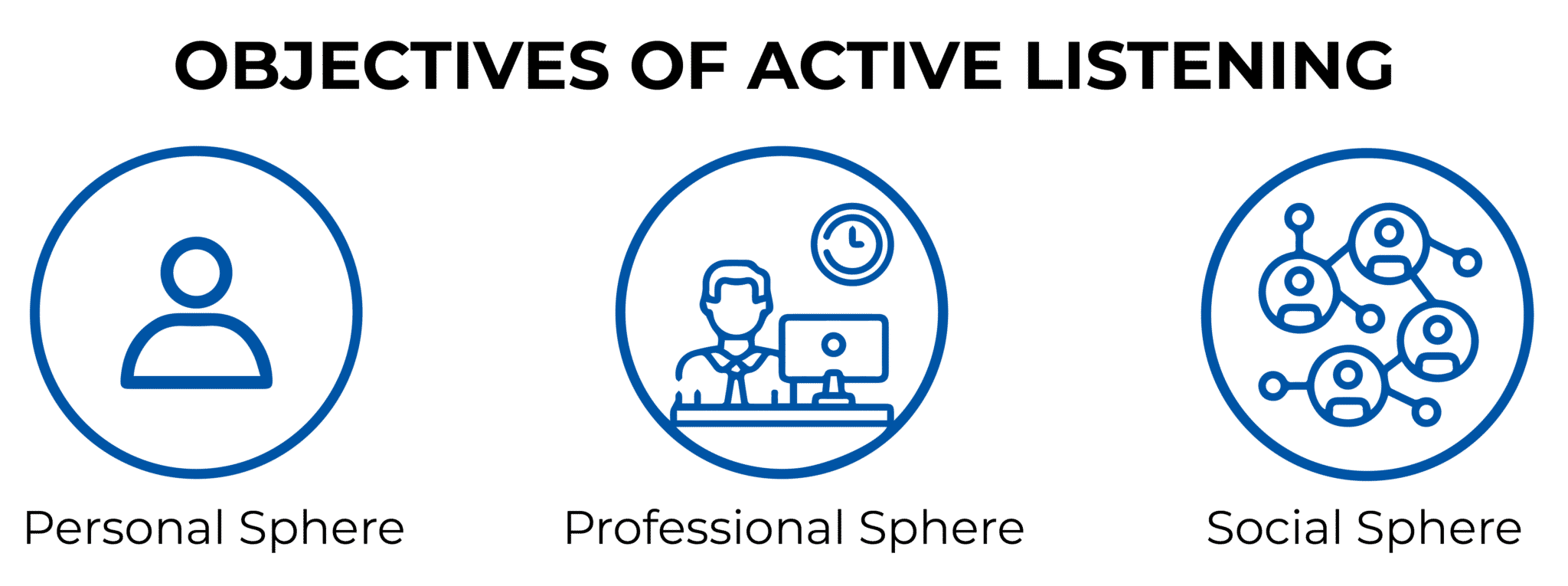
1. Personal
Depending on the type of advice your client is looking for, Active Listening can help you earn their trust.
If a client seems to be struggling in the personal sphere, the aim of Active Listening would be to help craft an empathetic response.
While it’s important that coaches learn Active Listening, it is also equally important for them to pass on the skill to their clients.
This is so that they know when to play the role of a speaker and when to listen.
2. Professional
When it comes to professional issues, Active Listening will help you and your clients to work as a team and come up with solutions.
We already know that patience is one of the foundations of coaching.
Once you begin to practice Active Listening with clients, you will see how composed you are during your conversations.
3. Social
I have already covered what sets Active Listening apart. When it comes to the purpose of Active Listening in social spheres, meaningful communication emerges right on top.
When you are able to make your conversation partner feel heard, they engage with you for a longer period of time.
You can practice Active Listening not just with clients, but with other important people who can prove to be valuable to you in the long run.
After all this information about the key elements and purpose of Active Listening, you must be wondering what the benefits are.
I’m going to discuss that in the very next segment so keep reading!
Benefits of Active Listening
Before we jump into this section, I would like you to take a moment and ask yourself what your primary goal with each client is.
If you ask me — it is to make my clients happy. If my goal aligns with yours, Active Listening is the skill you need.
I understand that before committing to a practice, one would want to know its advantages — and whether it will work.
I’ll come to the latter in the next chapter, but for now, let’s talk about the benefits.
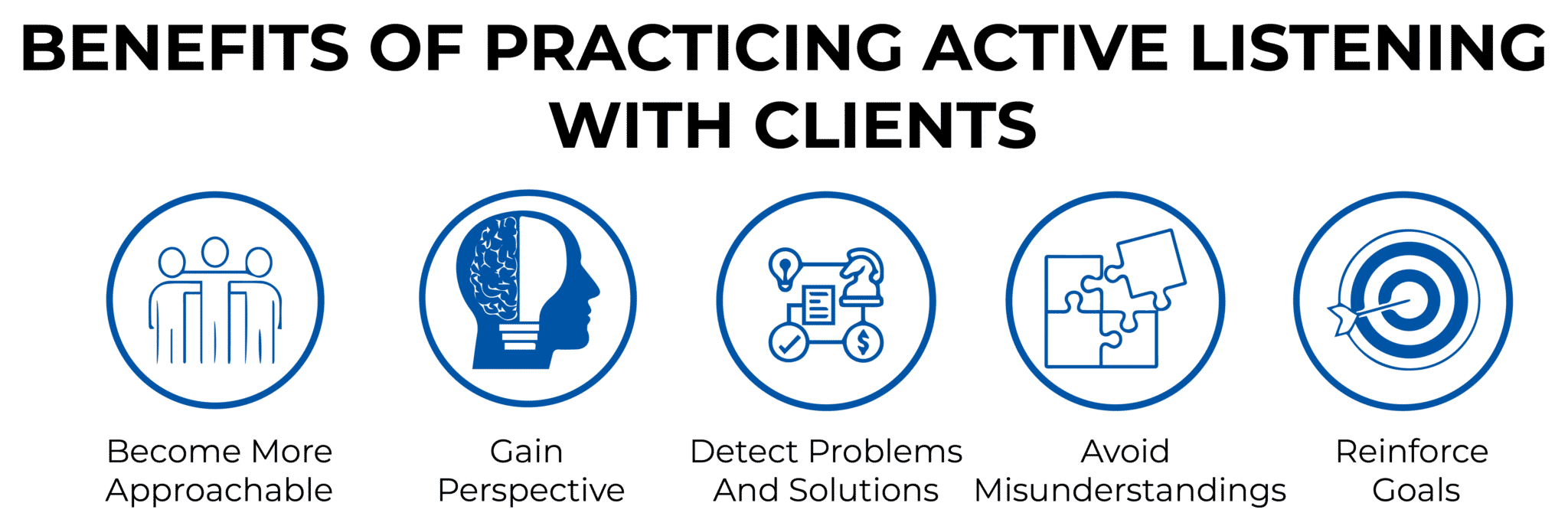
1. Become More Approachable
In the previous chapter, I mentioned that one of the many purposes of Active Listening is to help you earn your client’s trust.
When that happens, your clients begin to open up to you more because they can sense an authentic relationship between the two of you.
In other words, you become more approachable.
2. Gain Perspective
In the previous chapter, I mentioned that one of the many purposes of Active Listening is to help you earn your client’s trust.
When that happens, your clients begin to open up to you more because they can sense an authentic relationship between the two of you.
In other words, you become more approachable.
3. Detect Problems And Solutions Quicker
At the end of the day, clients want solutions. Your job is to help clients change for the better.
Interestingly, effective listening can help the speaker find loopholes in their own logic, because they are able to think and share information comfortably.
It’s something we experience all the time: we speak and share better when we’re not interrupted. This attitude helps in the creation of the ideal environment for problem-solving.
4. Avoid Misunderstandings
When you listen with all your senses, you are confident in your ability to understand the speaker.
When your client opens up to you, the next ideal step is to paraphrase or summarize what they have said, as mentioned earlier.
When you do this, you gain clarity and there is no room for misunderstandings, which — as you already know — can stand in the way of good coaching.
5. Reinforce Goals
When you respond to your client appropriately after having listened to them effectively, you remind them of their goal.
Think of it this way: when you ask your clients the right questions, you nudge them closer towards the goals they have set for themselves.
You begin to speak their language, which is intrinsic to coaching.
Chapter 4:
Active Listening — A Step By Step Breakdown
Active Listening is a set of skills that enable you to keep an open mind during conversations with clients.
While you might already be practicing some of these already, it’s important to be aware of the complete skillset.
That’s why I’m going to be taking you through a step-by-step breakdown to Active Listening.

6 Steps To Effective Listening
I am now going to share with you the six golden steps to Active Listening, and the best part about them is that they are very actionable.
Some are simple steps that you could immediately incorporate into your coaching, while others can take some time and practice.
Regardless, consistency is key.
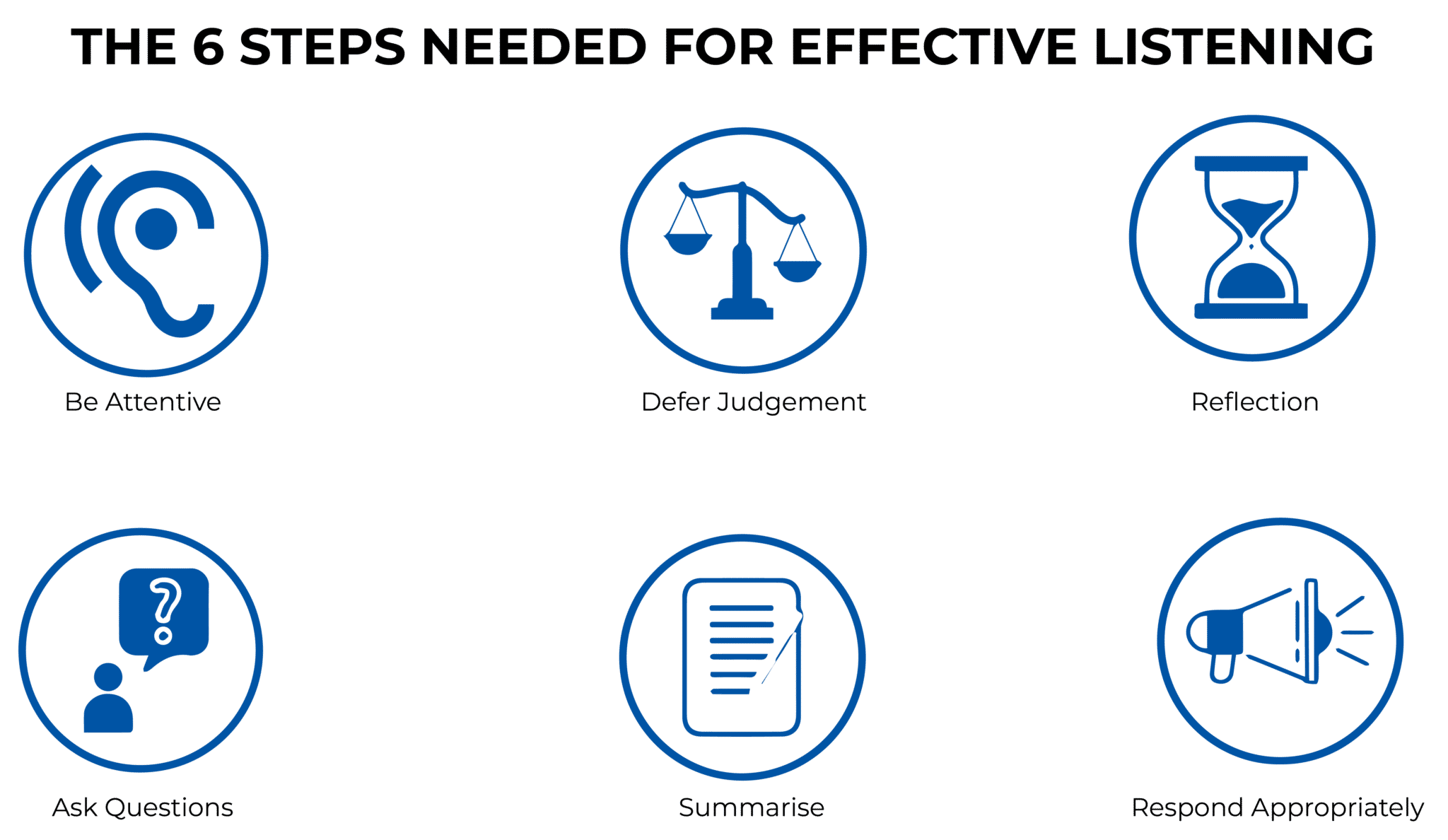
Step 1: Be Attentive
One way to get to the core of your clients’ problems is to make them feel heard.
Now, giving someone your undivided attention might seem easy on paper, but in practice, there is a process to it.
I’m going to break it down for you:
- Look at the client directly when they are speaking.
- Do not cut them off.
- Do not think of a response while they are in the middle of a sentence.
- Give them your full attention and avoid distractions that might be caused by the environment you are in.
- Be aware of the speaker’s body language. You might find something you did not know.
Step 2: Refrain From Making Judgements
Your clients come to you because they trust you to give them the best advice to grow.
Therefore, your job — as a coach — is to let them take the floor and listen with no judgement.
Active Listening means lending a ear with an open mind and deferring judgement.
When you interject and break your clients’ chain of thought, it can leave them in a frustrating and uncomfortable place. So you must remember to withhold opinions.
Step 3: Reflect Information
When you’re listening to your client, they do not necessarily know that they have your full attention.
However, when practicing Active Listening, you let them know by reflecting what is being said.
Let me share with you how you can achieve this.
Paraphrase the main points of your client’s words. Phrases such as “To me, it looks like you are…” and “So what you are essentially saying is…” will come in handy during a conversation with them.
Step 4: Ask Questions
Opening up isn’t easy; this applies to your clients, too.
Sometimes they might be a bit ambiguous about what they are saying. This is where you come in and ask them to dig deeper.
Asking questions is an important part of Active Listening, as it can help your client engage with their inner self and look at an issue from multiple perspectives.
Therefore, asking them simple questions can take the pressure off them.
Sometimes it’s better to look at how you want to solve a problem, instead of thinking of the events that led to that problem.
It can be difficult to do so, but good coaching is all about asking the right questions.
To sum it up, your questions can help set the tone for how your client addresses a certain situation.
Step 5: Summarize
Treat this as a recap of the conversation you just had with your client.
Recapping the key elements of your client’s predicament will help keep misunderstandings at bay.
Simply put — make sure you leave no room for confusion.
Ask your client if your understanding of their issue (or whatever it is that they shared with you) is correct.
Doing this helps both parties to share the responsibility and have more constructive conversations in the future.
Your role as listener is to not only hear what is being said but also to understand the context, subtext, and purpose of the conversation. This requires reflection on your part too.
Summarizing will help you set that in motion.
Step 6: Respond Appropriately
Once you think you have followed the main principles of Active Listening and have a sound understanding of the conversation, it’s time to respond.
Think of this step as a joint exercise between you and your clients; bring them into the conversation and ask them to think about problem-solving.
This point in the dialogue is important because it’s now your turn to share your perspective with your conversation partner.
While it is your job to offer solutions, be sure to not impose them on your client.
Let them make that decision for themselves.
Now that you are aware of the foundational steps of Active Listening, let’s move on to the advanced level in the next section.
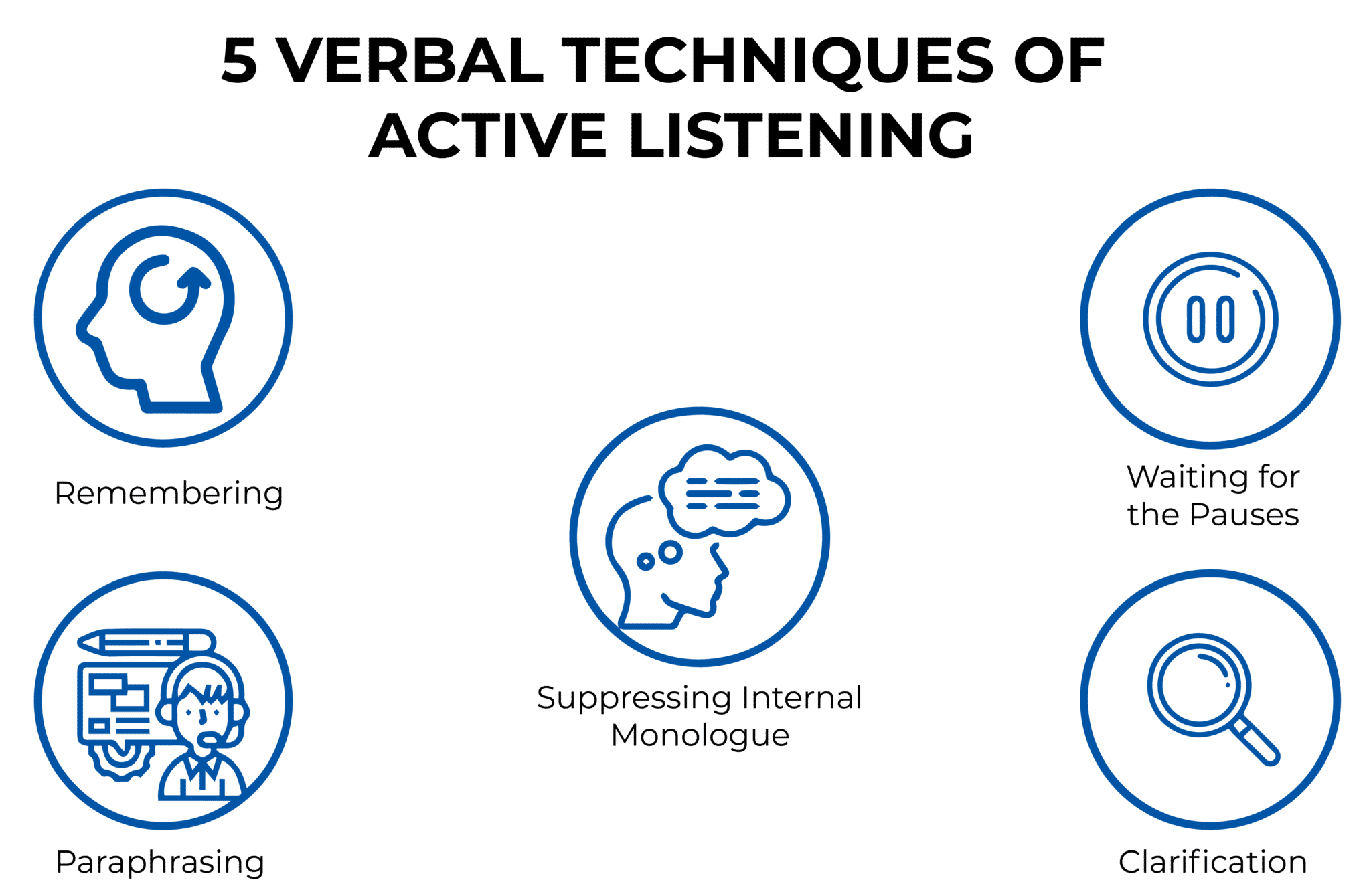
5 Verbal Techniques Of Active Listening
There are both verbal and non-verbal techniques in Active Listening.
I’m going to list out the verbal signs of listening first.
It is important to remember that these can be interpreted differently in different cultures. But the advantage, here, is that they are modifiable.
1. Remembering
It is difficult to retain everything from a conversation with a client.
However, the principles of attentive listening preach remembering the most important aspects of a given conversation with a client.
When you remember and repeat information, the client indirectly gets the message that listening has been successful.
2. Paraphrasing
Paraphrasing what your client has shared with you will ensure that they feel emotionally supported.
When that happens, you will naturally be on the same page as them.
3. Suppressing Internal Dialogue
Paraphrasing what your client has shared with you will ensure that they feel emotionally supported.
When that happens, you will naturally be on the same page as them.
4. Wait For The Pauses
I have already stressed on the importance of asking questions while practicing attentive listening.
However, it is important to wait for your cue to pose a question to a client. Let them finish their point and come to a natural pause in the conversation before you ask them for an explanation.
5. Clarification
Open-ended questions are always a good way to seek clarifications, rather than ones which can make the speaker feel pressured to respond in a certain way.
As a coach, you should be able to navigate difficult topics with ease.
It’s tricky to do that but that’s what attentive listening teaches you.
5 Non-Verbal Techniques of Active Listening
Non-verbal techniques are a great place to start if you are not sure about your Active Listening skills.
There are some techniques which you can follow during your sessions without worrying too much about the consequences.
It’s worth keeping in mind that the applicability of some of these techniques varies across cultures.
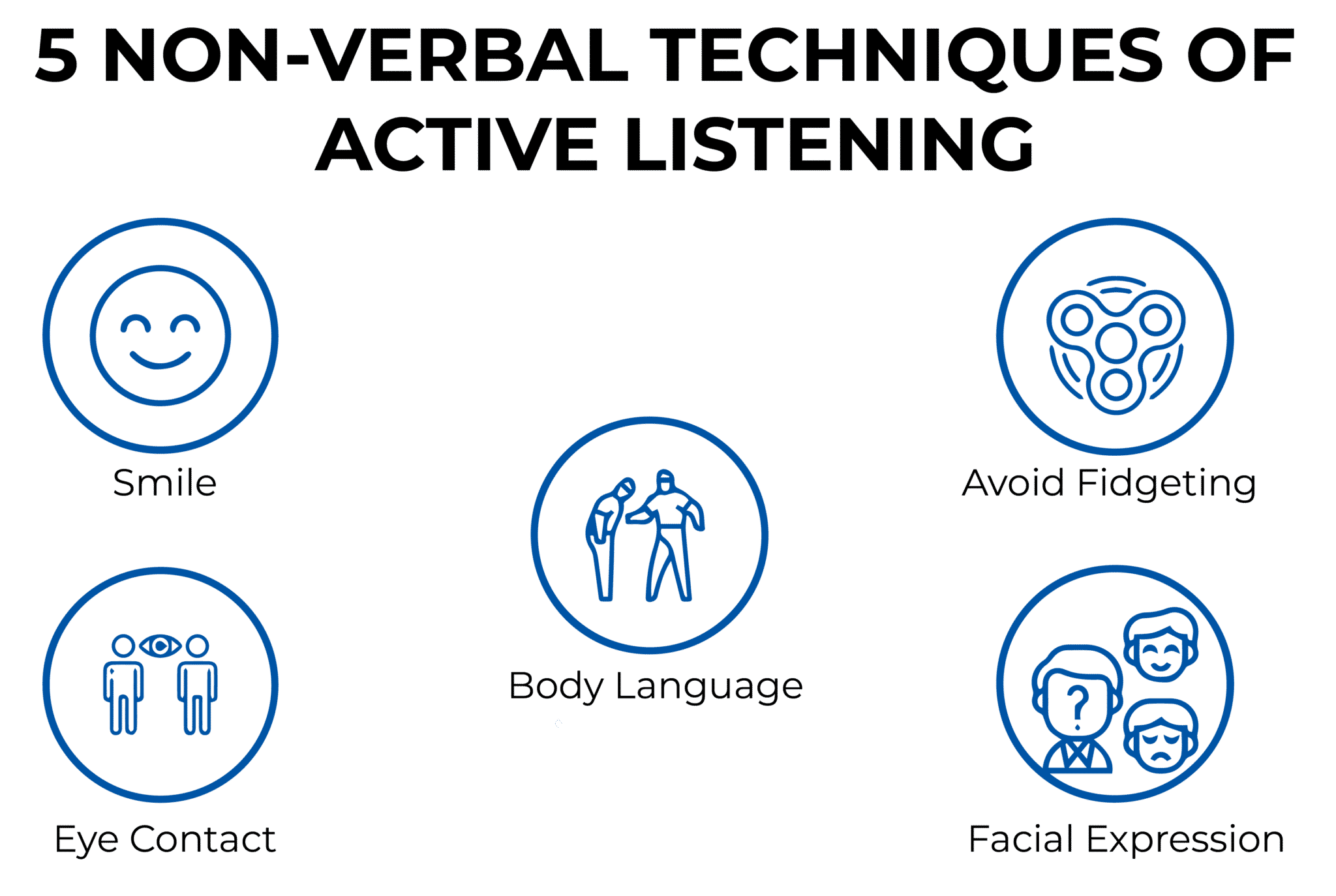
1. Smile
As simple as that sounds, smiling can really ease your client into a more comfortable position.
When you smile, you give your client the impression that you understand every word of what they are saying.
Smiling is almost a way of expressing solidarity with them.
2. Eye Contact
Looking at the person directly lets them know that you have their full attention, plain and simple.
However, you must be mindful of how much eye contact you can maintain with a person as it can be discomfiting, or even intimidating, sometimes.
So remember to test the waters before you jump in.
3. Body Language
Posture can be a strong indicator of how a conversation is going.
Make sure you aren’t slouching yourself.
Usually, you can tell a person is listening attentively when they are leaning slightly forward, or when they rest their head on one hand.
4. Avoid Fidgeting
Yes, coaches fidget too. Fidgeting too much can sometimes give your client the idea that you are not interested in what they are saying.
So keep your hands off that pen or paperweight.
5. Facial Expressions
Mirroring the facial expressions used by your client can make you seem more empathetic.
However, be cautious in doing so because you do not want to mimic their expression. You only want to let them know that you can feel what they are feeling.
A combination of these verbal and non-verbal techniques will do wonders for your sessions with clients. So go ahead and start using them to become a better communicator!
7 Tips To Improve Your Active Listening Skills
But now that you have over 10 techniques to incorporate into your coaching, I’m going to make things a bit more exciting by throwing in some tips that can make following these techniques easier.
If you take dedicated steps towards Active Listening, you will be able to build rapport with clients.
These skills will help you achieve that more effectively
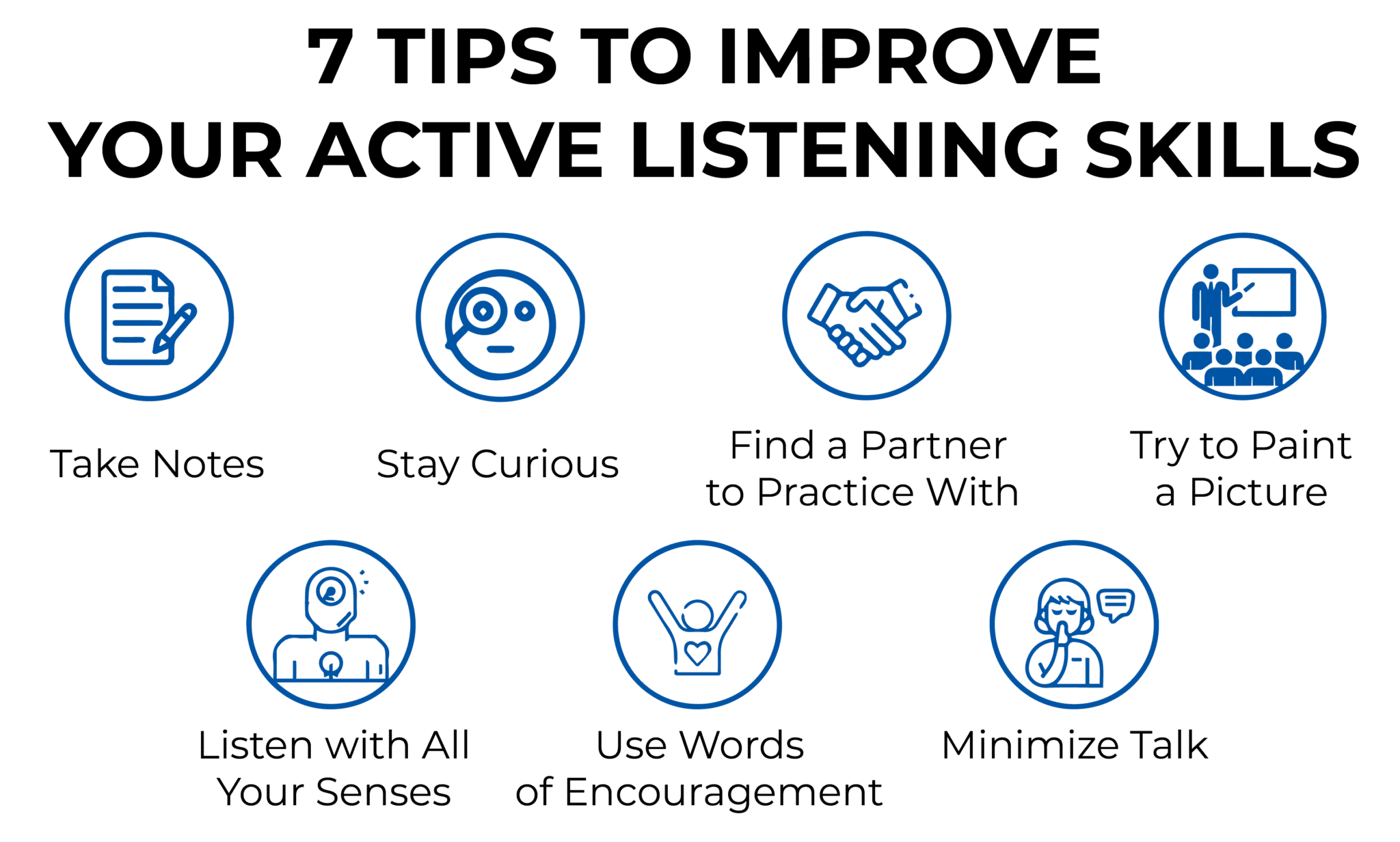
1. Take Notes
Bring out your notepad. Taking notes will show your clients that you are, indeed, listening to them with rapt attention.
It will also ensure that you do not miss anything and are spot on with your feedback.
2. Listen With All Your Senses
When I say this, I mean open up your heart and mind for your client.
Coaching is a give and take process.
You listen with all your senses, and that stimulates something in your clients that helps them share deeper information.
3. Stay Curious
We listen better when we are curious. So it’s a good idea for coaches to try and develop a genuine interest in what the client wants to address.
When you do that, you will notice that your judgements are automatically deferred and your rapport with the client improves.
4. Use Words Of Encouragement
It’s okay to remind your clients that you are listening, even if they struggle to hold a conversation.
Encourage them to continue talking. Use phrases like, “And then what happened?” or “how did you react to that?” to keep the chat going.
5. Find A Partner To Practice With
If you have other coaches you can practice with, start now. Have your friends call you out when you do not follow the principles of Active Listening.
Model the skills discussed so far till they become part of your natural reflex.
6. Minimize Talk
Keep track of how much you are listening in comparison to speaking. I briefly wrote about the importance of pauses while listening to a client attentively.
Let me reiterate: silence is sometimes important as it works as a buffer to crucial information.
7. Try To Paint A Picture
Imagine what the speaker is saying. Paint a picture in your head using cues from the client’s sentences.
This exercise will help you keep your brain alert.
When in the middle of a long, intense discussion, keep pinning up the important words on the “painting”.
Now that we have got everything about the practice of Active Listening out of the way, it’s time to weigh the pros and cons.
The next chapter tackles both the good and bad, so keep reading.
Chapter 5:
How Effective Is Active Listening?
Active Listening is being used in multiple fields to better interpersonal relations via communication.
Ironically, the average person listens at 25% efficiency, according to one report.
So while the modern world makes it harder to listen, it is also making it more valuable.
However, I understand that before committing to a practice, one must be convinced that they are investing their time in the right place. So I’ve put together some studies which reinforce the effectiveness of Active Listening.

A 2011 study notes that if your social skills improve as you develop Active Listening skills.
The findings indicate a “strong correlation” between attentive listening and conversational ability as well as emotional sensitivity.
Another 2014 study got 115 participants to converse with active listeners and regular listeners.
It was found that the participants who were engaged in conversation with attentive listeners were more satisfied with the responses, compared to those who received simple acknowledgements or advice from their partners.
Active Listening has also been found to be linked directly with success.
A survey of managers and employees of a large hospital, for example, found that effective listening defined over 40% variance in leadership.
However, I am not going to say that Active Listening works wonders in all circumstances. Like any other technique, there are some barriers.
Barriers To Active Listening
Let me take you through what these barriers to Active Listening are, and how to avoid them.
1. Navigating Emotions
Sometimes conversations can become challenging as the subject becomes personal.
Clients can feel vulnerable in moments like these, so take a moment to just let the emotions hang in the air.
Be mindful of the language you use with clients during these exchanges; helping them through an emotional response or recollection is also part of Active Listening.
2. Absence Of Solution
While the core of Active Listening is problem-solving, it can take up to months to get to the bottom of an issue with a client.
Being patient in such situations, and embracing that it might take multiple sessions to get your client to speak about something, is important.
3. Difference Of Opinion
We often tend to forget that our clients can have differing opinions on issues that we consider important.
Their perceptions of gender, culture, age and politics can come up in conversation.
However, as a coach, you must learn to work through the “noise” and stay focused on the message your client is trying to convey.
4. Personal View
Since you deal with clients every day, you probably have some go-to solutions that seem to work in most situations.
However, with Active Listening, you have to regulate the need to compulsively find a solution, as it can keep you from paying attention to the speaker.
Remember that it is okay to not be in total control — you are human, too.
Observe your own body language when you are faced with a situation in which you feel your personal view is obstructing the process of listening.
Now that I have introduced you to the strengths of Active Listening, compare them with the cons.
At the end of the day, you need to consider the potential changes that listening with all your senses could bring in your coaching practice, and then make a decision.
Chapter 6:
Take Your Learning Further
If you want to move a step further and hone your listening skills, what I’m going to tell you now will be useful.
Here are some courses and books that will come in handy:

Courses
While it is not necessary to be a certified active listener, you know I always encourage my clients to consider taking the certification route.
But if you think my guidebook has all that you think you need to practice Active Listening, you should start as soon as possible.
Nonetheless, here are some courses to choose from:
- Active Listening Masterclass by Everett Bowes has been created for coaches to improve their practice, if they have a willingness to learn. (Bonus: This course is currently being offered at a 25% discount!)
- The instructor-led course offered by SkillPath, running across four sessions.
Text and Video
If you’d like to practice your listening skills through basic exercises before jumping into a course, take a look at this video, and its corresponding factsheets, by the BBC.
Books are a good way to familiarise yourself with Active Listening, too.
My recommendation is the original handbook written by Rogers and Farson, Active Listening.
Conclusion
Congratulations! You have reached the end of the guide with this section, which means you now have a bonafide Active Listening skill set to practice and add to.
It is now time for you to apply what you have learnt in the chapters above and notice the changes it brings to your coaching business.
Since I have already emphasized the importance of asking questions — let’s try that, shall we?
Ask yourself some fundamental questions that you might have the answers to, now.
How has this guide changed your perception of listening?
Which of my tips can you start incorporating in your coaching practice immediately?
Do you have any additional questions about Active Listening, or anything else I might be able to help you with?
Let me know your thoughts in the comments. If you’d like to access a free course, feel free to leave a comment about it, too.
