
Ontological Coaching: What It Is and How It Works (2026 Guide)
Last updated: March 2026
Ontological Coaching
The Definitive Guide
How many times have you found yourself not being able to explain exactly what you are feeling or experiencing?
Or not being able to take action towards fixing what has been troubling you?
What if you could change any aspect of your life just by transforming the way you observe, feel, and react to your everyday situations?
Ontological Coaching gives you an approach to dig deeper into your emotions, language, and behavior i.e. your ‘way of being’.
So if you want to:
- Learn about an ontological approach to coaching
- Guide your clients in using it to transform their lives
- Get started on becoming an ontological coach
- Learn about the benefits of ontological coaching to not just your clients but for yourself too
Then this guide is for you!
Without further ado, let’s get started!
Contents




Chapter 1:
The Fundamentals
Any life coach’s purpose is to help their clients find solutions to their problems and guide them to lead a happy and fulfilling life.
Amongst the different methods of achieving that, ontological coaching is certainly the one that focuses on your client’s philosophical reflection of who they are, what and how they interpret and communicate. In this chapter, you will learn the fundamentals of ontological coaching.

What is Ontological Coaching?
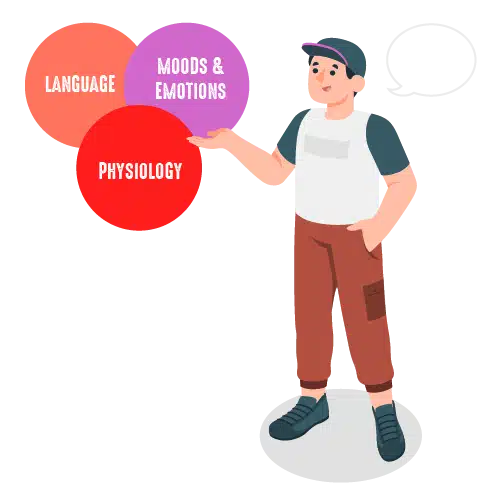
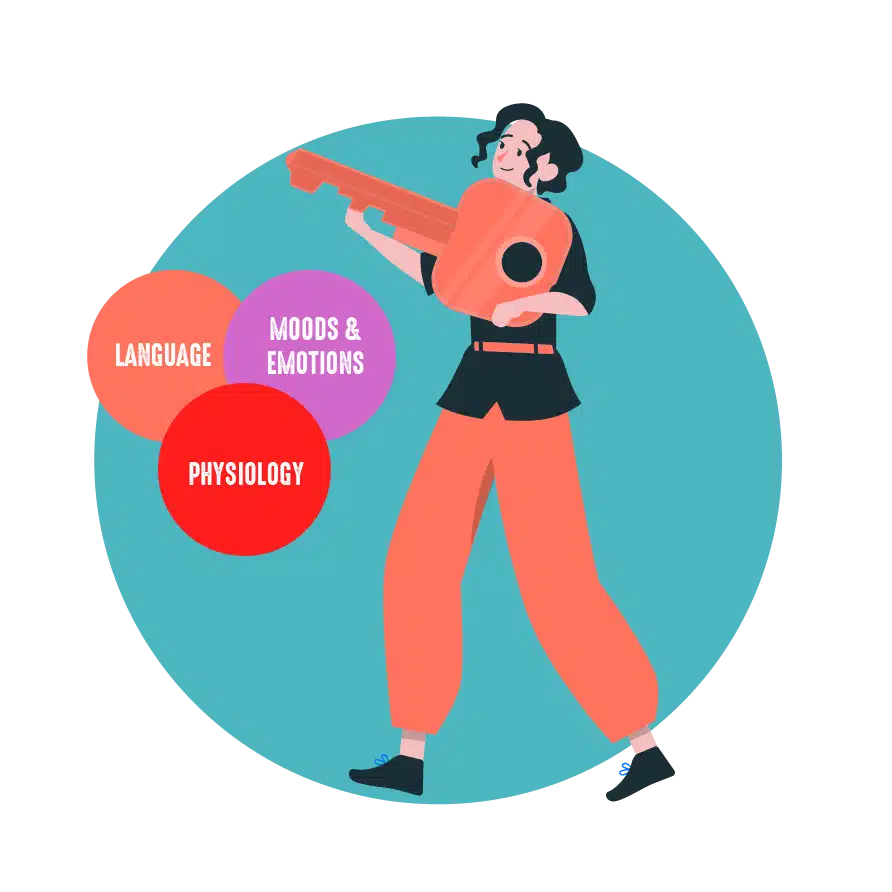
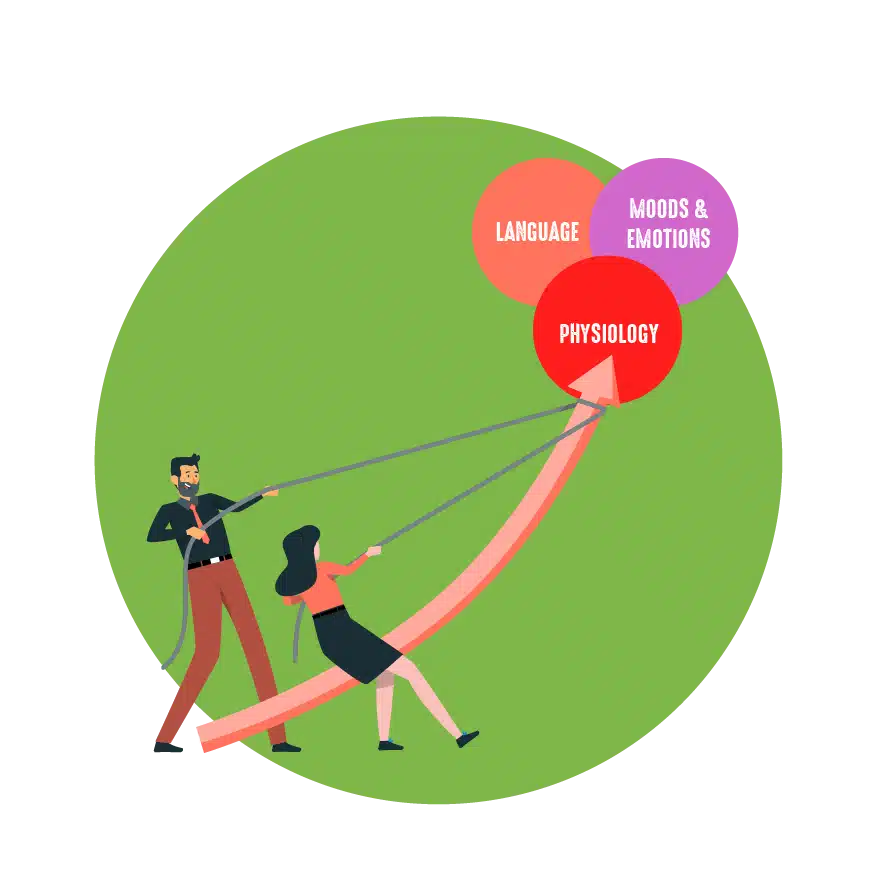
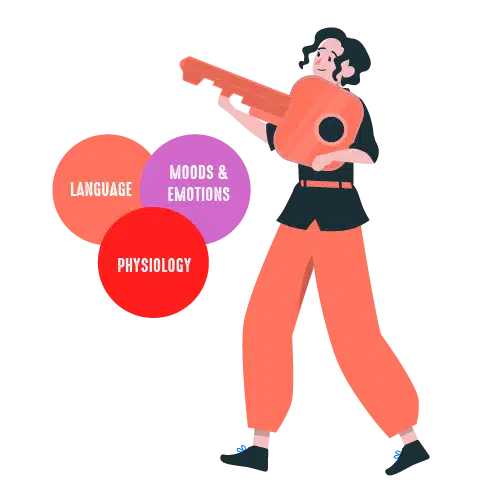
The ontological approach to coaching stems from the interplay of three core ways of being employed by humans and their interaction with the world around them — language, emotions, and the body.
Ontological coaching works with a methodology that helps build an engagement and ability to observe your attitudes, interactions, and perceptions more deeply and radically — making it one of the most holistic and transformational approaches to life coaching.
Ontological coaching guides people through perceptions they have created about themselves and how they communicate with their own being.
In other words, it is an approach to better the quality of life by observing behaviors of oneself when going through life’s goals, failures, losses and gains, and then acting from a sense of mental, emotional, and bodily awareness and intelligence.
History and Origin of Ontological Coaching
The origins and history of Ontological Coaching can be found when tracing the philosophical and physiological development of the word ‘ontology’ and the application of its concept into life coaching.
The term ‘ontology’ comes from Greek and basically means ‘the theory of existence or being’.
Martin Heidegger, Humberto Maturana, and John Searle, all had described language as a powerful tool for and of interpretations in their works. It was Fernando Flores who then founded the discipline of Ontological Coaching circa 1979.
The fields of philosophy, biology, and linguists shaped the thought behind, for example, how to observe oneself or how our thoughts impact people around us and our own actions.
But it was also the fields of psychology and business that proposed that we can be aware and shift our ‘way of being’.
Chapter 2:
Key Elements of Ontological Coaching
Now when you know what ontological coaching is and how its philosophical origins give this style of coaching an edge over many traditional goal or milestone based coaching practices, it is time to look at its key elements.
In this chapter, I will cover some of the key elements of ontological approach to coaching.
What is an Ontological approach to Coaching?
Alan Sieler describes Ontology as, “the study of being, and an inquiry into the nature of human existence.” He goes on exploring further the essence of an ontological approach to life – that is about becoming a deep listener and an observer of oneself.
An ontological approach to coaching aims to root out those many underlying ingrained behaviors, patterns, and web of narratives in your clients that may have been affecting their actions, communication and an inability to live a fulfilling life.
The transformational quality that ontological coaching’s approach has earned for itself, derives from the possibility of a sustainable and fruitful shift that you can help your client achieve.
Aboodi Shabi explains an ontological approach to coaching as the one where you, as a coach, support your clients in a way that they can reflect inwards, and become aware of their narratives and patterns.
What are ontological skills?
An ontological approach to coaching might not be that easy to learn or teach and that is why you need to develop certain ontological skills to support your clients the best way possible.
Let’s look at what some of those are.
Deep/Active Listening
As you know by now, language is one of the foundational aspects of an ontological approach; you need a deeper level of listening skills to understand the blind spots in your clients’ speech.
On the other hand, active listening skill is one that your client needs to learn too!
Being aware of how they listen to themselves and how others might be listening to them is key to better and effective communication.
Emotional Intelligence
As an ontological coach, you’d be expected to hold competence in emotional intelligence that patiently listens and observes your client and doesn’t jump to goal-setting for them.
Although it can be sometimes good if that is what your client wants and needs in most cases, you will let your client define their problems and solutions.
Create Distinctions
Lynne Williams explains in her article the importance of studying and creating distinctions, as an ontological coach, in your client’s speech.
Your client may be overlapping the meaning of two distinct words in their conversation, leading them to undesired actions.
You need to be able to develop the skills to identify such overlaps and keep exploring what is holding your client back from their full potential.
But to be able to see these skills in action, you first need to be able to hold an ontological conversation with your client and develop that relationship.
What is an ontological conversation?
The ontological approach works around a methodology of recognizing and distinguishing different kinds of conversations and its patterns.
Both listening and speaking are crucial elements of interactions or conversations. Ontological coaching provides different ways to deepen this experience of listening and speaking.
It focuses on showing your client the power of narratives in shaping their realities, future and bringing in affect the needful changes.
At the Talking About institute, for example, an ontological approach has been developed further to look through three types of conversations, that your client might need, in your their speech – descriptive conversation, speculative conversation, and action conversation.
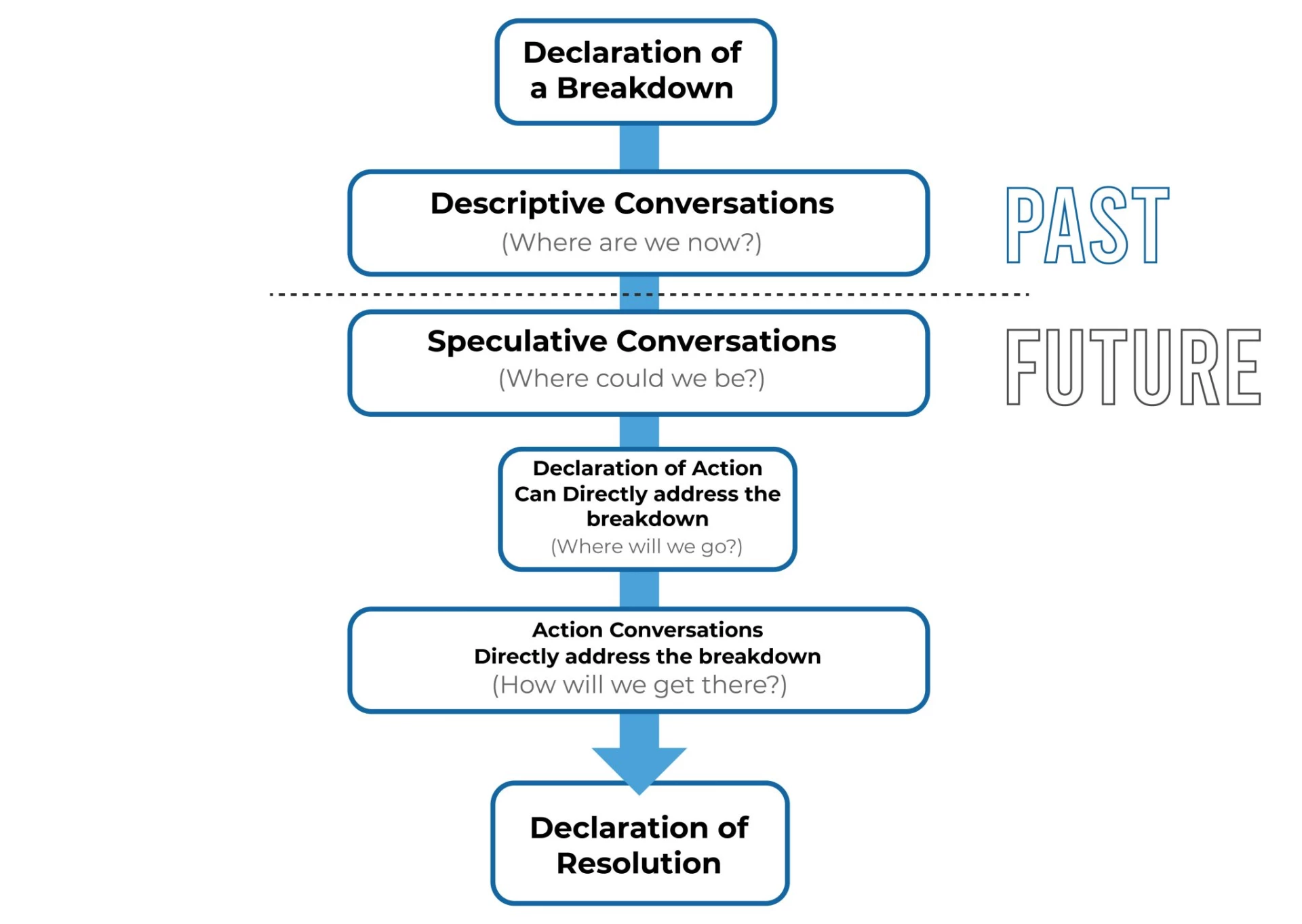
Understanding the pattern of conversation or narrative that your client is going through and establishing at what stage they are at, can really provide them with new knowledge over the behaviors and patterns.
Asking a question to your client such as – What is it about your way of being that is making you perceive the situation in this particular way, and what would you like to change about it? – can be an essential part of the ontological conversation you hold with your client!
While the coaching process is about unfolding new ways of perceiving and acting for your client, as an ontological coach your conversational approach must not be directive and assertive.
Your client should be able to create for themselves the language they want and need to reflect on their life.
Self-Coaching
For the nature of ontological approach to life and coaching is such, a coach also works on themselves in this form of coaching.
To uncover how their client interprets the world around them and what structures have shaped their habits and narratives, an ontological coach needs to open new interconnections.
A coach needs to do their own continuous individual reflections and become aware of their own emotions, judgments, and perceptions of life.
This is necessary in order to nurture the client’s willingness to participate in the process of transformations they visualize for themselves, and with as little influence from the coach as possible.
An ontological approach, therefore, is not just about working with the client but also with the self, before, during, and well after the sessions with your clients – a key element necessary for becoming that successful ontological coach you aspire to be!
Relationship with the client
Alan Sieler highlights in his book The Complete Handbook of Coaching, that one of the key elements of ontological coaching, and something that makes it unique too, is the relationship developed with the client!
An ontological coach’s own emotional intelligence and deep understanding of conversational nuances can guide the coachee to express their interpretations and make their own perceptions.
As a coach, you invite your client to self-assess how they speak, how they bodily express it, and what it is that they feel in their voice when doing so.
Developing a relationship with your client needs you to not just observe and interpret their behavior or attitudes but also share it with them respectfully and inquire what they would like to explore more.
Establishing a healthy relationship with the client also means listening to the body postures, tensions, and physical actions of the client. Identifying these patterns and communicating it with your client can lead to better-informed narratives and emotional expressions for them.
Next, in Chapter 3 ,I will walk you through the two models of Ontological Coaching.
Chapter 3:
Two Models of Ontological Coaching
Now that you understand what the ontological approach is and what makes it unique, it is time to look at how ontological coaching actually works.
In this chapter, I will describe the two most commonly used models of ontological coaching used by coaches to set a foundation to their approach. Let’s get right into it.

Observer, Actions, Result (OAR) Model
Business theorist Chris Argyis’ double-loop learning model (1977) is sometimes considered to be the foundation for the Observer, Action, Results model of Ontological Coaching.
Double-loop learning model is simply a strategy or method to help people become, firstly, aware of their current ways of thinking, secondly, challenge it, and thirdly, integrate those new perspectives or information into action.
Now, an OAR model also works on two orders of learning.
The premise of the model is that when your clients have tried different actions, and failed to get the results they are looking for, the OAR model nudges your client to observe, or look inwards on the way they observe their situations and what meaning they make out of it.
The main element of ontological coaching says that if you can change the way you observe, the deeper and profound results you will be able to create.
The OAR approach can help your client create a new vocabulary or a new learning for themselves.
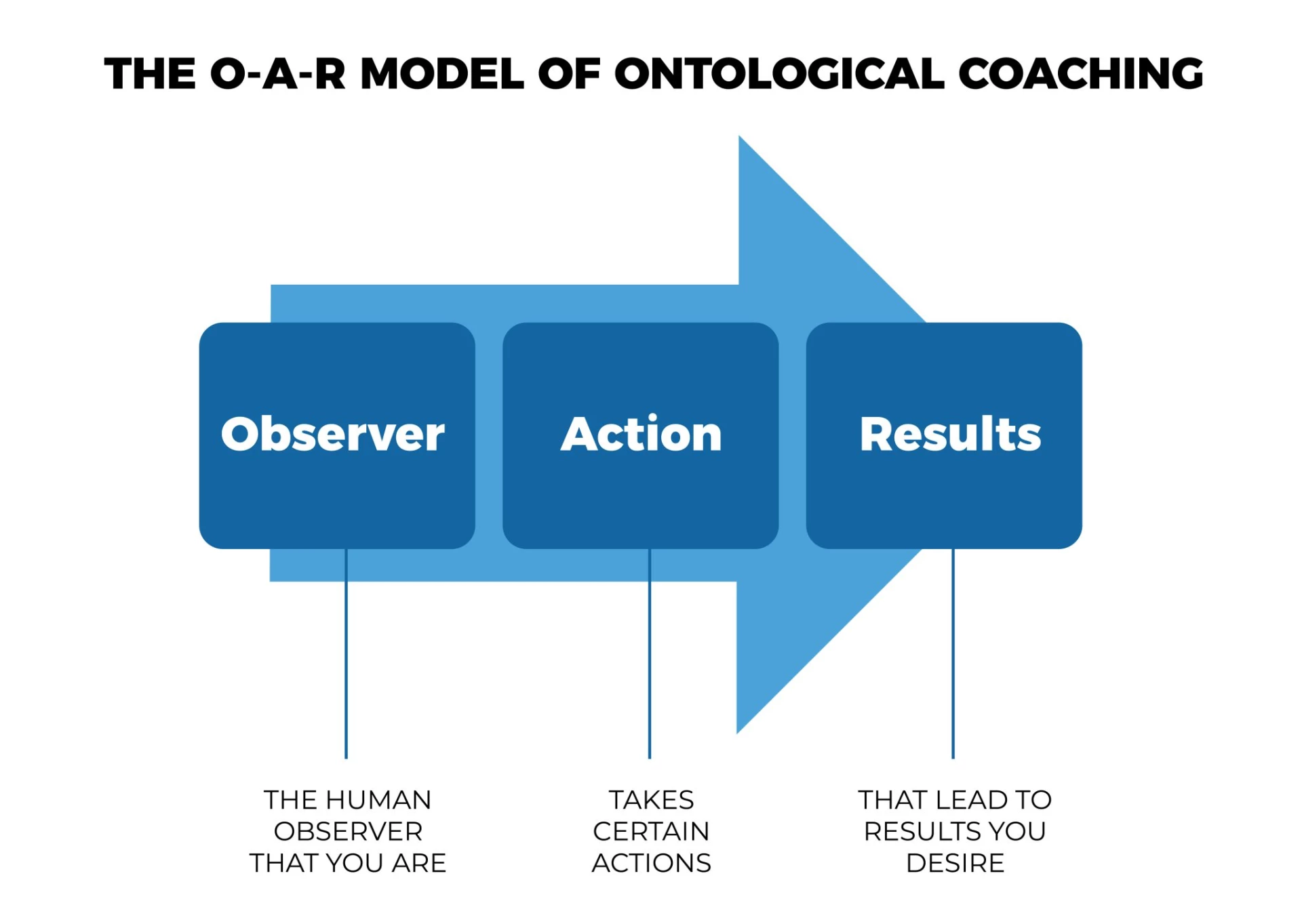
But in order to fully understand the OAR model of ontological coaching, you also need to see how the BEL model works.
Because what constitutes this inner observer and seems to be limiting your clients’ possibilities for action is situated in the nexus of Body, Emotions, and Language!
Body, Emotion, Language (BEL) Model
Body, Emotion, and Language are three elements of our ‘way or state of being’ that influence how we behave, act, communicate, and observe.
The BEL Model’s approach focuses on the idea that our bodies speak in a certain language, emotion and also a certain way we then express ourselves to others.
To understand it better, try and imagine that you or your client are handling some difficult (or just an everyday) life situation but you are in the mood of resentment.
What do you think your actions or interpretations are going to look like? A bit unfair or bitter even?
Now think that you are in the mood of gratitude or curiosity and handling the same situation – how will you see the world or yourself then?
Using the BEL Model approach into your coaching practice would mean opening up your client’s perspective to new or other stories from the one they have been repeatedly telling themselves over.
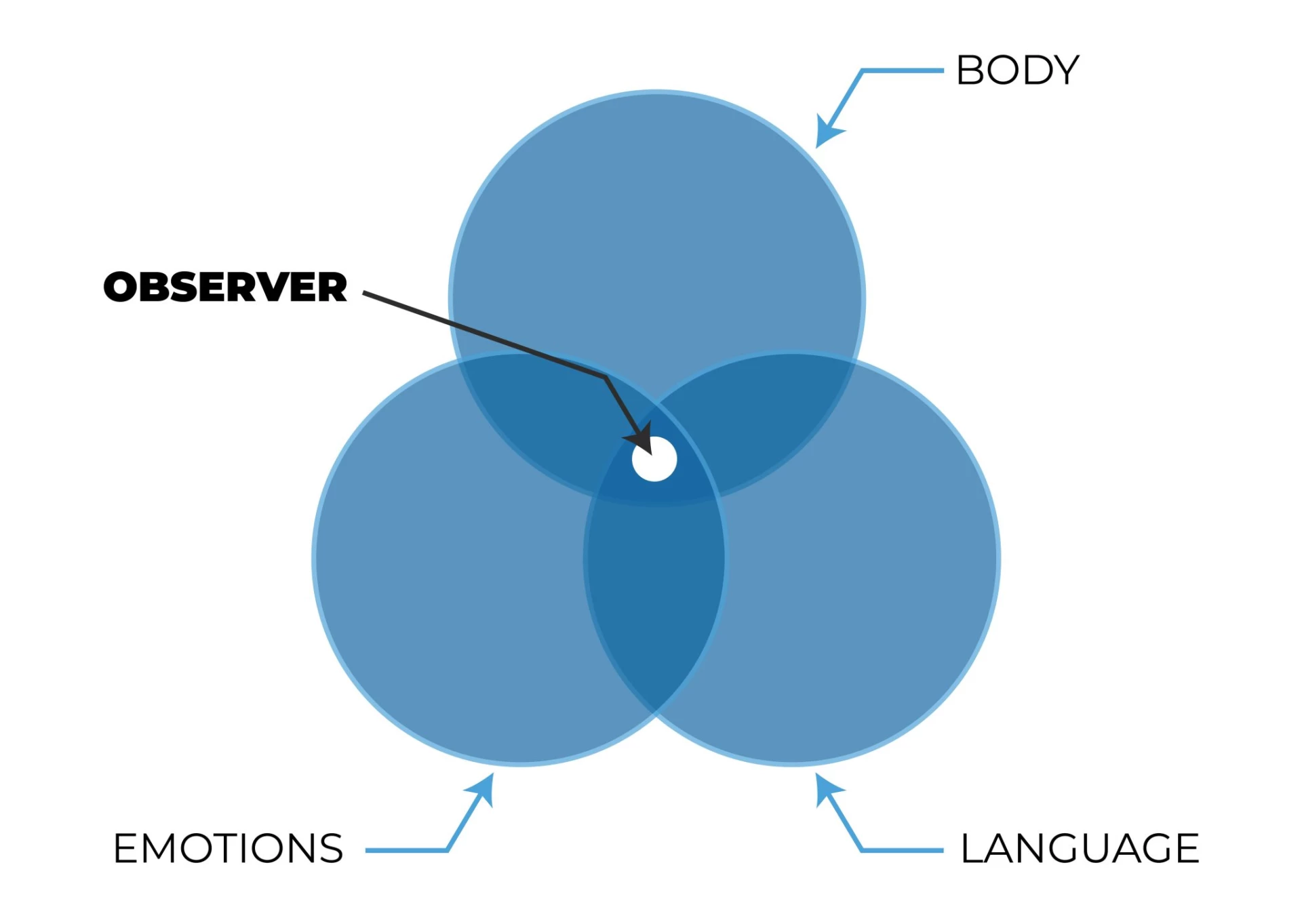
As an ontological coach, you can ask these following interrelated and leading questions to your client if you’d like to incorporate the BEL Model into your practice:
- What are you saying to yourself? (Language)
- What are you speaking to the world? (Language)
- Now, which kind of emotion do you feel when you are narrating these stories to yourself or to others around you? (Emotion)
- How do you think your body feels when you are experiencing this emotion? (Body)
Before we go any further, let’s now look at how you can become an ontological coach and what you can achieve with your skills!
Chapter 4:
How to be an Ontological coach?
If you have reached this part of my guide, I know that you are already looking into becoming an ontological coach and cannot wait to start aligning your practice to the transformational ontological approach!
Let’s get to it then!
In this chapter, I will take you through the process of becoming an ontological coach, its certification programs, and how you can sustain yourself.

What does an ontological coach do?
As an ontological coach, your job is to help your clients develop abilities to observe their behaviors and attitudes with new perspectives.
An ontological coach will meet with the client regularly and help them become aware of the interrelationship between their language, body, and emotions.
The relationship that an ontological coach develops with the client is one of trust and based on a reflective dialogue where your client is provided with opportunities to explore and design their own path.
In general, what is expected of an ontological coach is to be skilled in assessing themselves and their clients through the conversation patterns and help in bringing about that transformational shift the client desires.
How do you get certified?
Something important to know before you decide to get certification for your practice is that ontological coaching is still an unregulated industry. So while getting certified is not necessary, it can help to add credibility to your practice.
Let’s now look at some of the ways you can do that.
Accreditation by International Coach Federation
- The Certified Ontological Coaching and Leadership Program (COCLP) at Ontological Coaching Institute is one comprehensive training program and is also accredited by the International Coach Federation (ICF).
It is an 18-month program, with experiential workshops, personal mentor coach assigned, and is based on qualifying three levels which are:
Level 1: The Linguistic Basis of Ontological Coaching
Level 2: Emotional Learning and Ontological Coaching
Level 3: The Professional Practice of Ontological Coaching.
You can find more information about this particular program on this website – Ontological Coaching Institute.
- The Coach Partnership’s Ontological Coach Training Programs is another way you can get certified.
This program is also accredited by ICF and offers a nine month Coach Training Program (ACTP), Newfield Coach Training program.
Their programs consist of two modules which are:
Module 1: The Foundations in Ontological Learning Course
Module 2: The Art and Practice of Ontological Mastery
While both the programs/institutes offer transformational courses, COCLP is designed especially for coaches who have been in business for a while now and also business leaders or managers looking for incorporating ontological approach in their careers.
Depending on how long you can commit and what fits your needs, accreditation by ICF can certainly add that credibility you might be looking for in your coaching career!
How much money can you make as an ontological coach?
You might be wondering that starting up and establishing yourself as an ontological coach can be capital intensive and what might you earn by doing so.
Some studies and findings put together by Lumia Coaching estimate that the average annual income for coach practitioners can be up to 62,500 USD dollars.
They go on to identify what an average hourly rate for one session can be and that roughly comes down to 244 USD dollars.
But here are a few things to consider before you set that as your hourly rate.
Not only is this an average figure for all kinds of life coach practitioners, it also does not feature the experience you might be starting with and the specificity that an Ontological approach to coaching offers.
Another important aspect is managing your time and the number of clients you are currently offering your services to.
If you keep your hourly rate too low, you might want to take on more clients but if you keep it too high then you might not get as many clients, especially if you have less than a year’s experience.
It can certainly be a bit tricky to balance it but thinking about factors such as – if it is your main occupation or side business, if you are diversifying your portfolio or not, if you are targeting specific clientele or not, can lead you to a better informed decision.
In any case, setting out a clear goal of net earnings you desire, the kind of business you want to build with holidays, billable hours etc. all included, you can chart out your hourly rates.
Also knowing that an ontological coach’s approach and methodology is more niche than a life coach’s and that gives you a possibility to touch the higher end hourly rates per session.
Chapter 5:
What makes Ontological coaching unique?
Now that you are all set to begin your journey as an ontological coach, it is important to know exactly what makes this approach unique.
In this chapter, I will list down those distinct features of ontological approach to coaching which will benefit you as a coach and your clients in their process.
Let’s get right to it!
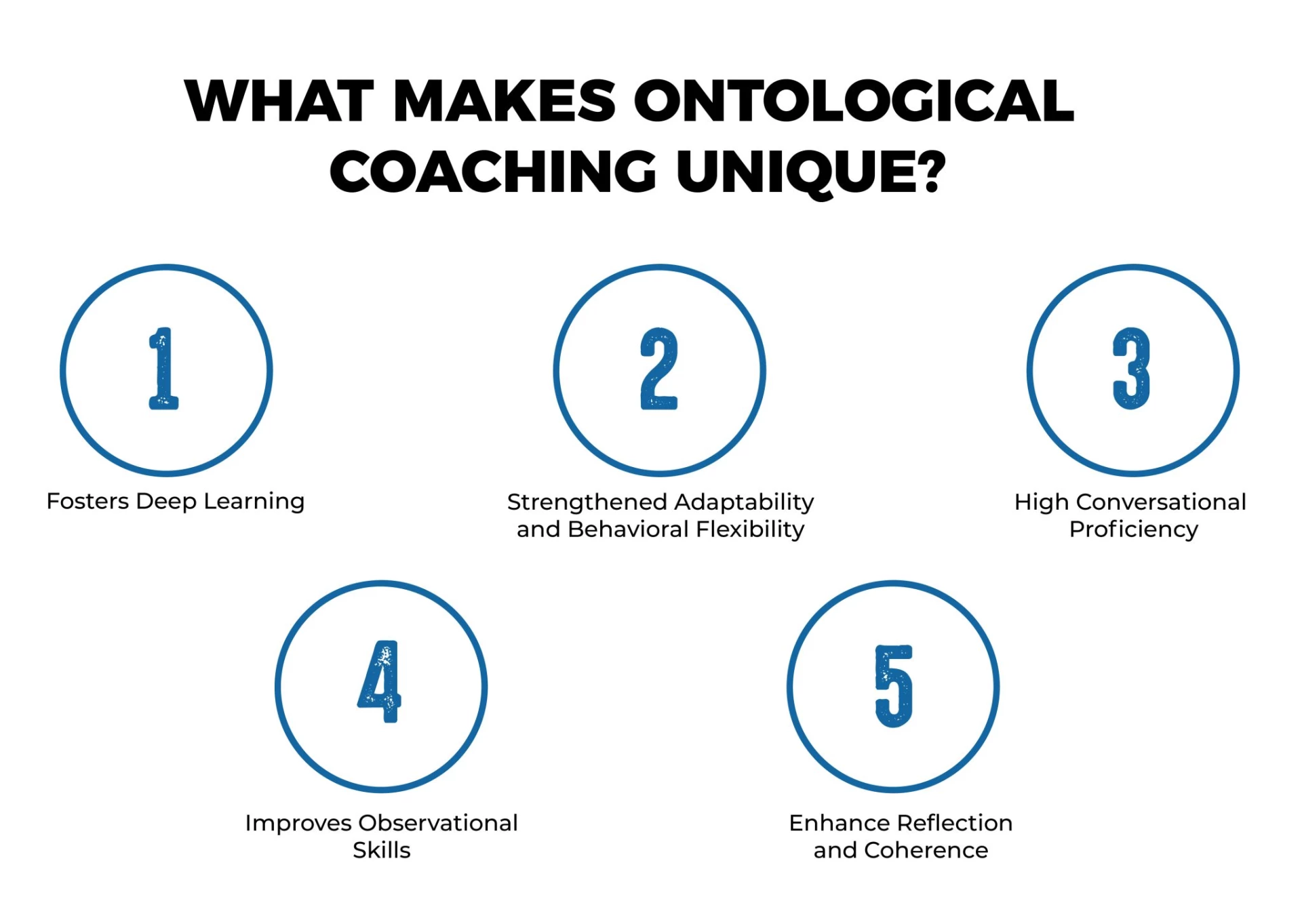
Fosters Deep Learning
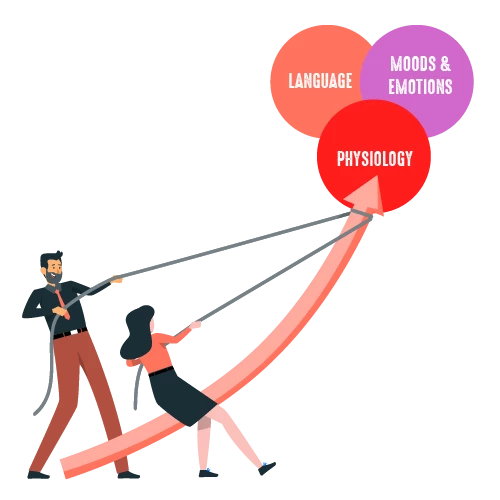
Ontological Coaching focuses on those perceptions and attitudes which are deep-seated and caught in the web of language, emotions, and body.
Finding out what underlies the narrative that might be restricting your client in achieving their goals, is where ontological coaching fosters deep and affective learning.
Strengthened Adaptability and Behavioral Flexibility
Because Ontological Coaching places substantial emphasis on moods or emotions and the reactions following those moods, it can help your client in developing more constructive and thoughtful perceptions over their situations.
Your client might already even know which behaviors they don’t want anymore but ontological coaching can help them explore why they have them in the first place and how they can be replaced.
High Conversational Proficiency
The knowledge strongly influences ontological Coaching that the conversations people do with the self and others around them, has a profound impact on how they interpret their life – possibilities and restrictions alike.
Suppose your client is struggling to construct more positive and fulfilling realities for themselves. In that case, you, as an ontological coach, can support them in identifying a language that is truer to their being.
That, in turn, would develop proficiency in how your client interacts and communicates with their surroundings.
Improves Observational Skills
Ontological Coaching pays attention to the emotions and language and the significance of embodied learning.
The ontological coaching process considers the body’s role as one of the most important in perceiving the world around and acting upon those changes your client desires.
In tune with the language or narrative your client believes in and building an awareness of their moods and embodied responses, ontological coaching truly helps improve observational skills.
Enhances Reflection and Coherence
An ontological approach to life involves a lot of interpretations, behavioral assessments, weeding out harmful and positive patterns.
The coaching methodology, therefore, illustrates a way to engage with multiplicity and paradoxes in thought patterns, and specific bodily reactions your clients might be accustomed to.
As we understood from the beginning of this guide, an ontological coach’s relationship with their client is unique and involves a sustainable and respectful dialogue.
This relationship can be the key to empowering or inculcating reflective behavior as one of the ways to perceive life for your client.
In many conversations where you, as a coach, focus on the being of your client by making them re-listen to their narratives, it can create a more coherent understanding for them.
While an ontological approach can benefit whoever is seeking this way of exploring themselves, there are a few fields or areas that can benefit from this methodology.
Let’s look at them in the next chapter.
Chapter 6:
Who benefits the most through Ontological Coaching?
So, ontological coaching can be most beneficial for those constantly and continually building relationships for work or personal life. It’s also beneficial for those who are searching for ways to sustain these relationships.
Let’s now look at some of those areas which might need the most of your skills and expertise.

Business or Management Executives
Business professionals or executives at the top of the leadership hierarchy need their relationship and communication skills to be most effective, efficient and empowering.
The most important task of their job is to keep their team or employees motivated and expand the business, both of which require them to be at their best at all times.
Ontological coaching can provide those transformational abilities to navigate such high intensity conversational, perceptive environments.
Intracultural Relationships
Alan Sieler mentions cross-cultural coaching as one area which due to the increasingly globalized world of business and travel, requires people to work across many barriers.
To be able to negotiate a relationship that proves beneficial to all the parties involved, deep listening becomes a necessary skill.
Crossing over many cultural, societal, political barriers or norms can be difficult and breakdowns or resentments can build up because of those.
An ontological approach can prove beneficial to walk your clients through their communication strategies, re-analyzing their body reactions and expressions of assertiveness or humility, for example, and find new perspectives through the process.
Useful Resources
You can probably tell by now that Ontological Coaching can be an extremely helpful tool and an approach to your coaching practice.
In addition to what my guide provides you with, there are many resources out there that can help you reach your fullest potential with Ontological Coaching.
Here are some useful online and also offline resources that can be an asset to your practice.
Books
- Alan Sieler’s three volumes on Coaching to the human soul: Ontological coaching and deep change are very well known and established works that can help you deepen your knowledge.
Podcasts and Videos
There are thousands of videos and podcasts circulating out there that can assist and support you throughout your journey of Ontological Coaching.
But here, I have selected a few important ones to help you dive deeper into the Ontological approach:
Podcasts
- Ontological Coaching & the Power of delight by Marita Bolles
- Ontological Coaching with Gonzalo Cordova
- Ontological Coaching and Achieving an Empowered Future with Pat Johnson
Video
Essays
- An essay on What is so special about ontological coaching? by Alan Sieler.
- An essay by Aboodi Shabi on Ontological Coaching.
It’s not just a matter of philosophy anymore by Charles Roe
Conclusion
Congratulations on successfully completing this guide!
Now that you have a thorough understanding of the ontological approach to coaching, you can shape, design, and tailor your practice to coach your clients more effectively and empathetically.
Also remember, becoming an Ontological Coach is not just about facilitating or supporting your client to live a more enriching life but it's also about you becoming a more powerful observer!
I would love to know what you think of this guide, and how you plan to incorporate these learnings into your practice.
In case, I have missed out on anything — please let me know in the comments, and I will address them.
