

Herzberg’s Motivation-Hygiene Theory: The Definitive Guide
Last updated: March 2026
Herzberg’s Motivation-Hygiene Theory
The Definitive Guide
Business coaches have to deal with a lot of factors related to employee motivation and satisfaction when coaching business clients. During such times, coaches can rely on science-backed theories to coach clients correctly. One such helpful model is Herzberg’s motivation-hygiene theory.
In this article, I will be explaining:
- Origin of Motivation-Hygiene Theory
- Benefits of Motivation-Hygiene Theory
- Two-Factor Theory in Coaching
- Criticism of the Two-Factor Theory
And much more.
So, let us jump right in!
Don’t have time to read the whole guide right now?
No worries. Let me send you a copy so you can read it when it’s convenient for you. Just let me know where to send it (takes 5 seconds)
Contents
Criticisms of the Two-Factor Theory



Chapter 1:
The Basics
This chapter will focus on the basics of this theory, how it is built, and understanding the different factors that make up the theory.
The information given here will serve as the basic understanding needed for developing this theory into a successful coaching practice.

What is Herzberg’s Motivation-Hygiene Theory?
According to Herzberg's Motivation-Hygiene Theory, there are specific workplace factors that contribute to job satisfaction while a different set of factors contribute to job dissatisfaction. All of these factors act independently of one another.
Frederick Herzberg, a psychologist, created this theory. There are satisfactory factors which employees need to function optimally and dissatisfactory factors which deter employees from achieving the needed results.
The two-factor theory was developed from data collected by Herzberg from interviews with 203 engineers and accountants in the Pittsburgh area, chosen because of their professions' growing importance in the business world.
Why is it called the “two-factor” theory and what are those two factors?
From examining the interview conducted, Herzbergs discovered that factors associated with a person's profession, or the type of work they do, appear to have the power to satisfy requirements for accomplishment, competency, status, and self-realization, making them happy and fulfilled.
However, it doesn't seem that the absence of these satisfying employment features results in sadness and discontent. Instead, adverse evaluations of work-related characteristics such business rules, supervision, technical issues, pay, interpersonal relationships at work, and working circumstances lead to unhappiness.
As a result, if management wants to boost job happiness, it should be concerned with the nature of the work itself and the chances it offers for achieving self-realization, status, and responsibility.
On the other hand, if management wants to lower unhappiness, it needs to concentrate on the work environment, including rules, practices, oversight, and working conditions. Managers must focus on both sets of job characteristics if management is equally concerned with both.
The two-factor theory makes a distinction between:
- Motivators that result from inherent conditions of the job itself, such as acknowledgment, achievement, or personal growth, such as challenging work, responsibility, opportunity to do something significant, engagement in decision-making, and a sense of importance to an organization.
- Hygiene variables, such as status, job security, compensation, fringe benefits, working conditions, decent pay, paid insurance, and vacations, do not increase motivation or produce positive satisfaction, but their absence causes unhappiness.

These are maintenance considerations, which is why the word "hygiene" is employed. These are not directly related to the work itself and include things like corporate rules, management techniques, or pay/salary.
Herzberg frequently referred to hygiene factors as "KITA" factors, which stands for "kick in the a**" and refers to the act of inducing behavior through the use of rewards or the threat of punishment.
Herzberg claims that a lack of sanitary aspects contributes to workplace discontent among employees. These hygiene characteristics must exist in a workplace in order to eliminate unhappiness, but their existence does not guarantee complete satisfaction.
What are the benefits of this theory?
Using Herzberg's two-factor theory in the workplace has the following main advantages:
- Explains the causes of team members' satisfaction or dissatisfaction with their work or job.
- Identifies the company's existing motivators and hygiene factors that should be maintained
- Aids in determining the hygiene and motivators that employees desire from the business
- Supports employee empowerment by inspiring staff to meet project goals on their own
- Identifies potential project and company risk factors that need to be quickly improved to reduce project disruptions.
- Deepens understanding: Hertzberg's thesis provides a more in-depth look at how employees view their jobs. To find the internal forces that motivate employees, one looks within.
- Cites various variables, including: The two-factor approach asserts that other factors, such as business policies and procedures, rather than poor work performance are to blame for a lack of job satisfaction.
- Elucidates the manager's duties: According to the theory, managers should encourage, support, and motivate their teams throughout the whole project life cycle.
- Promotes diversity and unity: The idea urges managers to be alert to employees who might find it harder to be satisfied in their jobs. This guarantees that their complaints are heard and that adjustments are made as needed.
Let us look at some examples of this theory.
Examples of the Theory
Let's look at a situation where the two-factor theory was put to use at work.
Let's imagine one of your team members approaches you with a concern – a team member is not contributing their fair share to a project. They disregard job deadlines and correct procedures, and when questioned about their lack of motivation, they adopt a dismissive attitude. You must decide how to help this team member get back into the right frame of mind for the project.
Herzberg's two-factor theory suggests that this issue can be resolved by taking into account the team members' motivations. Simply put, when someone feels something is missing (i.e., unhappiness) or when they feel confident in themselves, they will act out (i.e., recognition).
If we want this hypothetical team member to stop acting out, then it may be time to look at how well their needs are being met by the company.
Chapter 2:
Breaking Down the Two-Factor Theory
Now that we have the needed knowledge of the two-factor theory.
Let us look a bit deeper into the two factors aka motivation factors and hygiene factors to understand this theory better.

Details of the Two Factor Approach
Before diving into the different combinations of the two factor theory, we need to understand the details of the two factors that make up this theory.
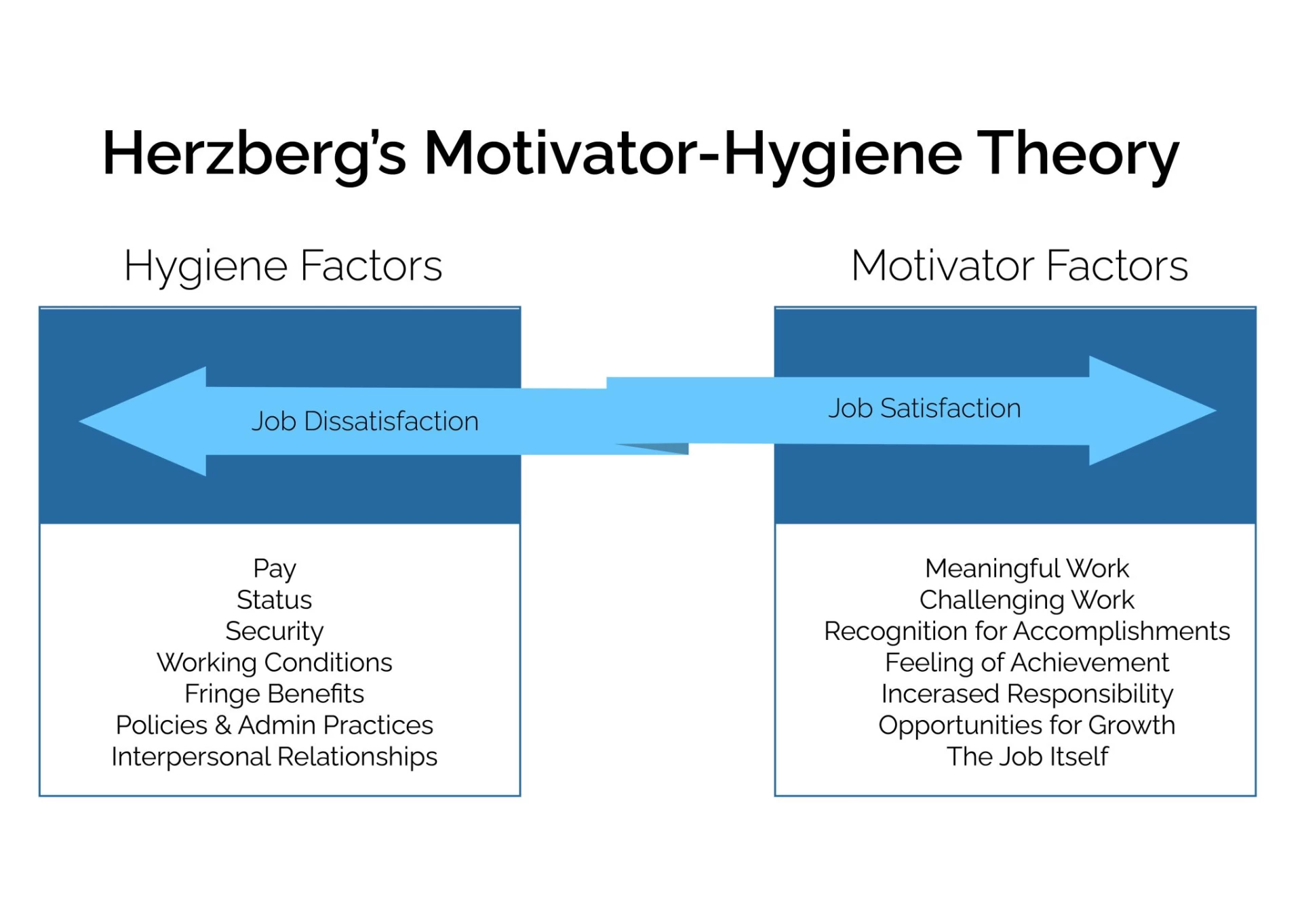
Motivation Factors and their Importance
The primary aspects of a job that encourage people to remain in and advance in a position are motivational factors.
The project crew may feel unsatisfied with their positions if these needs are not met. They might seek out more demanding positions that will help them advance their careers, pick up new skills, or handle bigger responsibilities.
As per Herzberg's two-factor theory, some instances of motivators are as follows:
- Achievement: the feeling of completion of a job or endeavor.
- Acknowledgement of achievements: receiving recognition for their efforts or services to the company that go beyond their professional responsibilities, whether through a raise, promotion, or significant assignment
- Advancement: the chance to advance internally in the company
- Creativity: The capacity to solve problems or generate novel ideas by thinking outside the box
- Variety: A change in the tasks, undertakings, or responsibilities
- Independence: The capacity to make decisions on one's own
- fascinating work Their interest is maintained by exciting tasks.
- Possibility of assuming larger project roles, additional responsibilities, and greater degrees of confidentiality
- Accomplishment: The capacity to complete a particular task before the deadline.
- Personal development: The chance to advance one's talents by picking up new ones, perfecting old ones, and gaining certificates
- Interpersonal relationships: The capacity to establish trusting connections with coworkers and clients through pleasant interactions.
- Status: Being regarded as the organization's leader, issuing commands, and seeing those commands carried out.
Hygiene factors and their Importance
Security, income, justice, and working conditions are examples of hygiene variables in a job that meet essential needs. Employees are more at ease and content with their jobs when these demands are met.
If these needs are met, it doesn’t ensure job retention. But if they are not met, employees won’t hesitate to leave.
Examples of hygiene factors include:
- Basic benefits: How successfully an employee's basic necessities, such as pay and insurance, are provided in terms of salary and benefits
- Job security: The degree to which the employer has control over filling the post
- Environment of work: The level of stress involved, the quantity of travel necessary, and the working environment (temperature, cleanliness, basic hygiene)
- Job regulations: How daily tasks of an employee are managed
- Supervision techniques: how effectively the workforce is managed
- Administration and company policies: how the organization has put up its policies
- Company reputation: The reputation of an organization outside of the company walls, such as with suppliers and business partners
Now that we have understood the two categories of the factors, let us try to understand the possible combinations of these factors that can exist in the workplace.
What are the four possible combinations of the two factor theory?
Herzberg claims that a lack of hygiene aspects contributes to workplace discontent among employees. These hygiene characteristics must exist in a workplace in order to eliminate unhappiness, but their existence does not guarantee complete satisfaction.
There are a number of ways to achieve this, but the most crucial ways to lower unhappiness would be to pay appropriate wages, guarantee employees' jobs, and foster a healthy working culture.
From most important to least important, Herzberg ranked the following hygiene factors: business policy, supervision, employee relationship with boss, working circumstances, salary, and peer relationships. The two factor theory's goal of eliminating unhappiness is merely one half of its task.
An employee needs to be motivated in order to perform at a better level. Herzberg further classified our acts, as well as how and why we carry them out; for instance, carrying out a work-related action out of need is classified as "movement," whereas carrying out a work-related action out of want is labeled as "motivation."
Before establishing the prerequisites for job happiness, Herzberg believed it was crucial to eradicate job dissatisfaction because they would be mutually exclusive. The organization can benefit in a variety of ways from employee satisfaction. Employees can achieve cohesion within the group and meet their social demands by, for instance, sharing their knowledge.
Also, sharing knowledge helps others to create new knowledge, which also can reinforce the motivating factors. By sharing knowledge, the employees feel satisfied and with the new knowledge it can increase the organizations innovation activities.
According to the Two-Factor Theory, there are four possible combinations:
- High Hygiene + High Motivation: The ideal situation where employees are highly motivated and have few complaints.
- High Hygiene + Low Motivation: Employees have few complaints but are not highly motivated. The job is viewed as a paycheck.
- Low Hygiene + High Motivation: Employees are motivated but have a lot of complaints. A situation where the job is exciting and challenging but salaries and work conditions are not up to par.
- Low Hygiene + Low Motivation: This is the worst situation where employees are not motivated and have many complaints.
We have now not only understood the two main factors as well as the various combinations of these factors that can exist. Let us take a look at how to actually use this theory in the workplace.
How to use this theory in the workplace?
How can project team management use the two-factor theory?
While external variables like income and perks motivate workers, other elements like prestige and reputation are as important. An explanation of how to apply Herzberg's two-factor theory to project management is provided below:
Identify the Motivating Factors
Determine the elements that influence your employees' level of satisfaction with their work. Use a questionnaire to learn about their requirements and preferences. See if there are any specific motivators or hygienic issues that your organization could address. If yes, consider what can be done to enhance these elements.
To learn what teams desire, run quick polls, online employee surveys, or have private conversations. Here are some questions that may be useful:
- What do you enjoy doing most?
- What don't you enjoy doing?
- What do you like most about your job?
- What would you change about your job?
Examine and Release
Find solutions to get rid of unsatisfactory aspects of their employment after analysing the elements that contribute to satisfaction. Establish a more frequent review cycle that includes regular project progress updates from the manager, for instance, if individuals demand more input from managers.
Measure it All
It is also possible to gauge team satisfaction quantitatively, for example:
- percent of satisfaction (dissatisfied vs. satisfied)
- The net promoter score (total promoters minus total detractors)
- assessments of client satisfaction (internal and external customers)
Keep it Aligned
Showcase team contributions and provide project updates. Inform team members that their opinions are valued if they feel that their thoughts and contributions are not being acknowledged.
Gain Insight
With reference to Herzberg's two-factor theory of motivation, some variables can be measured. Money, for instance, is a hygiene element for workers; it keeps people content with their occupations but doesn't always motivate them to be innovative or better themselves.
Project managers can better understand what can inspire their personnel by applying the two-factor theory. Try to think about and provide what the majority of the team wants.
Sync Up Motivators with Project Objectives
Finding strategies to match these motivators with the project's objectives is crucial once you are aware of what drives your personnel. For example, if people are happy with their work, they will remain productive and satisfied.
However, if there is no connection between an individual's goals and contributions to the project, they may become demotivated and end up adversely affecting team productivity.
We have now fully understood the ins and outs of the two-factor theory, let us now look at how we can use this theory in coaching in the next chapter.
Chapter 3:
The Two-Factor Theory and Coaching
Just as this theory is useful in understanding the workplace, it can be used in the coaching process as well.
In this chapter, we will focus on understanding how this model can be used in coaching.

Can we use the two-factor theory in coaching?
The two-factor model is so versatile that it can of course be used in coaching as well, without any doubt. Although it can be used for the niche of business coaching, it can also be used to understand the general human mentality.
Which type of coaching benefits the best from the two-factor approach?
Let us look into the different coaching niches where this model can be successfully used:
- Business coaching
- As discussed in length throughout this chapter, business coaching benefits the most from this model.
- Business coaches can focus on helping clients understand these two factors and how to utilize them to their benefit
- Athlete coaches
- Coaches who coach athletes can also use this model to understand the athlete’s mentality
- Psychology-related coaching
- These kind of coaches can also use this model to understand various mentalities
- Human Resources coaches
- Coaches who specifically deal with employee issues can also use this model to help guide employees better
I’ve also noted down some situations where two-factor theory can be used:
- When employee outcome is not satisfactory
- When building a new business
- When employees retention is low
- When employee reviews indicate a problem
- When employees seem dissatisfied
- It has been long since you checked in about the basic factors provided to your employees
If you notice any of these situations in your client’s workplace, it could be a good opportunity to evaluate their workplace using this model and advise them to improve on these factors.
In the last chapter of the guide, I will discuss common critiques related to this theory.
Chapter 4:
Criticisms of the Two-Factor Theory
No theory is fully validated before understanding the critiques of the theory.
Even for this theory, let us understand the critiques to understand the theory fully.

Common Critiques of the Theory
In 1968, Herzberg claimed that one of the most widely replicated studies on job attitudes, his two-factor theory study, had already been replicated 16 times in a variety of populations.
These included some in Communist countries, and corroborated with studies using different procedures that agreed with his original findings regarding intrinsic employee motivation.
George Hines carried out one such replication, which he then published in the Journal of Applied Psychology in December 1973. Hines used ratings of 12 job characteristics and total job satisfaction from 218 middle managers and 196 salaried employees to test Herzberg's two-factor motivation theory in New Zealand.
Contrary to dichotomous motivator-hygiene assumptions, those with high work satisfaction ranked supervision and interpersonal interactions highly, and there was considerable agreement between pleased managers and salaried employees in regards to the relative importance of job aspects. Results are explained in context of New Zealand's social and employment situations.
Satisfaction and dissatisfaction are no longer generally thought to exist on different scales, despite the fact that the Motivator-Hygiene paradigm is still highly recognised.
The Critical Incident Technique (CIT) that Herzberg utilized to record events has been shown to be an artifact, separating satisfaction from discontent. Furthermore, it has been emphasized that the hypothesis excludes individual variations, such as specific personality qualities, which might influence people's distinctive reactions to motivating or hygienic stimuli.
The flaws of the need for hierarchy and the motivation-hygiene theories have been highlighted by a number of behavioral scientists. The most fundamental critique is that, notwithstanding the possibility that this is not true, both of these theories implicitly make the premise that contented and happy employees create more.
For instance, if improving one's game of golf is the method selected to sate one's need for recognition, one will find ways to play and think about golf more frequently, which could lead to a decrease in production on the job as a result of less focus.
Despite the impact on output, employee retention—which is crucial in professions with a lack of workers—is mostly dependent on job satisfaction, as measured, for instance, by Herzberg's theory.
In other words, an individual's choice of means and the amount of effort they will put into these means are determined by their anticipation or assessed chance that a specific action will bring about a desirable outcome.
By asking themselves the question given by one researcher, "How much payoff is there for me toward reaching a personal goal while putting so much effort toward the completion of an assigned organizational aim?," the employee is essentially questioning their source of motivation. Victor Vroom's expectancy theory offers a paradigm for motivation based on expectancies.
It would seem that this method of studying and comprehending motivation has several conceptual advantages over other theories: First, it can accommodate individual variances, in contrast to Maslow's and Herzberg's theories.
Second, it stresses the present and future, as opposed to drive theory, which places more emphasis on prior knowledge.
Third, it directly links action to a goal, solving the issue of presumptive linkages, such as that between motivation and output.
Fourth, it connects ability and motivation. To sum it up, Performance = Drive + Skill.
However, a Gallup Organization study, described in Marcus Buckingham and Curt Coffman's book First, Break All the Rules: What the World's Greatest Managers Do, seems to strongly support Herzberg's split of happiness and dissatisfaction into two distinct scales.
The study's twelve questions, which offer a framework for identifying high-performing people and organizations, are discussed by the book's writers. While hygienic considerations were found to have little impact on inspiring high performance, these twelve questions are directly related to Herzberg's motivational factors.
Can this theory be altered and adapted to contemporary times?
This theory is very adaptive and can be used in any kind of situation, even in contemporary times.
Workarounds of the Two-Factor Theory
The focus of Herzberg's theory is on the significance of internal employment characteristics as employee motivators.
He created it to give workers more fulfilling jobs. Herzberg sought to provide workers the chance to be involved in the process of organizing, carrying out, and reviewing their job.
He advised doing this by using:
- Employee autonomy would be increased by reducing part of the management's influence over them and increasing their level of accountability and responsibility for their work.
- Where feasible, forming entire, organic work units. An illustration would be allowing staff members to design an entire unit or department as opposed to only a portion of it.
- Giving employees direct feedback on productivity and job performance rather than through supervisors on a frequent and ongoing basis.
- Encouraging employees to take on new and challenging tasks and becoming experts at a task.
Conclusion
Congratulations on completing yet another coaching theory with me!
By reading this article, you are now equipped with a whole new arsenal of tools to use while coaching your clients. But don’t just stop at reading this guide, make sure you are choosing and implementing this theory to best suit your clients’ needs.
I would love to hear your thoughts on all this theory.
Did I miss any important information?
Would you have liked to hear more about any specific aspect?
Please do let me know in the comments, and I’d love to add them in.
Feel free to leave comments even if you have any unanswered questions or doubts about anything covered here. I’d love to address them.
